

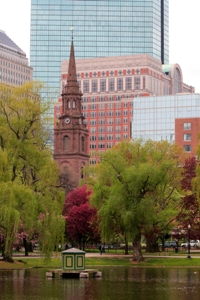
San Francisco tops the list of U.S. cities whose residents have a park within walking distance, according to the Trust for Public Land, with 98 percent of the city’s population benefiting from proximity to green space. Charlotte, N.C., is at the bottom of the list with just 26 percent. Of the 40 largest cities in the United States, those that placed the highest are as follows (the number indicates percentage of residents living near parks):
- San Francisco: 98
- Boston: 97
- New York: 96
- Washington, D.C.: 96
- Philadelphia: 91
- Seattle: 90
- Chicago: 90
Below are the U.S. cities with the poorest park distribution:
- Charlotte, N.C.: 26
- Jacksonville, Fl.: 30
- Louisville, Ky.: 32
- Indianapolis: 32
- San Antonio: 32
While acreage, atmosphere and activity are often key factors in determining the quality of a park, placement and accessibility should not be overlooked. Parks contribute to the environmental and psychological well-being of a community, so experts believe that investing in proper distribution should be a priority for urban cities.
The International Federation of Parks and Recreation Administration (IFPRA) says urban trees are capable of lowering air temperature at the local level, as well as absorbing various gaseous pollutants. In the lower 48 states, urban trees are estimated to remove 783,000 tons of pollution per year, resulting in a $5.6 billion annual societal value, according to the National Recreation and Park Association (NRPA). The conclusion was that parks would provide long-term benefits for industrial cities lacking forestry.
The advantages of proper park distribution also directly affect residential life. According to IFPRA, nature and greenery greatly contribute to public health, increasing perception of life quality and self-reported general health and physical activity, while reducing stress, mental disorders, and procrastination. Scientists in the Netherlands, according to the NRPA, discovered that people who lived in residential areas with the least green spaces had a 44 percent higher rate of physician-diagnosed disorders than those in the greenest residential areas. Low access to nature, for example, can increase ADHD and clinical depression. The NRPA also claims that greenery can contribute to feeling less isolated, and that is subconsciously encourages interacting with neighbors.
Time spent outdoors is the strongest correlate of children’s physical activity, according to the NRPA. Yet, one third of North Americans say there are not enough playgrounds in their communities to serve the number of children living there, and a study of California youth revealed that one in four don’t have access to a safe park.
Urban planners urge communities to acknowledge the benefits of accessible public parks and provide children with more outdoor options. As Switchboard’s Kaid Benfield wrote, “Intuition supports city parks, and so does evidence.”
Photo by Fotolia/Chee-Onn Leong





