While most everybody else is still just
talking about the problems of the energy crisis, a
few folks — such as the natural-energy leaders featured
in a little book called Design for a Limited
Planet — have quietly gone ahead and changed to
cleaner, more basic, and less costly (in terms of both the
individual and the planet) ways of heating and cooling
their homes. Here, three of those pioneering families tell
how they built their solar homes and describe what it’s
like to live on more intimate terms with Ole Sol.
Sydell and Steven Lipson:
Sydell and Steven Lipson (who was working in his father’s
florist shop in New Haven, Connecticut) wanted to build a
“live-in” greenhouse — one large, plant-filled space
that would get most of its heating from the sun. They had
seen the experimental house with transparent plastic walls
that architect Mark Hildebrand had built for himself in the
woods, and they asked him for a refined version that could
be bank-financed. The Lipsons’ 4-acre plot is next to a
forest preserve in the conservative township of Hamden,
Connecticut. Their “street-conscious” neighbors “didn’t
want a bomb on the street,” says architect Hildebrand, so
the design of the house had to be appropriate to the
community.
His design for the Lipsons’ house appears to run counter to
energy-saving theories because three walls of the house are
transparent. They are made of two sheets of hermetically
sealed polyvinyl chloride (PVC) plastic with an air space
in between. Hildebrand had first seen the “pillow” walls
used in Colorado and had tried it out on his own house
before adapting the technique for the Lipsons’ house. “I
was experimenting with industrial materials to replace
timber construction and thought of plastic because it was
economical,” he explains. The PVC he chose had good
standards for longevity and visual clarity. But the
material, used commercially for packing and wrapping, is
thought of as disposable and, if subjected to stress, can
become brittle and crack.
“We had to design the pillows and install them so that in
erection or inflation, they would never be taxed,” says
Hildebrand. When inflated, the skin stiffens and the
plastic forms both the interior and exterior surfaces. The
pillows are clamped in place with extruded aluminum frames,
similar to the ones that hold storefront windows.
The advantage of the plastic pillows, according to
Hildebrand, is that they insulate as well as Thermopane
glass — at about one-tenth the cost. However, because
of the impermanence of plastic, the pillows will probably
have to be replaced every three to five years, adding to
maintenance costs.
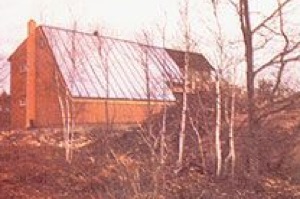
Since so much of the house is transparent, its siting and
profile had to be carefully planned. The roof is angled
upward toward the south, creating a two-story living room
with maximum exposure to the sun, while the north profile
is low, heavily insulated, and windowless except for a back
door. A roof overhang juts out enough to shield the pillow
walls in summer but allows the sun to penetrate all the way
to the north wall in winter. The living area is essentially
one space for living and dining with a separate sleeping
loft. The kitchen and bath are tucked under the low north
side.
Rather than clear the site, the Lipsons kept as many trees
as possible for natural climate control. In summer, the
leafy trees shade the house, while in winter their bare
limbs let the sun through. “Without ventilation,” says
Sydell Lipson, “the interiors can get up to 120 degrees.”
The house is designed for natural gravitation of air
through vents — placed low on the north side and high
on the south — that set up a strong air current through
the interiors. “In the winter, we open the vents for two or
three hours during the day and close them around the middle
of the afternoon, when it’s about 85 degrees, to conserve
heat for the evening,” she explains. On cold nights they
start a fire in their Franklin stove, consuming about 3
cords of wood for the heating season.
Connecticut building codes stipulate that all four walls of
a dwelling must be able to be heated to an average 68
degrees Fahrenheit, which necessitated an auxiliary heat source. The
Lipsons chose a type of electric heater commonly used in
theater lobbies. It is relatively inexpensive but eats up a
lot of electricity. The Lipsons rely on their electric
heaters only in the dead of winter. And yet the electricity
bills are low, running an average of about $35 per month in
winter and $40 for the coldest month, January.
Concessions must be made to living in a house with no
central heating system. “Most people find our house chilly
in winter,” says Sydell, “but you learn to live and dress
differently.” The Lipsons also tend to use the house in
zones. Some areas are warm, and others are allowed to
become quite cool. The area within 12 feet of the
wood-burning stove (which is set on tiles to absorb and
radiate the heat) and the kitchen, which receives warmth
from cooking, are used intensively.
The 36-by-32-foot house cost the couple $30,000 to build,
but they economized by doing most of the work themselves.
They had no building experience, nor were they even
particularly handy, and it took them five months to build
the house.
“The house suits our lifestyle,” Mrs. Lipson says. “We like
living in the woods. There is a certain joy in living in a
cool environment. I now find I don’t function very well in
a house with central heating; it dulls me and makes me
sleepy.”
Norah and Richard Davis:
In its first year of operation, Norah and Richard Davis’s
solar house attracted two thousand tourists. “We finally
had to put up a ‘No Trespassing’ sign,” Richard Davis said.
A transplanted southerner who went north to Bar Harbor,
Maine, to teach philosophy at The College of the Atlantic,
Professor Davis wanted to build a house out of recycled
materials. On the advice of a colleague at the college,
architect Ernest McMullen, his plans were expanded to
include a solar heating system.
Locating recycled materials wasn’t that easy, although the
Davises did discover some interesting “finds:” the ballroom
floor, doors, and 12-foot-long counters … from the
Evelyn Walsh McLean mansion (she was famous for owning the
Hope Diamond, now in the Smithsonian Institution);
structural timbers from a razed sardine factory; and a
2,000-gallon gasoline tank from a filling station to store
their solar-heated water. “We didn’t save much money using
recycled materials,” Richard says, “but we got materials we
couldn’t otherwise afford — the 1 1/2-inch solid wood
doors and the quarter-sawn oak floors, for instance.”
The Davis house is a compact, 1,300-square-foot building
with an open interior plan for the living-dining-kitchen
area, two bedrooms, and a utility room. Expenses came to
about $30,000.
The solar collectors, a trim bank of 26-foot-long
fiber-glass-faced panels, take up about half of the
southern facade of the house; a greenhouse that opens to
the kitchen and a deck occupy the rest of the front.
The house conforms to McMullen’s — and a growing number
of other architects’ — concept of energy-saving design:
that the right combination of materials for thermal mass,
siting, and fenestration will keep a house significantly
warmer in winter regardless of climate, without having to
install expensive solar hardware. A design change advocated
by engineers and architects concerned about fuel waste is
incorporated in the Davis house: instead of conventional
two-by-fours, the building is framed with two-by-eight
studs to make a deeper recess for wall insulation. The
house is insulated with 7 inches of fiberglass batts in the
walls and 9 1/2 inches in the ceiling.
McMullen’s solar design combines features of the basic
water, air-to-rock, and greenhouse solar heat systems. The
roof-mounted collector is composed of corrugated aluminum
sheeting under fiberglass. Water is piped up to a feeder
pipe at the top of the corrugated sheeting, where it
trickles down the gullies and is heated by the sun to 120
degrees. The water collects in a trough at the bottom of
the collector, and from there it flows down into a
2,000-gallon water storage tank that is embedded in a rock
bin below the house. Beneath the rock bin is a manifold
constructed out of standard concrete block. Air is
circulated through the manifold, picking up heat from the
rock bin, and then distributed through ducts to the rooms.
The hot water supply is also tied into the solar system.
The Davises found that a larger-capacity storage tank would
have given the house more heat. Their 2,000-gallon tank was
supposed to store enough heat for three successive cloudy
days — but they forgot to take into account Maine’s
strong coastal winds.
“If we have sunny winter days that aren’t too windy, with
temperatures around 30 degrees, we can just get by on the
solar heating system. If it starts to go below 30 degrees
and the wind picks up, we have to resort to our
wood-burning furnace,” Davis explains.
“We have adjusted to the fact that a solar house isn’t
capable of responding rapidly to changes in temperature,”
he adds. “For instance, if we come home at night and the
inside temperature has dropped to the mid-50’s, it takes a
while for the stored heat to warm the house up to the 60’s.
In early winter, we keep the house at 70 degrees, but as it
gets colder, we feel comfortable at 65 degrees. You live
differently in a solar house,” he says. “We are much more
aware of what the weather is doing.”
David and Barbara Wright:
Environmental architect David Wright developed a simple way
to heat a house by the sun that has worked in different
regions and different climates. A Berkeley-educated
ex-Peace Corps member, Wright was one of the original
members of Sun Mountain Design, in Santa Fe, New Mexico, a
non-profit group of engineers, builders, and architects
involved in solar-tempered design. They approached land
use, development, design, and research synergistically,
learning from their various disciplines. David, like the
others, prefers non-mechanical sun-heated houses to those
with complicated systems involving collectors, storage, and
circulation systems.
His own house on the outskirts of Santa Fe, in the
foothills of the Sangre de Cristo Mountains, is a prototype
of the non-mechanical structures he advocates. The only
visible hardware is a small separate solar collector that
stands several yards from the house on the south slope and
supplies the house with hot water.
In appearance, the house blends harmoniously with the
native New Mexican architecture. It uses adobe brick, and
the roof overhang echoes the traditional vigas ,
or roof beams, that extend out through the walls of old
adobe houses. Its inspiration goes even farther
back — to the twelfth-century pueblo dwellings at Chaco
Canyon, considered by many to be America’s first
solar-heated habitations on a grand scale. At Chaco Canyon,
the multifamily structures that were archetypal apartment
buildings to house a whole community were built in an arc.
The windows and doorways faced south, into the sun, while
the backs of the pueblos were shielded by the hillside,
giving them protection from northern winds.
The Wright house reflects that same design. From a
bird’s-eye view, it is shaped like a semicircle with a flat
front. The curved walls are 14-inch-thick adobe brick with
2 more inches of polyurethane insulation covered by a thick
layer of stucco. The flat front, facing south, is a
two-story-high window wall made up of double-glazed sliding
doors. An overhang shields the windows from the hottest
summer sun. In contrast to the front, the three remaining
sides of the house are surrounded by an earth bank and
broken only by a few small windows set high up to act as
vents. On the east, the main entry door is protected by a
vestibule that creates an air trap so warm house air can’t
escape each time the door is opened.
David, with his wife, Barbara, built the house almost
single-handedly with some subcontracting for electrical and
plumbing work and a couple of part-time crews who worked
two-week stints. The house took them less than six months
to complete and cost the couple around $13,000, not
counting their own labor. The interior is basically a
two-story-high room with a balcony. Although the house is
small, the window wall gives the interior a feeling of
generous space.
David Wright’s concept of a solar “heat sink,” such as the
one they adopted in this house, was popular in the late
1930’s. Houses were marketed and sold as “solar houses”,,
but they never adequately solved the basic problem: what to
do with the excess heat during the day and how to stem the
heat loss at night. (Night losses usually exceed the daily
heat gains.) Superior insulation and the thermal building
mass of adobe were Wright’s solution to that problem. To
augment the natural insulation provided by the adobe walls,
fifteen 50-gallon water-filled oil drums, buried beneath
the living room window, soak up the sun’s warmth. Water
holds about four times as much heat as adobe, and also
absorbs it and gives it off faster. To further reduce heat
loss at night, accordion-fold shutters made of canvas and
2-inch polyurethane panels are raised and lowered by a
hand-operated crank and pulley to cover the vast expanse of
the window wall at night.
Since completion, the house has required practically no
maintenance. The Wrights found that space heating based on
the concept of thermal lag follows natural rhythms and puts
the body’s metabolism in tune with it. “The body heats up
and cools down gradually with the building,” David
explains. During the winter months the Wrights found that
the house stores about five days’ worth of heat, enough to
carry through an average cloudy period in New Mexico. For
auxiliary heat, they have a wood-burning Franklin stove,
which uses less than a cord of wood a year.
This feature was excerpted from Design for aLimited Planet by Norma Skurka and Jon Naar, copyright © 1976 by Norma Skurka and Jon Naar, reprinted by permission of Ballantine Books (a division of Random House, Inc.)