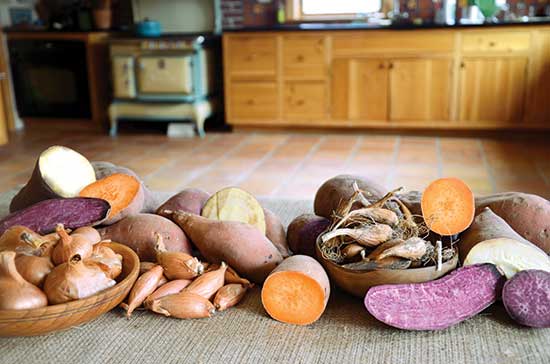
Having access to stored root vegetables gives a sense of comfort to the gardener-cook. There they are, always ready to bulk up a meal with their earthy flavors. But sometimes we long for the wide variety the garden yielded in summer, and then it’s time to try some new storage crops that are popular in cooking but not often grown at home. How about planting a bed of sweet potatoes or growing sweet potatoes from slips? And, for a gourmet treat, how about planting shallots? Both are easy to grow and easy to keep, since neither requires (or does well in) the moist cold of a root cellar. Sweet potatoes and shallots even pair well in cooking — one luxuriously sweet and the other pungent, with a subtle flavor all its own.
Growing Sweet Potatoes
Sweet potatoes are one of the most nutritious and sustaining foods you can grow. They’re not related to the usual “Irish” potatoes. Nor are they yams, as the bright-orange varieties are sometimes called. (The dark-skinned, white-fleshed Japanese yams sold in markets are sweet and tasty but not commonly grown in U.S. gardens.)
To succeed with growing sweet potatoes, choose a spacious section of your garden that hasn’t been heavily amended with manure. The soil should be moderately fertile for the tubers to plump up, but too much nitrogen can lead to lush, leafy vines and the skinny, underdeveloped tubers that I jokingly call “fingerling sweet potatoes.” Don’t add lime unless the soil’s pH is very low because sweet potatoes like slightly acidic soil. The soil they thrive in is deeply dug, so that the long roots can penetrate it, and very well-drained. If your soil is heavy, dig or till in a generous amount of compost, and probe the bed with a broadfork or a common digging fork to open up channels for water and air.
The other key ingredients in growing sweet potatoes are sun and heat. While you’re enduring the summer doldrums, your sweet potatoes will be rejoicing. Where summers are cool, gardeners often compensate by planting tubers into sheets of black infrared-transmitting plastic, or growing them in a greenhouse, or both.
The flesh of sweet potatoes varies from nearly white to deep orange. I prefer the latter as much for its beta carotene content as for its moist texture and good looks. The cultivar that does the best for me is the highly adaptable ‘Beauregard,’ which has good disease resistance. In areas where root-knot nematodes are prevalent, ‘Centennial’ is a better choice.
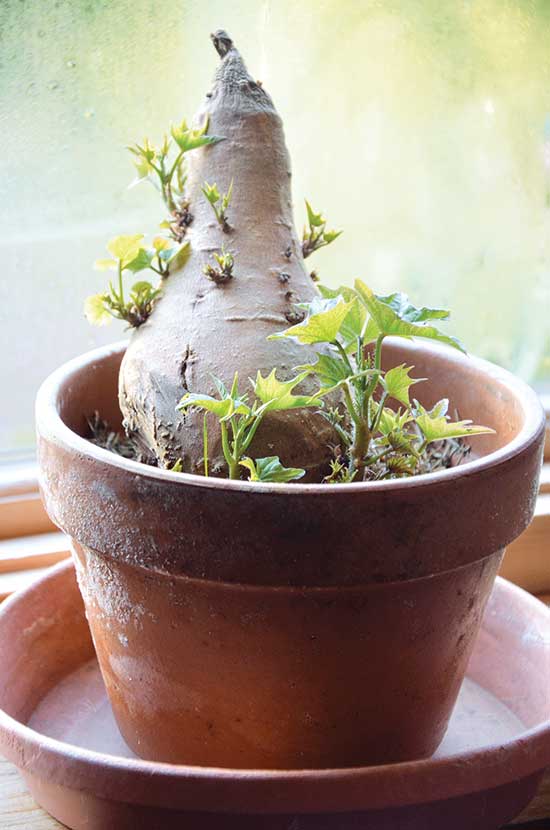
Sweet potatoes root so easily that you can just bury one in the ground and it will grow — as long as it hasn’t been treated with a sprout inhibitor. The simplest way to grow them is to buy plants, called “slips,” which are shoots sprouted from the tuber’s eyes and then rooted. You can find them at garden centers, or order them, as we do, from a supplier, such as Steele Plant Co. in Gleason, Tennessee. Or, you can just buy a few organic, untreated sweet potatoes and grow your own slips. To do so, plant a tuber in a pot with its bottom half in moist sand — or use toothpicks to suspend it halfway in a glass of water — and it will soon send up numerous green shoots. Pull these shoots off when they’re 6 to 8 inches long, and then put them in a glass of water, where they’ll quickly develop roots.
However you’ve obtained them, the slips should be planted after frost danger has passed. Set them deep, with just the top foliage above ground. As they grow, keep them well-irrigated. As the vines cover the ground, they’ll shade out some weeds, but the rest must be hoed or pulled. Dig the tubers at the first sign of frost and cure them for 10 days in a warm, humid place so the flavor can develop. Then keep them in a cool, dry area (not in the fridge) for winter.
I could happily spend winter eating baked sweet potatoes right out of their skins, slit lengthwise with a pat of butter dropped in. I also like them mashed and buttered with a handful of chopped pecans scattered over the top and briefly broiled. But it’s fun to branch out and try them in soups, stews, curries, breads, cakes, pies, and spiced puddings.
Planting Shallots
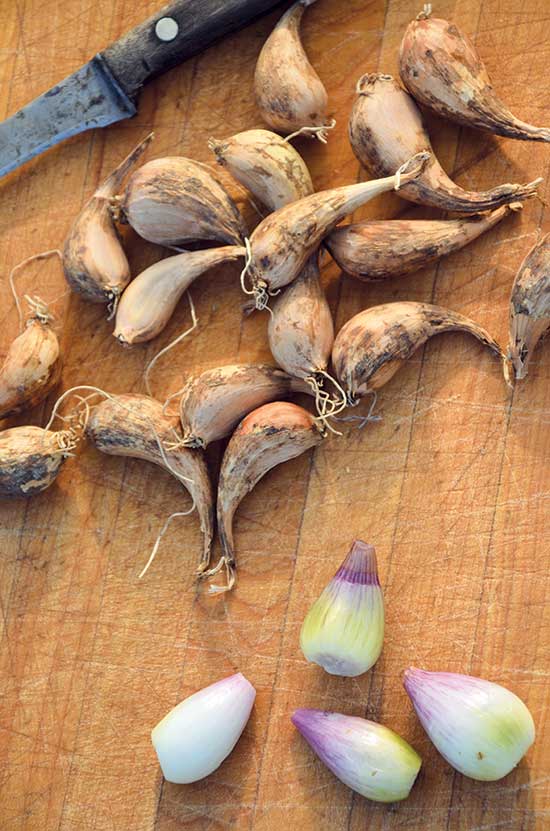
Shallots look like tiny onions, but their shape is somewhere between an onion and a head of garlic. They grow in clusters joined at the base like the cloves in garlic do — each clove in its own skin — but the clusters are more open than that of garlic. Their form varies. At one extreme is the ‘French Grey’ shallot, which has many small cloves. But in other cultivars, the cloves are fat and few. Shallots grown from seed are often the latter and may have a flavor that’s more onion-like.
Plant shallots in late fall or early spring by separating the cloves and setting them out individually, 8 inches apart in the row, with their pointed tops barely covered by the soil. In midsummer, watch the foliage, and when it dies back and turns brown, dig the clusters up carefully, clean them well, and store them in a cool but unrefrigerated place where they won’t freeze during winter.
Sauces and Recipes with Shallots
I like to grow several kinds. I use ‘French Grey’ shallots when I just want to add a few to make a dish special. They’re fussy to peel, so when I want to roast a lot of them whole alongside meat or in a pan of vegetables, such as Brussels sprouts or baby turnips, the big ones, such as ‘Dutch Yellow,’ make more sense.
I first came to appreciate shallots when I discovered certain French brown sauces — to which shallots are added toward the end of cooking — and the addictively buttery sauce béarnaise.
I often find myself reconvening the flavors of this sauce — especially shallots, tarragon, egg yolk, and butter — in an omelet or on toast spread with soft shallot-and-tarragon butter. The flavors also reappear in my egg salad and in butter-fried breakfast potatoes with shallots and tarragon.
Sometimes I’ll look at a pan or skillet glazed with syrupy drippings and yummy brown meat bits, and in will go the wine, tarragon, and finely chopped shallots, along with a little butter swirled in as needed — a perfect quick sauce for a cold winter day.
Try these healthy sweet potato recipes with shallots and learn more about cooking sweet potatoes:
Roasted Sweet Potatoes with Bacon and Whole Shallots
Spicy Sweet Potato Soup Recipe with Fried Shallots
Sweet Potato Pudding