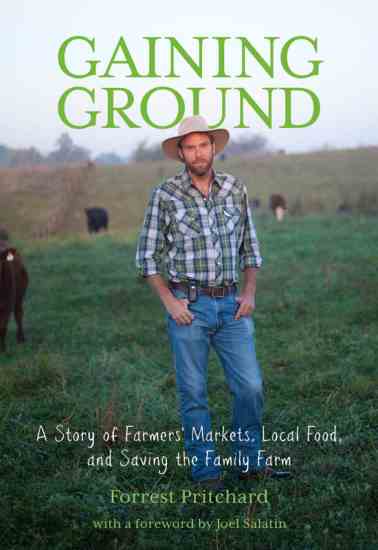
Forrest Pritchard creates a crash course in sustainable agriculture with Gaining Ground: A Story of Farmers’ Markets, Local Food and Saving the Family Farm and writes of his experiences with his career choice in organic farming. He sees and argues for buying from local organic farms instead of buying supermarket food and begins a successful self-serve farm store. The following excerpt, from Chapter 28, discusses the benefits of buying locally.
You can purchase this book from the MOTHER EARTH NEWS store: Gaining Ground
Friends at home often told me they wanted to support local organic farms, but in their opinion the food was just “too expensive.” Without telling me so outright, I knew that this included my products, too. Even though the price of our ground beef was very comparable to what was currently in the local supermarkets, perception seemed to trump this reality, and the meat in their refrigerators never had our label on it. That the food they purchased had traveled thousands of miles to get to their kitchen didn’t seem to make an impression on them.
As a farmer, and as their friend, I did my best not to let any of this bother me. But I can’t say I didn’t notice, or didn’t spend time thinking about it. If they were buying their food locally, I reasoned, they’d be supporting the country life that they seemed to value so much, the fresh air, the sweeping vistas. They always lamented when a nearby farm went out of business and was forced to sell. If only a few of them had changed their buying habits, perhaps even persuading their neighbors to do the same, some of these farms undoubtedly could have been saved.
In certain aspects of our society, price and value go hand in hand. No one questions the sticker price on an Italian sports car or is shocked that a luxury hotel could command five hundred dollars a night. In these instances, people have made the connection between high quality and higher prices. Although a Rolex keeps time just as well as a five-dollar wristwatch, the difference in value is unquestioned.
For some reason, even to this day, food has largely escaped this price-quality association. Dom Perignon aside, food is more or less food. Although none of my friends said it out loud, I could tell what was on their minds: Food was supposed to be cheap. Society had conditioned them to expect bargains when they entered the supermarket, placing price above freshness and quality. My sausages might cost only a dollar more per pound, but for many people, it might as well have been a million. When it came to food, the price tag was where the story both began and ended.
Part of me wanted to challenge my friends. Spend a year of your life growing acres of vegetables, twelve months of physical toil and sweat. At the end of the season, sell it all for twenty-five cents a pound. Then, let’s have a conversation about what’s cheap and what’s expensive.
Not surprisingly, nobody likes hanging out with a supercilious jerk. My friends were all overworked and underpaid; implying that my life was somehow more difficult than theirs would have been a great way to have my text messages go unanswered. So instead of defending my prices, I tried a different tack. When they asked me why the cost of organic food was so expensive, I came up with a new response. “First, shouldn’t we figure out why the other supermarket food is so cheap?”
On our farm, the food we raised reflected our true cost of production. When we set our prices, we did exactly what every other business in America did. We factored in our expenses and established a modest profit margin. That way, we’d still be around to farm the following year. It was Economics 101.
“Well, Mr. Smarty Pants Farmer,” my friends retorted, sensing that, despite my best efforts, I was still being a little patronizing. “Tell us, if you’ve got the numbers all figured out, then why aren’t these other farms asking for their true cost of production, too? Why does the supermarket food cost less?”
Much of this food was already discounted, I explained, paid for in advance by government subsidies. Tax dollars, the same taxes that were taken out of my friends’ paychecks before they received them, were used to partially pay for this food before it ever arrived at the supermarket. This “cheap” food was expensive, too. Unbeknownst to them, my friends were simply purchasing it on an installment plan.
“But if it’s already being taken out of our paychecks,” they argued, “doesn’t it make sense to keep buying supermarket food?” Sure, I said. If you think a hamburger is just a hamburger, or that all apples are the same, then absolutely. But if you believe there’s a difference between a burger made from a single cow versus a burger made from a thousand cows, or apple juice squeezed from a local farm versus barrels of concentrate shipped from China … then the conversation becomes more complex.
Government policies hand out advantages to big farms that small farms can only dream of. The more corn and soybeans these big operations plant, the more tax money they can receive. Even crop insurance, money paid out in case of catastrophe, is subsidized. This reliable flow of cash gives owners confidence to build the infrastructure they need to support their operations, making these large farms hum with the highest modern efficiencies.
In the end, the owners of large farms are secure in the knowledge that huge sums of money are electronically transferring into their bank accounts while they sleep. They become the preferred partners of billion-dollar food companies, each with their own massive, nationwide processing and distribution centers. It’s all an economy of scale, and the scale is often gigantic.
Small farms like mine never have the economic firepower to match our larger counterparts. Our acreage is too small to adopt the efficiencies of big agriculture, and though we are entitled to subsidies as well, these payments are a pittance compared to what larger operations receive. As one secretary of agriculture famously proclaimed in the middle of the twentieth century, American farmers either needed to “get big, or get out.”
Over the years, instead of following this advice, many small farms turned to organic production instead. By forfeiting government handouts, however, the production costs of smaller operations automatically became higher. Banks studied the balance sheets of these nonsubsidized farms, viewing them as shaky lending partners and denying them loans. As they turned to organics as an economic alternative, farmers were forced to rely on human labor as their number one input instead of subsidized oil, machinery, and petroleum fertilizers. Organic costs and prices simply had to be higher, because an unleveled playing field rewarded those who raised food on the largest scale.
For me these discussions were never intended to be a battle of big farm versus small. Farmers everywhere shared an unspoken passion that united us all, defined our core values. Although I might not agree with many of their practices, I’ve never considered industrial-size farms to be my enemy. The world was entitled to make its own food choices, and these farms simply provided a very different product than what we offered on our farm. But whether my friends realized it or not, every dollar they spent on this kind of supermarket food was an endorsement of these practices, a vote for more cheap abundance, continued industrial output, and subsidies quietly siphoned from their salaries.
This was never the response my friends wanted to hear. Reliably, about three sentences in, I could see their eyes glaze over. “There goes Forrest, giving his stump speech again.” They politely allowed me to finish, but after a while, I could tell they were no longer listening.
The subject was too didactic, too scholarly. Part of me wanted to jump up and down, shouting “Hey, we’re only talking about an extra dollar or two! How can you fawn over a Ferrari but not appreciate the beauty of a herd of free-ranging cattle?” Instead I let the topic go, steering the conversation toward the new Wilco album, or college football. If I couldn’t even get my own father to eat the food we grew, I asked myself, what chance did I have with them?
After a while I finally understood. It wasn’t anything against our farm, or organic food, or buying local. Their shopping habits were simply the result of a life filled with children, mortgages, commutes, student loans, and credit card debt. Making the effort to continue or begin buying local was just that: an extra effort. Despite their best intentions, it was easier to make one simple stop, where food was discounted in bulk, along with their toilet paper, fabric softener, and deodorant.
I took this as a lesson. I stopped trying to persuade my friends to shop with us, and put my energy into establishing a self-serve farm store instead. Now if anyone in the community wanted to shop with us, they could persuade themselves. The farm store, unstaffed, operated on an honesty policy. People drove in, took what they wanted out of the fully stocked displays, and either left cash, a check, or swiped their credit card. It was pretty much the exact opposite of every other store and supermarket I had ever been in.
Located in the center of the farm, our store allowed customers to be fully engaged with their shopping experience. As they drove down the lane, they passed cows and sheep grazing in the pastures. A map inside the store pointed to where they could walk to see our flocks of free-range chickens, or where the pigs were rooting. People were pleasantly startled when they realized that, completely unsupervised, they were trusted to pay for their food. Gradually, year after year, our farm store found its way into people’s routines. If they really wanted to shop and buy locally, we were always open.
Our products began to grow in popularity. As customer demand rose, however, it became increasingly clear to me that our farm could supply only so much. This wasn’t to say that our farm was incapable of producing tremendous amounts of food; to the contrary, our reinvigorated pastures hinted that we had only begun to glimpse the land’s true potential. No, I told myself, supply had to be a function of what our land could sustainably provide, not a response to how vociferously customers demanded our products. As hard as it was to do, I restrained myself from quickly ramping up production and tried instead to better understand how the soil and the seasons functioned together.
Despite its humble origins, grass-farming eventually became enormously trendy. As new farmers rushed in to start their own grass-based operations, I shook my head as far too many focused on satisfying customer demand instead of placing emphasis on long-term sustainability. The allure of grass-fed animals quickly wore off as overgrazed, stressed pastures couldn’t support the enormous public appetite these farmers had courted. Grass-farming might be founded upon simple principles, but inexperienced growers quickly learned that sustainable production is exquisitely complicated. Expansion was more challenging than simply ordering another box of lambs the following year, or planting another row of piglets.
As much as I wanted to make all of our customers happy, our farm inevitably began to sell out of certain items each week. Eggs were normally the first casualty, but it wasn’t long before we occasionally ran out of sausage, or steaks, or lamb chops. I did my best to sensibly increase supply, trying to anticipate how much pasture the farm could produce the following year. When we ran short, there was no warehouse I could call to order more, no international calls to a factory in Hong Kong. When things were sold out, they were sold out.
Still, I wrestled with my cultural economic upbringing. I had been taught that businesses should constantly grow and expand. Owners should demand annual productivity increases, and resources were to be tapped for their maximum potential. Like most things in our melting-pot society, the message was a uniquely American blend — equal parts Manifest Destiny, Yankee ingenuity, and Protestant work ethic. A dash of Horatio Alger seemed to be thrown in for good luck.
Throughout my life, the message had been constantly thrust in my face.
Be more! Live more!
Drink this for more energy! Eat this to lose weight!
Consume! Produce! Be the extreme!
It was, in a generalized sense, the advertising campaign of every product anyone had ever tried to sell me.
Sitting in my field one day, my back propped against an old walnut tree, I wondered what a major international company would think if an advertising firm, hired to come up with the next big slogan, suggested the following: Please try our food. But . . . there’s only so much of it, so don’t be angry or frustrated when it runs out. We promise to grow more, eventually. In the meantime, you can always buy it from a different farmer, or even try growing it yourself. That way, everyone wins!
In my mind’s eye, I saw corporate executives clutching their chests and falling sideways out of their leather armchairs. What would the shareholders think? The board of directors would have a conniption. Not even a clever jingle could salvage such transparent capitalistic sabotage.
But this was exactly how I felt. For nearly twenty years, from when my grandfather passed away until I returned to the farm, we had tried to be something that we weren’t, listening to voices that propelled us to the brink of failure. I would no longer trade tractor trailer loads of food to commodity traders in Chicago who offered me eighteen dollars for my efforts.
What if, at the end of the day, just growing what we could grow was good enough? And what if we genuinely wanted other family farms to succeed as well? These were the ideas that I valued most, and the questions I wanted to answer. Everything else began to feel like noise.
This excerpt has been reprinted with permission from Gaining Ground by Forrest Pritchard, published by Globe Pequot Press, 2013. Buy this book from our store: Gaining Ground