

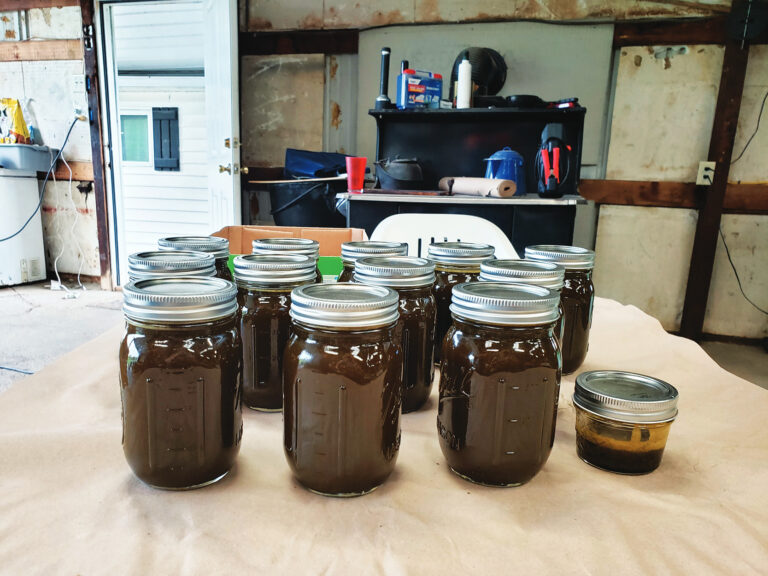
Sweet sorghum syrup. To some, this liquid foodstuff is a bit of mystery. What is it? How is it made? How do I use it in a recipe? Here, I intend to remove the mystery so more people can become familiar with this delicious and highly nutritious natural sweetener.
History of Sweet Sorghum
The scientific name for sorghum is Sorghum bicolor. This includes grain sorghum, grown primarily for the seed located at the head of the plant, and sweet sorghum, grown for the juice in the plant’s stalk, which can be turned into syrup. Historians suggest the plant was originally cultivated and refined in northeast Africa and later spread elsewhere, including China, India, Australia, and the Americas. In the mid-19th century, abolitionists attempted to use sweet sorghum as an alternative to sugarcane because it was easier to grow in northern regions of the U.S. When the Southern cane sugar supply was eventually cut off during the Civil War, sorghum syrup became the dominant sweetener in the North. A labor-intensive crop, its popularity declined after World War II.
Cultivating Sweet Sorghum
Sweet sorghum cultivars come in a variety of old-timey names, such as ‘Dale,’ ‘Della,’ ‘Simon,’ ‘Sugar Drip,’ ‘ROX Orange,’ ‘Mennonite,’ and ‘Black Bonnet.’ Each cultivar has its own distinct characteristics. Some have higher sugar content; some grow shorter, larger-diameter stalks to resist lodging (blowing over); and some will produce different colors of finished syrup. The commonly available sorghum cultivars are not genetically modified, and most are non-hybrid and open-pollinated.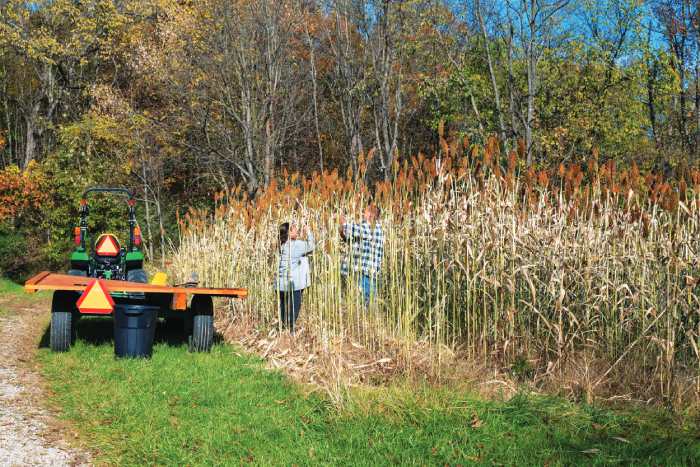
Sweet sorghum can be grown in a variety of soil types, but loam and sandy loam are ideal. The plant prefers a pH of 6.0 to 6.5. It’s drought-tolerant and should always be planted in well-drained soils. Sweet sorghum consumes low amounts of nitrogen; an excess of available nitrogen has been known to have adverse effects on the taste of the finished syrup.
In the Midwest, we plant our sorghum from mid-May to early June. When choosing a planting date, factor in frost dates. The closer you can align the maturity date with the first fall frost without going past, the better. We plant our sweet sorghum about an inch deep with a 36-to-40-inch row spacing.
A few weeks after germination, we manually thin out the rows to 2 to 3 plants per linear foot. As with most crops, weeds are a nemesis we battle until crop canopy is achieved; after that, the patch chokes out most of the weeds on its own.
The old-fashioned way to know when the cane is ready to harvest is to take a seed and smash it in your palm with your thumb. If the contents of the seed resemble bread dough, the patch is ready to process. Around here, sorghum-making day is the high-water mark of our year. Family, friends, and neighbors gather, and we enjoy the fellowship as we work.
Processing Sweet Sorghum
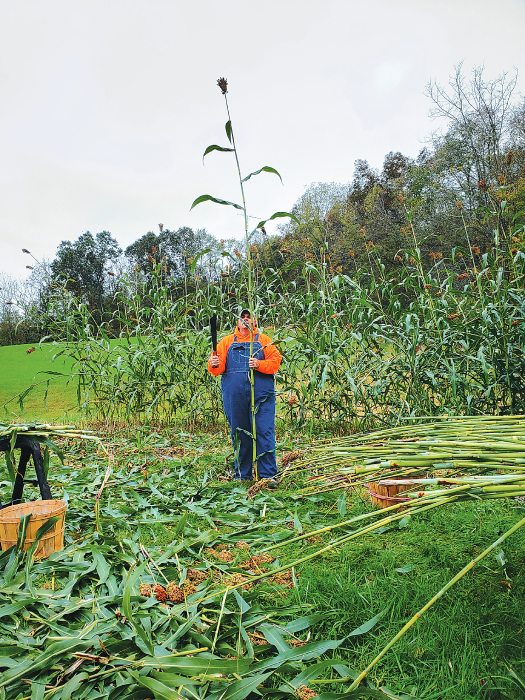
The first step in processing sweet sorghum syrup is to harvest the cane from the field. First, we remove all the leaves from the standing cane. Then, wielding our trusty cane knives, we proceed down each row, cutting the cane at the base and gathering the bundles. The cane is then loaded onto a truck or hay wagon, where we remove the seed heads to retain them for next year’s seed and poultry feed.
Once all the cane is harvested, we head to the local mill that dates back to 1916, powered by a horse that pulls the pole, or “sweep,” in a circle. The cane is fed through, and the mill exerts 75 tons of pressure on the stalks. The raw green juice that flows from the mill is filtered, allowed to settle, and transferred into our 30-gallon, wood-fired pan.
Alternatively, if you cut your cane into smaller pieces, you could use a sturdy cider press with a grinder to extract the juice. Our neighbors purchased a hand-powered sugarcane mill they use to mill their sweet sorghum cane for personal use.
As the raw juice is cooking, impurities rise to the top in a coagulated foam that should be skimmed off. The more impurities you can skim, the better your finished product will be. As the density of the juice increases, you’ll begin to see the transformation from juice to syrup.
Visitors to the homestead are quick to point out the similarities between cooking sorghum and evaporating maple syrup. Larger sweet sorghum operations might use a continuous flow pan similar to high-end maple syrup equipment. We use what’s called a “batch pan,” where the whole vessel is boiled down in one batch. Using a batch pan can be a challenge; when you’re finished, the whole 30 gallons of juice is either ruined, perfect, or somewhere in between; it’s more difficult to adjust your cooking procedures with a batch pan. Keep a close eye as it boils down.
Sorghum syrup has an average yield of 9 gallons of raw juice to 1 gallon of finished syrup. That ratio can vary depending on many contributing factors, such as the cultivar grown, weather conditions, and the sugar content of the juice. Cooking should be done as rapidly as possible, but not so fast that the juice or syrup burns. The final stage of the cooking process is the hardest part, in my opinion. When to make the final call that the syrup is finished cooking is a hot topic among seasoned makers of syrup. Old-timers have two main methods they use to determine doneness. The first is to evaluate how the hot syrup sticks to a wooden spoon. The goal here is to achieve good adhesion to the spoon, and large, slow drips. The second method is to place some syrup on a plate to cool. If the syrup is thick enough to tear a fresh biscuit in half when dragged across the plate, your syrup is done. The modern method involves measuring when the syrup reaches 226 to 230 degrees F or a density of 78 to 80 Brix. We usually incorporate all of these methods to determine doneness.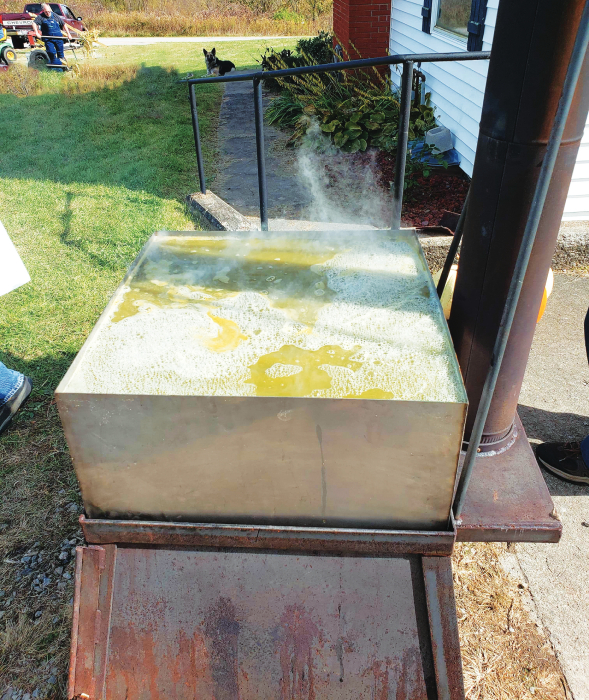
Enjoy Your Sweet Sorghum Syrup!
Finally! All of that hard work and patience has paid off in jars filled with golden-brown, sweet sorghum syrup. Traditionally, sweet sorghum syrup was used as a table syrup for biscuits, pancakes, and the like. It was also used in any recipe that called for a sweetener. Modern homesteaders and chefs are discovering more ways to use it as a “secret” ingredient that brings a flavor profile that’s unmatched by any other food.
We grow our sweet sorghum organically and don’t use herbicides, fungicides, or commercial fertilizers. We also don’t add anything during the cooking process, so the finished product is a pure ingredient. Sweet sorghum syrup is one of the healthiest sweeteners that can be produced on the homestead. It’s a rich source of manganese, vitamin B6, magnesium, and potassium.
Sorghum syrup has a sweet, earthy taste that’s hard to describe. Added to a pot of spicy chili, it brings a subtle sweet note, and the spice accentuates that earthy flavor you can’t find anywhere else. I can make a tasty batch of baked beans using sweet sorghum syrup. As the sweetener base in a barbecue sauce, it excels in complementing the meat, as opposed to overpowering it. I use it in my bacon cure in wintertime when we butcher our pasture-raised KuneKune pigs. It can also be used to sweeten coffee and tea or added to smoothies and homemade yogurt. The possibilities are endless.
Jeremy Clift and his wife, Gesila, live on a small diversified farm in east Ohio named Wakatomika Homestead.
Originally published in the October/November 2025 issue of MOTHER EARTH NEWS and regularly vetted for accuracy.






