Feeding China’s one billion people isn’t an easy task,
and feeding them well (as participants on MOTHER EARTH NEWS’ tour to
that country last fall discovered is generally the case)
seems little short of a miracle! And even though the
nation’s current administration deserves much of the credit
for this feat, the farming techniques that have enabled
land–which has been tilled for thousands of
years–to remain productive are, themselves,
just short of incredible.
Eighty percent of China’s people, using methods developed
over centuries, are now involved in the most intensive and
efficient agricultural system in the world. Many of
the vegetables that these farm workers–and their city
cousins, too–consume come from private family plots
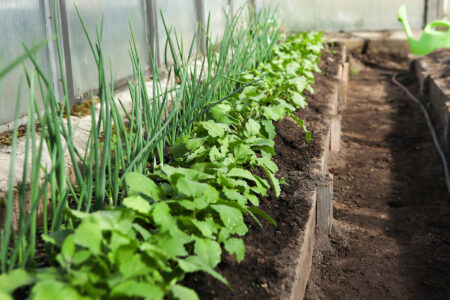
of raised vegetable beds that are smaller than the space
needed to house a Western farmer’s tools!
With the exception of areas containing such “water crops”
as rice and lotus (which require sunken beds), this
intensive gardening technique is used on almost every spare
inch of land. Entire fields of raised beds stretch to the
horizon. There are tiny strips of cultivated earth
beside factory walls, city dwellings, and highway
right-of-ways. Some small gardens are even tucked in among
the rock monoliths of Kunming’s “Stone Forest” national
monument. Such “postcard-size” plots play a large
part in putting good fresh vegetables on family tables, and
often produce enough surplus to earn the gardeners extra
income at “free markets.”
Backyard Beds
If you think that Chinese intensive gardening–which
is designed to get the most benefit out of air, soil, and
water with the least amount of work–sounds like an
ideal method to use for backyard growing, you’re right!
Once created, raised beds are permanent. They never become
waterlogged, never have to be plowed, will “warm up”
earlier than soil tilled in the usual manner and thus allow
you to get a head start on spring planting and–when
one vegetable is harvested–can be worked and
replanted without disturbing the surrounding crops.
Additionally, because you walk on the paths between the
beds and never on the planting area itself, the earth
doesn’t get packed down. Roots won’t be damaged and can
grow easily, and the beds will stay aerated (which will
help nitrogen-fixing bacteria create nutrients from air in
the soil).
Raised-bed gardeners never have to worry about accidentally
sitting on the plants behind them as they weed or harvest,
and–because such folks will have to fertilize and
water only the beds themselves, rather than the whole
garden area–they’ll use less of both of these
essential ingredients and eliminate much of the
mud that can follow garden chores into the house. As an
added bonus, a raised-bed garden can be kept looking
wonderfully neat and beautiful with a minimum of effort
What’s Involved
A person could almost make a museum out of all the
wonderful hand tools that the Chinese have developed to
make cultivation easier, but–to prepare your own
Oriental raised beds–you’ll actually need
only a shovel, a sharp spade, and a rake. (You might want
to add a trowel and a bulb planter to ease the tasks of
weeding and transplanting seedlings.)
When laying out a bed, remember to keep it narrow enough so
that its center can be reached without your having to step
on the bed itself. In China, raised beds are–at the
most–four to five feet wide and usually rectangular.
However, we also saw them formed into squares, triangles,
crescents, or whatever shape best suited the available
space.
Peter Chan (a man who is among the strongest proponents of
this method) builds beds
that are four feet wide at the bottom and three feet wide
at the top, with a side slope of six inches. Each bed is
then surrounded by paths at least a foot wide.
Permanent Planning
Once you’ve completed your garden layout on paper (plan
well, as the whole idea is to make permanent plots
and thus reduce your future work), measure and mark out the
first rectangle by attaching twine to four corner stakes.
Then, working from the center and using the string as a
guide to keep the sides of the bed straight, turn the soil
one shovel deep (as opposed to the “one shovel and
one fork deep” preparation necessary for biodynamic/French
intensive gardening), removing weed roots and rocks as you
go along. (If you turn up a lot of stones, save them to
pave your garden paths.)
As you turn the earth, work in compost, manure, sand, lime,
or whatever soil tests indicate that the earth needs. And
be sure to dig a small, narrow trench between the base of
the bed and the paths, to catch water runoff and send
washed-away nutrients back into the bed rather
than onto the area where you’ll walk. Finally, smooth and
shape the top and sides of the plot with a rake, remove
the twine, and move on to the next bed.
It’s best to leave the corner stakes in–as Peter
Chan has suggested–because they’ll help prevent your
hose from dragging across young plants as you water. Don’t,
however, be tempted to shore up the sides of your beds with
rocks or railroad ties, as such supports would provide fine
homes for slugs and snails.
Remember, too, not to crowd your vegetables when
you plant. In a bed that’s three feet wide at the top, for
example, make only one row–down the center–of
such spreading crops as cucumbers, zucchini, and squash; two rows of cabbage, broccoli, tomatoes, peppers, eggplant,
peas, beans, and corn (you can stagger these plants to give
them even more room); or four rows of garlic, leeks, and
scallions.
Other Wisdom
Another bit of simple “technology” has to do with watering:
In China, farmers always take care of this chore in the
morning, rather than in the evening, because they feel that
the cold “bath” at that time helps to stun and sicken
aphids, small worms, and other pests that like to dine
during the cooler part of the day. Although extremely hot,
dry weather sometimes makes it necessary to give the crops
another drink in the late afternoon, the Chinese point out
that plants are not performing photosynthesis at night and
thus don’t need water. Besides, evening moisture
evaporates more slowly, and the “standing” humidity
attracts many insects, and encourages the development of
destructive fungi and mildew. Tomato blight, for instance,
often occurs when the soil is too damp.
Fortunately, with the good drainage provided by raised
beds, your vegetables won’t have to contend with “wet
feet.” Even after a heavy rain, you’ll find
that the earth begins to dry and becomes ready to work much
sooner than would that in a regular row garden, while
moisture is actually held longer beneath the soil,
stimulating root development.
To further discourage insects and pathogens, never put the
same crop in the same bed for two seasons in a row. As a
matter of fact, don’t even replant a vegetable twice in the
same spot during a single gardening year if you can avoid
it.
The extra crops that your raised beds ought to
produce may not feed a billion, but you’ll obtain more
vegetables, from a much smaller space, with much less
effort, than would be possible using traditional
row-gardening methods!
Want to Know More?
Although the accompanying article provides an overview of
the philosophy and methods of Chinese raised-bed gardening,
it doesn’t go into all of the intricacies of the
Oriental intensive horticultural technique. However, if
your interest has been aroused, there is a source
of more information available.
Better Vegetable Gardens the Chinese Way by Peter
Chan with Spencer Gill not only offers a
detailed presentation of the methods used by one of the
foremost proponents of the Oriental method, but also
features color photographs that actually manage to convey
the author’s love for gardening. Folks who have a yen to
try this form of horticulture will find the help they need
in Peter Chan’s attractive volume.