

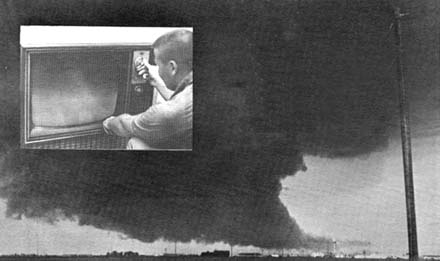
On September 22, 1968 Newton Weller–a self-taught electronics researcher–released a strange story to the Des Moines Register and Tribune. He told Iowa readers of his long efforts to develop a reliable tornado detection system, and gave simple instructions for turning any TV set into a tornado detector.
The story could not have broken at a better time. Sunday morning found the newspaper already delivered in Orange City, a town not far from Des Moines By noon ominous dark clouds blotted out the sun and the air became sticky with heat. At five o’clock an Orange City fire truck raced through the streets, its beeper wailing. This was the town’s method of giving a tornado alert. Recalling the tornado detection story in the morning’s paper, many Orange City residents hastened to their TV sets.
Following the directions in Weller’s article, they turned the sets on, let them warm up and tuned to Channel 13. By using the brightness control knobs, the screens were darkened until they were almost black and the sets were switched from Channel 13 to Channel 2. The TV’s were then left alone, as instructed, with no further adjustment of the brightness controls.
Before the eyes of these viewers the screens of their TV sets soon began to glow with a strong white light: the signal of a very close and approaching tornado! Heeding the warning, the Orange City residents rushed for places of safety and–minutes later–the tornado struck the town. Damage was later assessed at over one million dollars but, fortunately, no deaths resulted. Here was solid proof that the Weller Method of TV Tornado, Detection worked!
Any functioning TV set will pick up electrical disturbance from a twister as far as 20 miles distant and Weller’s research has shown that Channel 2, the lowest of all TV frequencies at 55-megacycles, is the most sensitive to a tornado’s electrical discharge. As a twister approaches a TV set tuned to that channel, the storm will produce a steady white light on the receiver’s previously-darkened screen.
There is always the possibility, of course, that a person turning on his TV set, switching to Channel 2 and finding an already–glowing screen could unknowingly darken out the twister’s signal. To avoid this possibility, Weller insists that–for tornado detection–a set always be tuned to Channel 13 and have its screen properly darkened before it is switched to Channel 2. Using such a technique, Weller says, makes the system foolproof.
This home detection of twisters gives as much as 30 minutes warning, depending on how far away the tornado was when the TV set was turned on. As the storm roars away or exhausts itself, the brightness of the TV’s screen will dim accordingly.
Though few tornadoes have a life history longer than an hour, they are the most violent and destructive winds known to man. While a twister advances along its path at a speed of only 25 to 40 miles per hour, the funnel-shaped cloud extending toward the ground from the base of a thundercloud rotates at a speed of 500 miles per hour.
Twisters may be born at any moment of the day or night but they are most common during the hours closely following the warmest temperatures of the day. Fifty two percent of these violent storms have been recorded between the hours of 3 to 7 p.m., 82% roar into existence between noon and midnight and the most tornado-dangerous hours are from 4 to 6 p.m.
Tornadoes occur in many parts of the world and in all of our states but the central part of the U.S. spawns more twisters than any other geographical area. An average of slightly, over 200 deaths due to tornadoes occur annually in the U.S. but the chances of a tornado striking any particular place are extremely small. This is due to the fact that the path of the average twister is only 16 miles long and less than a quarter-mile wide. Since tornadoes are purely local storms, watching for them during critical periods by means of the Weller method can now pinpoint them with an accuracy hitherto unknown.





