

Note: All content here excerpted with permission from Farming for Self-Sufficiency: Independence on a 5-Acre Farm by John and Sally Seymour. Copyright 1973. Read More
John and Sally Seymour’s record of
18 successful years on a shirttail-sized homestead in
England is important now and should offer welcome
encouragement to today’s back-to-the-landers . . . both
real and imaginary. I started serializing the book in my
No. 25 issue and I’m sure that many readers will want a
personal copy for their home libraries.—MOTHER.
Every farmer will understand me when I say, that he
ought to pay for nothing in money, which he can pay for in
anything but money. — William Cobbett
How to Keep Bees
The pre-industrial Revolution manner of keeping bees would
not commend itself to the officers of the R.S.P.C.A.,
because the bees were ‘put down’, as the latter would term
it, every autumn. The hive with precision-cut moveable
frames had not been invented, and the only way in which the
honey could be extracted was to burn a little sulphur
underneath the hive and liquidate the bees. The picturesque
straw skeps were treated in this manner, and in Africa and
most parts of Asia today this is still the manner of
keeping, and ceasing to keep, bees. In Central Africa one
frequently sees hollowed – out logs hung in the
trees: these are the equivalents of the medieval bee skeps
in England. There are bee keepers in dear old England today
who, whisper it not, do this very thing. They put old
orange boxes or other crates and receptacles around the
backs of their houses, where the neighbours can’t see them,
and put a few old bee frames with a bit of wax on them and
the smell of bees inside them, and either hope that some
bees will arrive from somewhere (and if bees have been kept
in that garden for a long time you can be fairly sure some
will) or else go out and capture a swarm and put them in
the box. The busy little insects fill the box completely
with honeycomb and honey, but all jammed in there
higgledy-piggledy, and there is absolutely no way known to
man of extracting that honey without killing those bees.
But there, the economics of the thing, from Man’s point of
view, are perfectly sound. The bees, by the autumn, have
done their work. They have made their honey. If the man is
going to keep them alive all winter it either means that he
has got to leave a large part of their honey with them for
them to live on, or else feed them with sugar. In a country
with a high proportion of woodland and forest, and
therefore of wild bees, there will always be plenty of
fresh swarms in the spring, and a swarm of bees in May is
worth a load of hay, and worth none the less because you
didn’t have to feed it and look after it all winter.
It was the discovery of the bee space that made
this yearly butchery unnecessary though. The bee space is
the exact space in which a bee will build its comb and yet
leave a space for itself to crawl about in. Thus the frames
of a modern beehive are exactly the right distance from
each other so that the bees will build the combs out from
them to the correct size of combs but yet leave a bee space
between the combs. If the frames were a small fraction of
an inch further apart the bees would start building ‘wild
comb’ between the frames and thus fill the whole space in;
if they were a fraction nearer the bees would not be able
to build out from both frames, because there would not be
room for them to work. Therefore, with this discovery of
the bee space, it was possible to construct beehives with
such precision that the bees build their combs as we want
them to, on frames that we put there for them, frames that
can be removed to extract the honey without disturbing the
bees too much, and be put back again for the bees to start
filling with honey again. The stock of bees can be kept
from year to year, which is more humane, and also enables
the bee keeper to start early in the season with strong
stocks of bees in all of his hives. He doesn’t have to wait
for the Lord to send him ‘a swarm of bees in May’ because
he’s already got several good swarms of bees tucked up in
his hives in January.
The feeding of a little sugar to the bees to keep them
alive in the winter and to enable the beekeeper to rob them
more thoroughly in the autumn has developed, among many
modern beekeepers, into feeding them on sugar all the time
exclusively. Bees will not bother to go and look for nectar
if there is plenty of sugar available, and many beekeepers
buy stores of cheap sugar generally condemned for human
consumption, and feed it direct into their hives, and the
bees just turn it directly into honey. Which is why so much
honey today tastes something like honey, and yet not
quite like honey. The honey that comes in from
underdeveloped parts of the world like Mexico, however,
generally really tastes like honey, because the beekeepers
in such lands cannot afford to buy the sugar to feed the
bees: it is when labour is dear and industrial sugar is
cheap relative to labour that beekeepers shove in the
sugar.
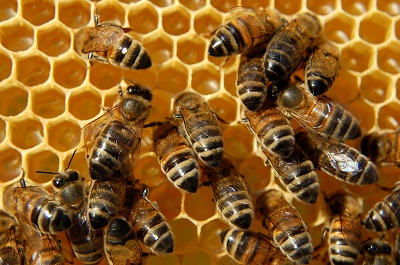
But the keeping of a few colonies of bees is an obvious
ploy for the self-supporter. The initial outlay necessary
on modern hives and equipment is fairly high (you have to
have an extractor, for example) but once you have the
equipment there is a very valuable harvest to be taken
every year for the rest of your life. You don’t need to buy
any sugar, condemned or otherwise, to feed the bees on. We
have not so much kept bees as had bees around for the last
sixteen years, and most years we have got some honey from
them, and we have never fed them on any sugar. We merely
abstain from robbing them too severely in the autumn.
Of all the arts and crafts of the countryside, beekeeping
is the one that least lends itself to being taught by a
book. Also to give any idea of the subject would take a
book at least as long as this one. Therefore, I must merely
recommend the novice to join his local bee group, if he has
one (and he probably has), or at least put himself under
the tuition of some good master. Also, buy a book on the
subject. There are many. We have two hives, but not enough
‘supers’ for them (that is stories to add to their height
and make more room for honey), but this year we took nearly
a hundred-weight of honey without going to much trouble and
leaving plenty of honey to keep the bees through the winter
time. A day a year is really all you have to devote to your
bees. All I would advise is, do not make the mistake that
we have made and get hold of components from two different
sorts of beehive, also get a really bee-proof rig to wear
when you are working with your bees. Nothing is more likely
to diminish your love for these little insects than having
a few score of them buzzing about inside a leaky veil
trying to get out, while a few hundred of their sisters
outside dive-bomb angrily at you outside trying to get in.
And remember bees, when they alight on you, crawl upwards.
They won’t crawl down into Wellington boots but by God they
will climb up your jumper if it isn’t well tucked into your
trousers. And the presence of a dozen or two crawling about
your midriff, and occasionally stinging you, will not
increase the calmness and efficiency with which you are
likely to carry out your operations. If you are completely
bee-proof you can be very cool and efficient, and cool and
efficient you have got to be.
If you had enough bees, and looked after them well enough,
you would not need to buy any sugar at all. Two hives,
managed in a professional manner, would be enough. I for
years in what was then called Barotseland, in what was then
called Northern Rhodesia, in what I believe is still called
Africa, without ever tasting sugar. There was plenty of
wild honey. Once you have got used to it honey is fine in
tea or coffee, and on porridge if you must eat the stuff.
In fact there is no good purpose for which honey is not
better than sugar. It is not in any way bad for your teeth,
as sugar is, nor it lead to all the other evils now being
put down to refined sugar. It is a lot dearer than sugar
— if you have to buy it, but if you don’t
have to buy it as we don’t, it is, quite simply, free.
Hunting for Wild Food
It goes without saying that the
kind of wild food that you will get will depend entirely
upon where you live. As an example, when we lived in
Suffolk, pheasants, hares and wild duck made up a very
large proportion of our meat intake (particularly pheasants
and hares); we ate, of fungi, parasol mushrooms, ceps,
shaggy ink caps, saffron milk caps, puff balls, field
mushroom; there were plenty of blackberries, some nuts,
plenty of elderberries, sloes, plenty of wild plums every
three years, mussels down on the estuary. In Pembrokeshire
we find no pheasants, no hares, very few fungi except a few
field mushrooms, tons of the finest blackberries, most
years plenty of hazel nuts, elderberries and sloes, and
cranberries on the mountains if we have time to pick them,
which generally we have not. Small sea mussels, cockles and
razor fish are there for the getting.
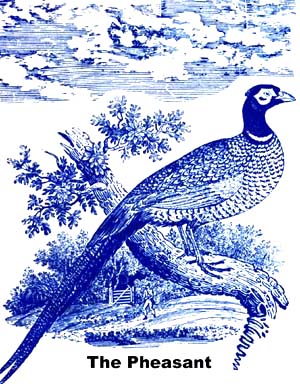
Hunting Pheasants
The self-supporter, unless he
is just doing it for a game like Marie Antoinette playing
shepherdess, will scarcely wish to indulge himself in
shooting driven pheasants with twelve-bore cartridges at
tenpence a shot. But there are cheaper and more effective
methods of taking pheasants, and, if you have a game
license, you are quite within the law shooting pheasants on
your own land unless the right has been reserved by a
previous owner when he sold the land. You can’t own a rifle
without a police permit, but if you have this then a .22 is
a very effective weapon for killing pheasants, and ‘short
rifle’ ammunition is very cheap.
In the first place, if a man occupies even a small piece of
land, and his neighbours have pheasants, he can also have
pheasants. There are certain crops which pheasants just
cannot resist. One is the Jerusalem artichoke. A row or two
of it won’t make much difference, but a stand of, say, a
quarter of an acre will bring pheasants from far and wide.
They like the cover it affords them and they like the
artichokes themselves as food.
Buckwheat is a marvelous crop for attracting pheasants.
Kale is not bad but only so-so. Maize is good. Sunflower is
absolutely splendid — as good as Jerusalem
artichoke, which it so closely resembles. But I would say
the latter plant plus buckwheat are the ones to plant.
Dogs will catch pheasants. Many a gypsy man has a lurcher
dog (a cross-bred with greyhound or whippet in his
ancestry) which will take a pheasant on the ground. It is
unforgivable of course to take a hen off the nest, and no
decent poacher would do it. If it did happen by accident he
would collect the eggs and put them under a chicken hen to
bring them off.
But if you do get any pheasants, or partridges, hang them
up, guts and all, by their necks (not their legs like
chickens) in the larder, and leave them there for at least
a week in the winter before you cook them. You hang them by
their necks to keep the blood in the body, and also to keep
the guts from tainting the breast meat.
Hunting Pigeons and Other Birds
Pigeon would be
fine if they didn’t cost so much to shoot. I used to shoot
wild geese but don’t any more since I discovered that they
mate for life. We all may get fed up with our husbands and
wives from time to time but we don’t want them shot. Wild
ducks don’t though, and are noble food, so are most of the
waders. Curlew, lapwing, golden plover, red shank were once
considered grand eating, but they are protected birds in
Great Britain. They all want hanging for a few days, at
least.
Catching Rabbits and Hares
Rabbits, if they ever come back, can be
picked off with the .22 in the early morning or the
evening, driven into a purse-net from their holes by
ferrets, driven into a long-net at night by a dog or two.
The long-net is set, very quietly, between the feeding
grounds of the rabbits and their holes. It is set on
sharpened pickets sloped into the ground, but very baggy.
Then one operator takes the dog and walks round the feeding
grounds and drives the rabbits into the net, while the
other crouches down at one end of the net and runs along it
to take the rabbits out and ‘show them London’ by breaking
their necks in the manner I have described for killing
chickens. I used to go long-netting with a deaf man, and as
we had to be very silent (it was gamekeeper country)
communication between us could be hazardous. A countryman
will ‘hulk’ a rabbit (paunch it) and ‘hock’ it (cut behind
the gam string of one leg and shove the other leg through
so that it can be hung on a stick or on the handlebars of
his bicycle) without using a knife. He uses the sharp claw
of the rabbit’s own foot. Gut or ‘hulk’ rabbits as soon as
you catch them, but not hares.
Hares can be caught with a good lurcher.
We had a very small lurcher named Esau who would run down a
hare very often if he had the chance, and I remember taking
him for a walk over the marshes when we already had too
many hares in the larder and coming back with three more
hares. A lurcher can be trained to keep out of sight, and
never to come near his master if a stranger is in sight.
Don’t hulk hares immediately. They are game, while rabbits
are not. Hamstring a hare, hang her up in a cool larder by
her hind legs for a week (or a fortnight if you like game
hung well) then skin her carefully before you gut her, then
hulk her (a stinking and disgusting job —
but don’t be put off by the whiff, it doesn’t matter);
always save the blood to put in the sauce. Hares are
absolutely delicious and there are many ways of cooking
them besides jugging them. A hare a week through-out the
winter is not too many.
Edible Wild Fungi
Most fungi are edible and some,
notably parasol, shaggy ink cap, and cep, are absolutely
delicious. But I positively refuse to start describing
which fungi are edible and which are not, for without very
good photographs this course might lead to disaster. You
must either get somebody to show you, or get a very good
book. It is absurd though that only the field mushroom
generally gets eaten, when there are so many other
excellent ones. We have a good book, and try any fungus
that we can identify as edible at least once. Some are
edible but pretty tasteless.
Mussels and Other Sea Life
Mussels are fine if they come
from genuinely unpolluted water but can be very dangerous
if they do not. In any case do not take the advice of most
cookery books and only steam them long enough for them to
open their shells. This is very dangerous. They should be
boiled, or thoroughly steamed, for at least twenty minutes.
And make absolutely sure that you use none that were not
tight-closed before you cooked them.
Cockles can be raked out of sand-beds at
low tide with a steel garden rake. Professionally they are
raked into a little hand net and swished about in shallow
water over the sand to get the sand out. I have seen four
men rake out a ton of them on one low tide. In such cases
the fish are generally loaded straight into the holds of
smacks which have been stranded on the sands at high water,
but in Kent there are men who load them on to old bicycle
frames, and in Wales women who load them on donkeys. Boil
them for twenty minutes in sea water.
Razor shells, or razor fish, are delicious
to eat: a kind of clam. You may see their blow-holes in
sand right down at the water’s edge at very low spring
tides. If you walk backwards over the sand you will see
them spurt water after you have passed. Either dump a
handful of salt on the hole, ‘in which case they will come
out and you can get a spade under them, or use a
‘razor-fish-spear’. This is a slender steel spear with
small barbs on it. You push it down the hole, the razor
fish closes on it, and you pull him out.
Limpets can be eaten, and I have eaten
them raw. To get them off the rocks kick them quickly
before they know you are there, or they will cling down
hard and you won’t get them off. They are better cooked.
Refine Your Own Sea Salt
If you don’t like buying salt
— take a large vessel down to the beach one
fine summer’s day, send your children looking for plenty of
driftwood, light a fire under the vessel and keep pouring
buckets of sea water into it. Make sure you draw your sea
water from where it is fairly deep and has no sand in
suspension. If you keep doing this all day you will have
enough of the very best sea salt to last you for table use
throughout the year, although not — of
course — enough for curing fish or ham.






