A good horse is a real asset to any farmstead. Riding
through the woods can provide countless hours of “home
entertainment,” and if the creeks are up or the vehicles
broken down (which seems to be the case more often than
not), a pleasure steed becomes invaluable as transportation to visit friends, pick up supplies, or keep
appointments.
However, a whole new realm opens up when you train a
“riding” horse to harness and put the animal to work around
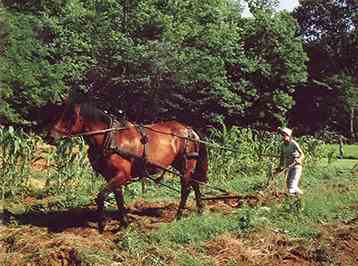
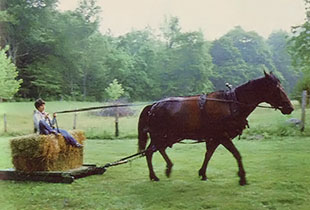
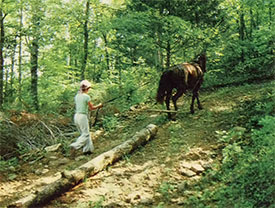
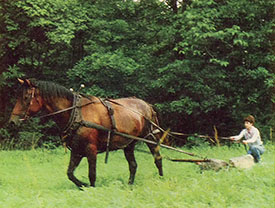
the farm. I use my mare Gypsy to pull logs from the woods,
haul rocks on a stoneboat (sled), and even cultivate my
gardens.
It seems to make good sense–especially considering the
amounts of costly grain and hay a horse consumes–to let the
critter “pay its way.” Furthermore, this transition from
saddle horse to work horse can be an easy one if you
keep a few basic equine principles in mind. For one thing,
a horse has a relatively short attention span, so
training is best done in gradual steps. You must also be
aware of your beast’s limits, because it’ll become frustrated and rebel if pushed too
hard. In addition, be
careful in your enthusiasm not to excite the trainee in any
way when introducing new tasks. A workhorse
must be a mellow, slow-moving animal.
Punishment and Praise
Reward and punishment go hand in hand. Praise, pats, and
bits of carrot are a horse trainer’s most helpful tools.
You can assure and calm your steed instantly with a word or
touch, and praise (or a tasty reward) will stimulate
ol’ Dobbin’s interest and response.
Some critters will test their limits every so often,
though, so punishment may occasionally be unavoidable. When
such chastisement does become necessary, it’s very
important to know when to apply it and when to stop. Timing, therefore, is essential. For example, a pull on the
reins is a form of punishment, and the release of that
pull is a reward. So if you tell your horse “whoa” and it
doesn’t respond, you must continue pulling on the reins
and repeating “whoa” until the horse slows to a stop. When
the order is obeyed, release the pressure at once. After a
while, the oral command will be all that’s needed.
Most of the time, a harsh word will be sufficient to
reprove your helper, but every now and again you can expect
to become involved in a battle of wills. After all, you’re
dealing with an animal that may have 10 times your body
mass. This huge critter has to learn to respect
you. I’ve used a long switch on Gypsy a few times, but a
slap with the reins is usually all the encouragement she
needs to move a head. As soon as my wayward worker
responds, of course, she receives immediate praise.
A Step at a Time
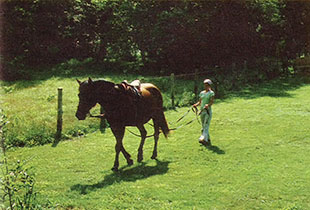
To begin training my horse to accept a harness, I ran a set
of long reins through her stirrups and guided her from
behind through areas she was already familiar with,
introducing the words “gee” (right), “haw” (left), and “get
up” in the process. (Gypsy already knew “whoa” and “back.”)
Your horse will want to keep an eye on you, so while
standing behind the animal you can extend an arm to the
right or left to help reinforce the spoken directions.
Once Gypsy was fairly adept at following word commands, she
was ready for the harness. It’s wise to let any horse take
a good look at (and smell of) this apparatus before you put
it on. Make the necessary adjustments and be very wary when
you fasten the crupper (the strap under the tail) if
your harness has one. After that’s done, let the animal
have a moment to get used to the feel and sound of all
those straps and chains.
When the horse seems unconcerned, walk it in a
familiar area-while you guide from behind and practice
commands and backing. (This first harnessed stroll should
be all that’s attempted in a one-day lesson.)
After your beast will walk in harness calmly and willingly,
the animal is ready to learn to pull. I introduced my mare
to the task with logs. Some folks say it’s best to fasten
your “novice” to something that won’t move too easily,
like a sled full of stones. Perhaps such weighty
“insurance” is necessary for unmanageable runaways, but a
properly prepared horse is unlikely to bolt. You see, your
worker must learn to ease into the pull if the animal is to
use its weight and power to advantage. A calm and
confident horse will soon do this smoothly and
consistently.
Don’t Push It!
One cold winter day in Michigan, I used Gypsy to haul some
big logs up from the river bottom. The snow was fairly
deep and the uphill pull made for some pretty rough
going, so she paused momentarily, lost her momentum, and the large log packed into the snow.
When Gyp tried to continue, the timber wouldn’t budge. I,
of course, encouraged her to pull again, upon which she
reared and plunged. Still, the log didn’t move. I unhitched
the horse, and she got really nervous and started to run
around and around, too frenzied to cope.
In the meantime, a friend cut the tree trunk in half and I backed the old girl (again in her harness) up to the
log one more time. That was the final straw! She plunged
ahead and galloped up the hill, dragging both the
length of timber and me!
That experience taught me not to get between the horse and
whatever it’s pulling, and never to overburden my
beast. Gypsy, however, was much more upset than I was. It took months for her to regain her calm while being
hooked up, and I had to teach her to ease into the pull all
over again.
Since those early lessons, Gypsy has learned to haul other
implements, too: a riding disc, an A-harrow, and a
stoneboat. (Next on the agenda are a small plow and a
wagon.) It seems that the more she’s used, the better she
gets! But whenever I put something new behind her, I’m
careful to work her for only a short while and always
to end the lesson on a good note.
Take, for example, the first time my mare pulled a
stoneboat to help gather rocks from a field. She started
out fine, but before long she became feisty, plunging,
trotting, and getting that “wild look” in her eyes.
After a good hearty battle I finally got both horse and
sled to our destination, whereupon Gypsy was praised
(between clenched teeth) and given the rest of the day off.
I think she and I were equally exhausted!
The next day when I put her to the task again, she performed
perfectly the entire time. From then on, whenever the wild look appeared
I just halted until it subsided, and then continued as
before.
Confidence to Perform
Always keep in mind that a horse usually revolts because it
doesn’t have the confidence to do something it hasn’t
attempted before. However, if you can relate to the beast
in such a manner that it understands and accomplishes a
simple task with much-deserved praise, it will soon become a
willing, gentle giant. And, again, don’t push your animal. A good two hours of work is fine for the newly
harnessed horse.
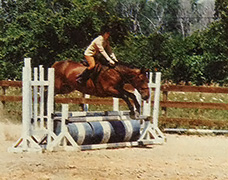
Gypsy–whom we now usually refer to as
“Ol’-Gyps-Down-on-the-Farm”–was by no means a natural-born
workhorse. She spent the first three years of her adult
life in and out of the show ring as an English
pleasure horse and hunter. I believe her early career did
much to teach her discipline under stress and contributed
to her fine work as a draft animal.
It’s been six years since my lady’s show days, but she
exhibits as much enthusiasm in the field as she did in the
ring. I think the transition from riding horse to workhorse
was a rewarding and welcomed change for her. In fact, both
Gypsy and I couldn’t be happier!