

Regular readers of this publication know that I often work up lists of “commandments” on the proper care and feeding of various barnyard critters. In part one I discussed the first five of my ten commandments for raising chickens. These tips included information on choosing the specific variety of clucker that best suits your needs … building and maintaining a safe, sanitary shelter for the birds … distinguishing a healthy chicken from one that’s not… and understanding the seasonal — and biological — cycles of your flock.
In my opinion, the best way for a beginning poultry producer to get started is to buy a batch (usually 25) of day-old, straight-run, dual-purpose chicks. (For all those who missed the first part of this article, “straight-run” refers to the birds delivered direct from the shell, and not separated by sex. “Dual-purpose” means that they’re both adequate egg producers and meat makers.)
VI. Coddle the Youngsters
Day-old chicks will do little more than eat, drink, and sleep during their first few weeks in this world. And, unless you find a “broody hen” willing to adopt your flock, all the joys of motherhood will be yours to experience. (A broody hen, by the way, is one that demonstrates a desire to raise a family, usually by refusing to give up eggs or even sitting in an empty nest box all day long.)
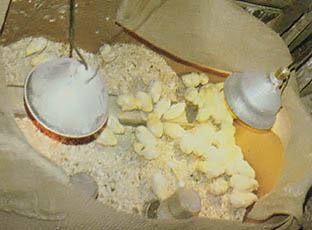
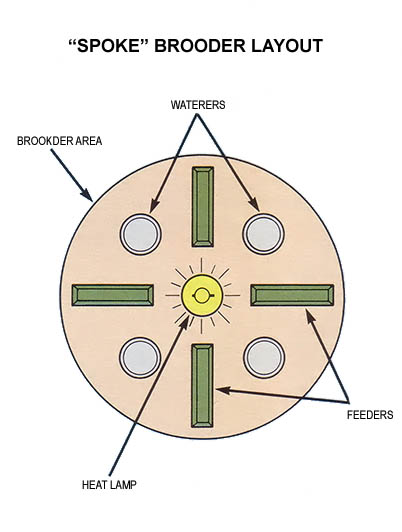
If you appear to be the most likely candidate for mothering, it’s best to be prepared for the event before the chicks arrive. The young birds will need the warmth and protection of a brooder, a kind of “nursery” which can be easily built from sheet metal or cardboard. The containment area should be round (to prevent the little balls of fluff from crowding into corners and smothering themselves) and heated (to keep the young ones at a constant temperature of 95°F). A heat lamp, suspended by heavy-gauge wire over the center of the brooder area, works well.
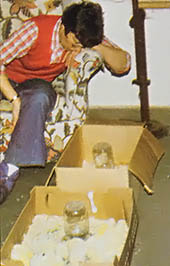
The brooder’s floor should be covered with three to four inches of clean, dry litter at all times. And, to insure that the chicks encounter sources of nourishment no matter which way they wander, place feeders and waterers in a spoke arrangement. The first feeders can be made from box lids or empty tuna cans. A homemade chick waterer can be fashioned from a canning or mayonnaise jar inverted over a plastic or metal dish. Be certain, however, that the jars are not easily tipped over, as the chicks — and their home — should be kept dry at all times.
Decrease the temperature in the brooder by 5° each week (starting, of course, from 95°F) until the thermometer reads 75°F. (Always measure the temperature at a level three inches above the litter.) At that point the month-old, partially feathered chicks can be allowed outside in moderate (50°F, or warmer) weather.
VII. Feed Your Critters Well
Chickens will choose to eat a balanced diet if they’re given the option of both high-quality feed and a pasture or garden to forage in. One acre of land will support from 300 to 500 pullets provided the young hens also have access to a steady supply of a 10-15% protein mash or grain supplement.
There are a few problems associated with letting birds roam free, however. One is their tendency to scatter eggs over the entire “back forty.” Another is the fact that the scratchers do hold a fondness for garden produce. For those reasons most folks opt to pen in their poultry. But if you decide to limit the feathered foragers’ range, remember that you’re also limiting their ability to balance their own diets.
Fortunately, commercially formulated chicken feed — available in both mash and pellet forms — will give your birds the balanced nutrition they require. Of course, you can feed your birds almost exclusively on table scraps and garden surplus … but if you do, expect fewer eggs and a slower growth rate, since the homemade rations won’t be exactly balanced as is the commercial variety.
Baby chicks will require a 20% protein diet during their first six weeks of life. Allow 40 pounds of starter ration per 100 baby chicks during the first two weeks, then a total of 250 to 300 pounds per 100 birds over the course of the following four weeks. Broilers will require slightly larger rations than will the lighter egg-laying breeds. Remember, too, that you should not skimp or experiment with other meal plans during your chicks’ early childhood because the youngsters just aren’t tough enough to handle changes that soon. It’s better to feed the babes a strictly commercially prepared feed and give such things as greens and leftovers to older (and tougher-bellied) hens.
You’ll want to reduce the birds’ protein ration to 15% when the chicks become “teenagers” at re between 6 and 18 weeks. (If you’d like to mix some grain in at this time, continue to feed your birds the 20% protein mixture but add 10 pounds of grain for every 100 pounds of mash. Then, in the succeeding weeks, gradually increase the amount of grain until the birds are eating equal parts of seed and mash.) Finally, in the course of a two-week period beginning when the birds reach 18 weeks of age, gradually switch your pullets’ “growing” ration to a “laying” ration higher in calcium and vitamins A and D.
Another important ingredient in a chicken’s diet is grit. This gravelly mixture is necessary in order for the birds’ digestive systems to function properly, since chickens don’t possess stomachs or teeth with which to grind up their meals. You can buy grit at most livestock feed stores or simply make your own by gathering small pieces of gravel and sand particles from nearby streams. (By the way, there’s no need to supply grit if you rely entirely on commercially prepared feeds.)
Always keep “helpings” of crushed oyster shells and finely mashed eggshells in front of the layers, too. They’ll need the extra calcium to produce nice hard-shelled eggs. And never forget the birds’ water! One hundred full-grown birds will drink six to eight gallons of the liquid each day, and even 100 baby chicks will consume between one and two gallons daily. In the wintertime, you might want to paint your waterers black and situate them in a sunny area so that collected solar heat will help prevent the liquid from freezing.
Hanging the feeders off the ground — at a level equal to the height of the birds’ backs — is one of the most efficient and sanitary feeding methods. Don’t overload the devices (two-thirds full is plenty) but do keep fresh feed in them at all times.
VIII. Keep Accurate and Meaningful Records
Unless you actually enjoy thinking up names for each and every hen you raise, flock records are probably more practical than individual ones. Use a notebook to record the number of eggs collected each day. During the prime egg-laying season (spring through fall), you should be counting four eggs from every five layers you own. You’ll also want to keep a record of the butchered weight of your chickens so you’ll have an idea how “profitable” your operation is each year.
It stands to reason that you should keep close tabs on the red side of your ledger as well, noting such expenses as your feed costs and veterinary bills. This information will give you valuable guidance when choosing future chicken breeds to raise.
IX. Cull the Worst
Cull (dispose of) any nonlayers. There’s no reason to continue to feed an adult hen that isn’t producing eggs. And once you’ve learned the correct technique, it’s easy to find out who’s laying and who isn’t.
Any injured, ill, or otherwise indisposed bird should be removed from the flock immediately, too. Dead fowl should be promptly incinerated or buried.
Finally, if you’re realty concerned about achieving top efficiency and economy in your chicken coop, you should plan to replace your laying flock on an annual basis. Although hens will usually produce over a period of about four years, they reach their peak of productivity in their first egg-laying season. Therefore, annual replacement insures the greatest egg production; you’ll have fewer disease problems if there aren’t any older hens around, since ailments such as worms or tuberculosis tend to occur most often in older birds.
X. Help Your Chickens Prevent Their Own Diseases
If you closely follow the other nine commandments I’ve listed here and in part one, you’ll travel more than 90% of the road toward maintaining a healthy flock. Let’s quickly summarize the most important chicken-raising rules:
Keep baby chicks warm and free from drafts during their first “critical days”. Maintain a coop so clean that you wouldn’t mind eating a picnic dinner on the floor. Provide plenty of interior space for the birds. Give them the opportunity to run, sun, and dust themselves outside every day. Separate age groups from one another. Don’t raise more than one generation of birds in any pen. Keep the youngsters at least 40 feet away from the older birds. Feed the chicks a complete (20% protein) diet for at least the first six weeks. After that, if you want to, you can supplement the feed with grains, pasture, and/or table scraps. Keep all visitors — human or otherwise — away from the flock. Dogs, cats, wild birds, rodents, and even neighbors can carry diseases that could spread to the chickens. Butcher your hens after their first, prime laying season.
Of course, despite your most careful precautions, chickens can and do pick up diseases. The following common poultry ailments can be prevented if you’re knowledgeable about them:
Pullorum is a disease that’s transmitted from parent to chick via the egg. Often the hen or rooster involved will appear normal, but will be a carrier of the malady.
It’s important to note that an egg infected with pullorum may carry the disease on its shell … a place from which other newly hatched chicks are able to pick it up easily. And unfortunately, most youngsters who contract pullorum will die.
The secret to preventing this disease is never to bring the germ into your flock. Be certain all your chicks, hatchery eggs, breeding stock, or replacement poultry are certified pullorum-free. (There’s a simple blood test to determine carriers, and most hatcheries will guarantee their stock.)
Newcastle, bronchitis, and fowl pox are other diseases that you may need to vaccinate your chicks against. A local vet or county extension agent will know which vaccinations are recommended for your particular area and can explain how and when to administer them.
Coccidiosis is caused by microscopic food robbers common to all penned-in poultry: unfriendly protozoa that set up housekeeping in your critters’ intestines and cause bloody diarrhea, weight loss, and — in some cases — death.
To prevent this disease from breaking out in your coop, give all penned chicks a medicated feed — either sulfas, amprolium, or furacins — until they reach six weeks of age. After that time the birds will be less susceptible to the microbes, especially if you keep the coop clean and dry.
External parasites such as mites and lice are another problem you should continually watch for. They’ll feast on your flock’s feathers, skin, or blood depending upon the type of bug. Most are so small you’ll almost need a magnifying glass to spot them. Be sure to examine your chickens any time they appear to be digging and scratching at themselves more than they should, or if they’re losing feathers when it’s not molting season, or if their egg production drops, OR if the birds’ legs or wattles become particularly dry and scaly.
To find the pests, you’ll have to part the chick’s feathers and get right down to the skin or feather shafts. If you see tiny specks scurrying about, check with your vet for a good “de-louser”. (There’s one little “creepy crawler” that hides in perches during the day and attacks your birds at night. You’ll need to take a flashlight into the coop after dark to catch this bug.)
If your chickens have access to an outdoor area where they can take daily dust baths, they won’t be as likely to attract external parasites. (One good way to provide further protection against the bugs is by occasionally mixing a few wood ashes into the flock’s dusting area.)
Take the Plunge
I hope my ten commandments for raising healthy chickens will inspire you to try your hand at poultry parenting. Once you’ve got the basics down, there’s really nothing at all complicated about raising a coop full of contented cluckers. And if the comical behavior and winsome personalities of your feathered crew aren’t reward enough for you, then surely the tasty fried chicken and fresh farm eggs you’ll be reaping from your labors will be!
Layers vs. Nonlayers: Which Is Which?
If
you know what to look for, a quick glance is often all that’s needed to
tell you which hens are responsible for your morning meals. The comb
and wattles of a laying bird are large, bright, soft, and waxy, and
her eyes will be bright and prominent. The nonlayer’s eyes will appear dull, as will her comb and wattles.
In
some chicken breeds (notably the yellow-skinned types), it’s also
possible to identify the nonproductive members of the flock by their
coloring. As a hen proceeds through her egg-laying cycle, you see, the
yellow pigment in the feed she consumes gets deposited in the yolks of
her eggs … and the normally yellow parts of the hen’s body will
eventually “bleach out”.
What’s more,
the bird’s skin pigmentation will fade on her body in a definite
pattern. After the first four to six days of her laying cycle, the vent
(the opening from which the eggs leave the body) will bleach out. In
two weeks the color of the skin around her eyes will be gone. It
takes three weeks for the “ear lobes” and four to six weeks for the
beak to “de-yellow.” Finally, the shanks (legs) will bleach out after
four to six months.
When — on the other hand — a chicken stops laying, her yellow coloring will reappear
in the same order that it disappeared. So, by examining yellow pigment
(or lack of it) in the areas mentioned above, you may be able to tell
which hens are earning their keep.
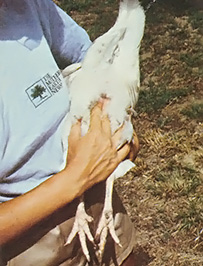
However, if all the visual
signs leave you stumped for an answer, here’s another telltale and
reliable method: Pick up your bird and gently palpate (examine by
touch) her vent area. If she’s laying, her abdomen will be soft and
pliable and the vent will be moist and enlarged. You should be able
to place two or three fingers between the hen’s pubic bones (on either
side of the vent) without any difficulty.
Conversely,
a nonlayer’s vent will be dry and contracted, and the space between the
pubic bones will be narrow. Cull such poor producers from your flock.
Hatching Your Own
Once you’ve got
the first year of chicken-raising under your belt, you may want to try
hatching eggs from your own poultry instead of purchasing another batch
of day-old chicks.
But, before you try
to set that first egg to hatch, be sure you understand the genetics
involved. Most of our modern chicken breeds are hybrids, and — as is the
case with many hybrid vegetable varieties — most are sterile.
Even
if you find — and use — a fertile hybrid breed, the parents will often
produce offspring at a lower rate than their ancestors did, and any
youngsters you do hatch will generally produce 10% fewer eggs — or 10%
less meat — than did their parents. In addition, each succeeding
generation will have a further 10% decrease in production.
Therefore,
the secret of successful hatching is knowing which breeds can be
hatched, or can be crossed with other breeds. A reliable hatchery will
be able to furnish this information. Or you can check with your
county extension agent or the nearest agricultural college.
When
you’ve figured out the genetics, select a good healthy rooster and turn
him loose with about 15 hens. As you collect the fertilized eggs in the
days to come, store them — pointed end down — in a cool, draft-free
area. (Nature allows a period of dormancy in eggs so that a hen can
collect a clutch together before she begins setting. This also
insures that all her brood hatches at the same time.)
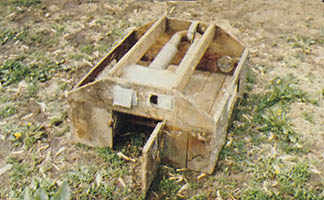
After
you have accumulated a nice clutch of eggs, place them in an incubator
for 21 days. (If you have a hen on hand that’s feeling broody, you might
get her to sit on the eggs instead.) It is very important to keep the
eggs at a constant temperature of 100°F since any chill will cause
the embryos to die. You’ll need to turn the eggs 180° twice daily.
The
air within the incubator needs to be kept moist … so it’s best to
have a jar cap filled with water inside the device at all times. Be
extra certain there’s lots of available moisture on hatching day, too,
because humidity helps the youngsters to “pip” their way through their
shells. Then, after the chicks emerge, let them dry off for a few hours
before moving them from the incubator to the brooder.






