

–Nevada Chief Smohalla’s reply to agricultural directives from Washington
In 1952, Richard St. Barbe Baker led a Sahara University expedition into the Libyan desert to visit once forested lands the Roman Empire had converted to grain production. As Mr. Baker observes, “An iron plow is a
dangerous implement, because it loosens the earth to a
considerable depth, allowing the soil to be washed away in
the first torrential downpour.” In equatorial regions,
especially, the clearing away of extensive areas for the
production of row crops, such as corn or cotton, leads to
certain disaster . . . even to the decline and fall of
otherwise thriving civilizations.
Actually there is only one remaining ancient
row-crop-based civilization: the Chinese. This fact rather
impressed a University of Wisconsin soil scientist. In 1910
Professor F.H. King determined to study firsthand the row
crop farming methods of the Chinese. His delightful travel
book, FARMERS OF FORTY CENTURIES, appeared the
following year. In it King describes the tilling,
fertilizing and planting techniques that have enabled
survival (and even improvements in soil structure and
fertility) throughout these many centuries. Even before his
trip to the Orient, maverick King found little acceptance
to his theories of minimum tillage . . . which he
pronounced in 1890. When he later gave credence to the use
of human excrement as a row crop fertilizer, his colleagues
discredited him completely. Professor King was perhaps the
foremost soil scientist of his time, and FARMERS OF
FORTY CENTURIES is the most important book on food
production . . . yet it is not even listed in the
Department of Agriculture’s bibliography of 500 important
books on soil management (SOILS AND MEN, Yearbook,
1938).
Chinese row crop production methods are not presented here
as the final word. Rather, their sensitive regard for
fertilizing, tillage, and planting
establishes a neat basis for discussing pre-modern and
post-modern row cropping techniques.
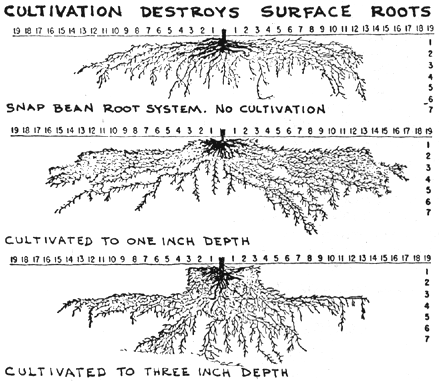
Traditionally, the Chinese till their row crops to a very
minor extent. Mainly, they broadcast legumes such as
soybeans or cereals among row crops . . . when the plants
reach a few inches tall they are worked into the soil with
a hoe. The Chinese realize that young green
manures are best for feeding microbe populations. Soil will
soon lose its crumb structure following the cultivation of
annual crops, and must be replenished by a system which
permits an accumulation in the soil of active humus capable
of cementing the soil into crumbs. Instinctively, the
Chinese had a concept of growing space which we
would do well to understand and appreciate . . . one might
call this space the humosphere, the vital, most
active upper-six-inches of the soil. It is in this zone
that 80% of the organic matter is concentrated. Antibiotics
are also produced in the humosphere by aerobiotic
microorganisms, and tillage buries and asphyxiates these
sensitive microbe populations.
There is also a substantial loss of nitrogen when the soil
is tilled. The tillage process suffocates organic matter
and at the same time introduces excessive oxidation into
the soil structure. Ordinarily the oxidation process is
slow . . . which allows the ammonium salts to produce an
intermediate ammonium nitrate stage before finally breaking
up into nitrogen and water. Ammonium nitrate is an unstable
(even explosive!) substance and readily
dissipated–wasted–to the atmosphere in
conditions of excessive oxidation.
Professor Yarwood, plant pathologist at University of
California, points out that the food production per unit
area of land increases 6,000 times as a result of tillage.
This is of course good news to agribusiness mentalities,
who select crops specifically for big yields. But big yield
production reduces the power of the plant to manufacture
protein. Also, big crop yields reduce the protection
against microbe and virus invasion. Yarwood mentions that
of 20 fungal pathogens, 12 were more severe on tilled
plants. Concurrent with increase in crop production since
1926, the number of recorded diseases of principal crops
increased threefold. Yarwood counted 659 different diseases
found in conventionally tilled crops, and 374 in untitled
“native” plants.
In a few years, perhaps the concept of “zero tillage” will
be more widely circulated throughout agricultural circles.
Major advancements are now coming from England and Germany,
for the development of new machinery and mulch-planting
techniques. At the agricultural university in the
Netherlands, a special “Tillage Department” has been formed
to do research on herbicides and non-soil-compactive
machinery. The Dutch reason that herbicides can very
readily replace tillage, as the traditional purpose of
plowing and cultivating is to eliminate competitive weed
growth.
Most of the significant progress in zero tillage has been
done during wartime . . . when power sources are low and
food requirements high. The Spanish-American War no doubt
influenced Professor King’s minimum tillage approach. At
the time of the First World War, Professor Hollack in
Germany published his no-plow arguments the same way that
Faulkner did in 1943 (PLOWMAN’S FOLLY). A
three-year research on minimum tillage was conducted during
the early years of World War II at Rothansted Agricultural
Station in England. And in Vienna, Viktor Schauberger made
his claims against the plow that is moved at a fast rate
through the soil. Electrical disturbances supposedly occur
which destroy essential trace elements. The
modern–peacetime–exponent of zero tillage is,
of course, Ruth Stout. As with Faulkner, none of her books
are even hinted at in scientific publications, due possibly
to the frivolity of her presentation.
Ruth Stout has successfully popularized mulch planting
among organic gardener circles. She also represents a
viable–though nonscientific–position against
the use of fertilizers and manures. Fertilization with
mineral nutrients (NPK) is of course responsible for
tremendous crop yields. But as Professor Yarwood reminds
us, increased crop yields bring increased disease. A
concentration of fertilizer is far less desirable than a
minimum balance of nutrients. Excessive quantities
of nitrogen, for instance, promote wilt disease by
providing better nourishment for the parasite.
The value of manure as a mulch is far greater than as a
fertilizer. The humus that manure supplies improves soil
structure by increasing its capacity to take in and hold
water. Soil moisture is retained by shading, the
evaporation is minimized, aeration increased and the
biological activities of microorganisms are augmented.
Professor King reports that the Chinese
manufacture their fertilizers in the form of earth
composts. Dwelling walls and floors and village walks are
periodically dug up and composted for use in their fields
and gardens. And, of course, the use of night soil is
common throughout the Orient.
Intensive row crop planting techniques developed by the
Chinese would be difficult to improve upon. They hold
advanced concepts of intercropping, successive planting,
rotation planting, and companion growing. Basically, the
Chinese believe that diversification is
fundamental. Different crops are grown together, to
permit the different root systems to thrive . . . the
shallow feeders, deep feeders and intermediate-level
feeders. Professor King noted that as many as three crops
occupy the same field in successive rows, all in different
stages of maturity. One field has a crop of winter wheat
nearly mature, a crop of beans about two-thirds mature and
a crop of cotton newly planted.
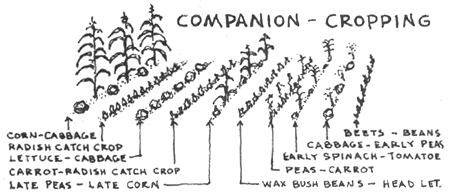
In some instances, intercropping is used when one crop is
grown and cleared off the ground before the main crop
requires the room to itself. Radishes or lettuce are often
intercropped with carrots . . . the latter being the main
crop. Endive can be sown three weeks prior to the main crop
of cauliflower. An early, or incidental, crop is often
referred to as a catch crop.
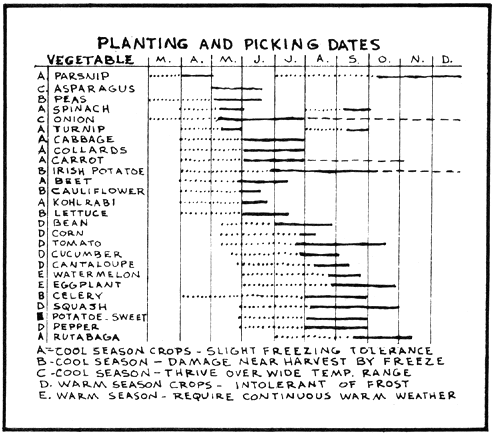
There are both “early” and “late” varieties of the
same species of crop. Early means the crop matures
in fewer days. And of course individual species of row
crops mature at different times. Cabbage, for instance,
requires 90 days where lettuce needs 50 days and radishes
only 30 days. Many combinations of early-late plantings have
been worked out: spring spinach followed by Brussels
sprouts, beans or tomatoes; late peas followed by a late
planting of corn; early peas followed by cabbage, tomatoes
or by a planting of strawberries for next year’s bed.
Chinese row crop production maintains a constant and even
growth. Crops are sown successively, so they ripen as they
are needed; and when a crop is harvested, another one is
transplanted to take its place . . . a plant is never
allowed to stop growing. The Chinese make good use of
nursery beds . . . where winter and spring crops can be
started a month or so earlier. Also, stronger and more
uniform plants can be grown in a controlled nursery bed
situation.
Rudolf-Steiner, founder of the bio-dynamic gardening
approach, maintained that permanent raised beds
increased the growth activity on their surface. His
esoteric arguments for raised beds are not clear to me, but
there are obvious practical advantages: such beds insure
maximum use of the planting space. The first principle of
intensive gardening is uniformity of space. Flats
and frames should be built to an interchangeable module, so
that they can be moved from any one part of the garden to
any other part when needed. A four-foot-wide module with
bed length of 16 feet seems to be the most practical size.
Paths have to be provided between the six-inch-high beds.
In medieval Europe, monks grew vegetables, herbs, flowers,
berries and fruit trees altogether, for mutual benefit. The
Chinese hold a near-religious sentiment against sameness
and uniformity. They feel that monoculture is a wrong row
crop gardening approach because pure stands are not found
in nature. Monoculture makes for an efficient
truck-gardening operation but it favors disease. The
greater the variety of planting, the less likelihood of
insect infestation buildup. Where a rich variety of plants
make up a biological community, that community has a better
chance of remaining stable. Crop rotation and crop
combinations are the best ways to achieve a balanced plant
community. It is based on variations in species . . .
plants of the cabbage family (cabbage, cauliflower,
broccoli, radish, turnip, etc.), for instance, should not
be grown in the same location.
Plants should also be grown relative to the root level they
occupy in the soil, as well as to the nutrient feeding
capacity of the plant itself. Heavy feeders like the
cabbage family, tomatoes and leafy vegetables should be
followed with light feeders like carrots and beets. An
ideal rotation might be: light feeder plants, selected from
the legume family–peas or beans–would prepare
the soil for following heavy feeder rotation. Bacterial
blight can be controlled by rotating peas and beans with
cabbage. Tomatoes and potatoes are both attacked by the
same organism, so they should never be grown in the same
location each year (biodynamic theories notwithstanding) as
the verticillium-wilt organism which attacks tomatoes is
carried over in the soil. The sugar beet nematode builds up
a dense population when beets are planted in the same
location for several consecutive years.
Row crop rotation principles should be extended to include
sod crops, cover crops and animal grazing. And during the
late summer dormancy periods, one would do well to
encourage a healthy crop of weeds. Domesticated
animals, as well as wild animals such as birds, frogs and
moles, should be allowed controlled access to the garden
and field crops. No better method of insect control exists.
Sir Albert Howard said that insect pests and plant disease
are mere indicators that farming methods are
wrong. Insects attack the weaker plants because the plants
are not suited to their environment . . . they are less
healthy in terms of their own internal protection against
microbial attack. And of course first causes of an
unhealthy plant can be traced to the unhealthy soil in
which it is grown. This fact is succinctly illustrated by
the Missouri Experiment Station:
With some of our most troublesome crop pests, there is
a direct relation between insect numbers and soil
fertility. The less fertility,the more insects.
Our experience and studies over the last several years have proved this. In other words, as we
over-crop, single-crop and permit the damage of
soil erosion, we grow more crops ofharmful
troublesome pests than we need to have.
Soil fertility is of course a prime consideration when
establishing a row crop garden location. A good rule is to
plant where weeds flourish. One should also consider wind
and frost protection, drainage and land slope, and degree
of available sunshine. Some plants, like tomatoes, will
thrive in one-half the normal sunshine. The dead shade of a
building is of course more harmful than the moving shade of
a tree.
Row crops should be located at a point immediately
accessible to the homestead cooking area. Experience in a
wide range of gardening situations have proven this to be a
very important factor . . . both from the standpoint of
occasional harvesting and occasional maintenance, home and
garden must be contiguous.
There are possibly a hundred published row crop garden
plans . . . each purporting to be the most optimum,
well-thought-out scheme. Actually it is impossible to
design a garden plan for someone else . . . site
conditions, regional climatic variations and personal food
tastes and dislikes are far too variable.
A few rules, however, may prove helpful. First, keep the
space as small as possible, relative to family
food need, available space and amount of time and help for
work. As an old adage has it, never plow up(!) more
space than your wife can take careof .
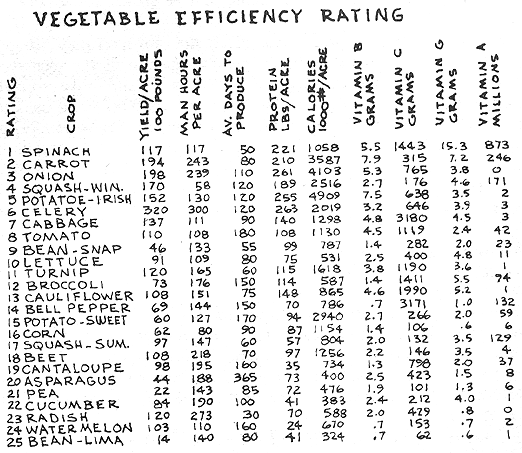
Second, grow plants of the very finest quality. Every
homestead family should make a row crop rating
chart, with each crop chosen on the basis of season,
adaptability to site, nutrition value, taste and growing
efficiency.
The Owner-Built Home, Chapter 5: Individual Living Space
Under the heading of individual living space is
included all private and personal recreational, sleeping,
bathing, and dressing activities. Again, in matters
personal, as with family arrangements, our concern here is
not so much with “room planning” as with the various
activities that are pursued. The manner in which
the planning procedure should operate is as follows: First,
list the various activities in their relative importance to
social, family, and personal life. Then assess the
conditions necessary for their pursuit in terms of space,
“atmosphere,” efficiency, comfort, furniture, and
equipment. Next group those activities that can be carried
on together, and those that cannot–in terms of place,
frequency, time, and sequence. In short, the determination
of living requirements is based on the threefold
relationship of Space (place), Equipment (facilities and
furniture), and Atmosphere (physiological aspects, control
of heat, noise, etc.). The successful determination of
these three conditions will naturally lead to a
Healthful Environment.
Health is man’s ultimate need, and as such should become
the criterion of housing design. A dearth of research
exists on this all-important subject. The most notable
instance of work in this field has been done, of course, in
the Pioneer Health Centre at Peckham (London)–from
1926 to 1951. Doctors at Peckham practiced
preventive medicine and treated the whole
person: disease in relation to living environment. Health
is possible, they discovered, only when movement and
flexibility are not impeded. In their building design they
considered free circulation, visibility, and the flow of
space into space–all vitally important components of
the healthy environment. Hallways were eliminated–as
the whole building should function as circulation space.
The central purpose of the Peckham Experiment was to study
function in healthy man. To realize his
full function man must live in a fully free
environment. The open-plan and New House design concepts go
far to achieve these ends.
A more detailed building design analysis of the functions
of family living was conducted in 1941 by the Pierce
Foundation. Interesting space and motion studies were made
as well as actual field studies of families in their homes.
Family habits, attitudes, and possessions were evaluated
and physiological and psychological housing requirements
determined.
All of which leads this writer to feel that the environment
where we spend more than one-third of our time is the most
neglected by designers and manufacturers. A person’s living
space should offer something more than what furniture can
be crammed into a 10 X 12 sleeping-room-box.
Our personal living space should first of all be
private. Everyone in the family at one time during
the day or night should be able to “get away from it all.”
It is therefore advisable to locate the personal living
quarters at some distance from the area for group living
activities. Besides complete separation of the two spaces,
we enjoy a contrasting architectural treatment: a sense of
change from group activity to individual activity. This is
the reason why a walk up a flight of stairs or down a long
passage to the individual living area has always held a
certain attraction to the space-sensitive person.
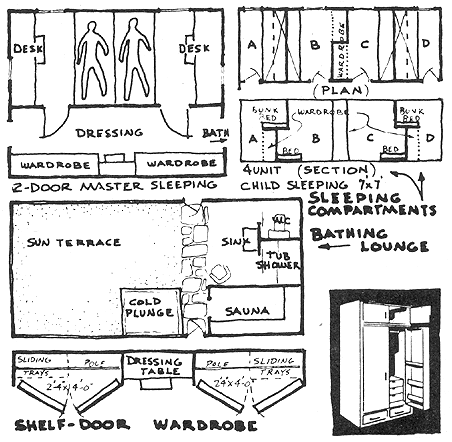
It is the bed and its activity-space that
determines the size of contemporary “bedrooms.” An area of
at least 10-feet by 10-feet is required to house a double
bed. A conventional 3-bedroom house has about 400 square
feet allocated to sleeping. This area can be reduced to
about one-half by enclosing the bed in an alcove or
compartment. This is not a new idea: Our European ancestors
used to sleep in cabinets in the Middle Ages: A modern
equivalent might be a compartment having controlled
lighting, heating, ventilation, and soundproofing. Sides and
ceiling of this compartment could be lined with reflective
panels to reflect body heat, thereby eliminating the need
of confining blankets. The circulation of warm air under
the floor would supply sufficient heat if the mattress were
placed at floor level.
There are numerous advantages of sleeping close to the
floor (besides the floor-heating possibilities). Asians
have, of course, exploited floor sleeping arrangements.
Comforters, folded and stored in a closet during the day,
replace the bulky, massive bedsteads used by Western man.
There is a general consensus among New House builders that
the bathroom should lose its identity as a separate room.
It was perhaps Le Corbusier who first broke down the strict
division between bedroom and bathroom when he (in 1929)
placed the bathroom in the same room as the
bedroom. He felt that the bathroom should be designed as a
luxurious adornment to whatever room it occupies.
A bathing lounge–complete with sauna, sun
terrace and cold plunge–is presented here as the
ideal bathing arrangement. Each personal living area should
have its private sink in conjunction with the dressing
area, and a private toilet in a separate cabinet. The
bathing lounge, then, might better function as a place of
group-living activity.
There is a current trend to place laundry functions in the
bathing area. This certainly makes more sense from a
compatibility standpoint than placing it in or near the
cooking area. Most laundry comes from the nearby sleeping
area (linen and soiled clothing) and is stored there. Of
all rooms in the house the bathing area is least likely to
be upset by laundering during the normal hours for that
operation. Plumbing, hot water, and room finishes (for high
humidity) are already available in bathing areas.
Much work needs to be done in designing more accessible and
ample storage facilities for the individual living area.
One should first of all list all the items to be stored.
These items should then be grouped according to most and
least frequent use. Items which require special provision
because of weight or size should be listed separately.
Detailed closet and cabinet storage units can then be
designed.
The usual closet has much area that is almost impossible to
use because the sliding, folding, or swinging door
arrangement hampers inside visibility. A recent improvement
in wardrobe design has been the shelf-door
wardrobe, which provides more convenient storage
space. Closet doors should open to the complete storage
facility. Customary drawer-faced cabinets conceal inside
contents, and require the opening of many drawers to find
an article. In self-door arrangements, sliding trays make
clothes hunting easier.
BIBLIOGRAPHY (books listed in order of
importance)
HOMES FOR TODAY AND TOMORROW: Great Britain
Ministry of Housing and Local Government, 1961
MEASURING SPACE AND MOTION: John Pierce
Foundation, Research Study 6.
THE PECKHAM EXPERIMENT: Pearse and Crocker, 1943.
The Owner-Built Home, Chapter 6: Cooking-Dining
In Chapter 4, Group Living Space, open planning
and flexibility concepts were discussed–concepts to
enhance and embellish space for esthetic appreciation.
Then, Individual Living Space design and structure
considerations stressed the need for a physically and
psychologically healthful space arrangement.
This present section on the design and structure of cooking
and dining functions likewise includes esthetic and
healthful considerations, but also some concepts that have
to do with human engineering, which is simply
engineering for human use. In our use of cooking
appliances, for instance, we design for optimum efficiency
(measured by the comfort, safety, accuracy, and speed of the
function to be performed). The house that holds the
appliances should be designed the same way. Many
“physiological work studies” have been developed in England
and in Scandinavian countries to better determine housing
needs. Designers in these countries have gone far to
engineer equipment to meet human requirements. Their
considerations take into account: (1) the psychological
aspects conditioned by tradition and social pattern; (2)
the physical aspects of solar orientation, view, indoor
climate, air circulation and sound insulation; and (3) the
human engineering considerations that have to do with a
person’s convenience arc, involving his or her height,
reach, motion pattern, and space needs.
Contrast this human engineering approach with our present
condition: a recent University of Illinois Small Homes
Council survey of over a hundred housing developments found
that 90% had inadequate base cabinet storage, 77% had too
few wall cabinets, and 67% had constricted counter space.
From the standpoint of human engineering there are five
requirements for an optimum cooking-work center: (1)
adequate activity space; (2) adequate counter space; (3)
adequate equipment space; (4) adequate storage space; (5)
an arrangement of all these areas for maximum efficiency.
Obviously, few home builders follow the necessary steps to
develop a truly efficient work center.
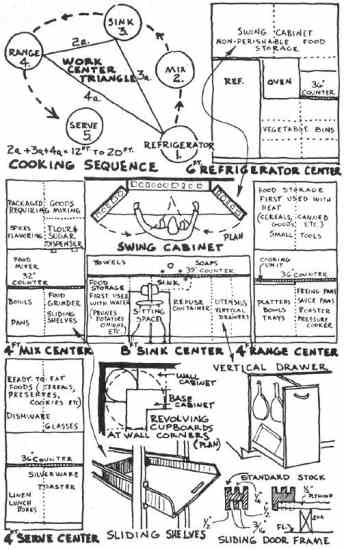
“Motions take time.” So, in designing a cooking layout the
first question is, “Where is the best location for what?”
In answering this we first must analyze the work to be
done. For a right-handed person the cooking sequence is from
right to left: Store, mix, sink, range, serve. For each of
these areas we next determine the equipment and supplies
needed. Pieces of equipment and supplies should be arranged
in order of sequence of activities required to do the job,
and at heights related to your body and its ability to use
them in that position. Cooking research at Cornell
University established a 12-foot to 20-foot relationship
between refrigerator, sink, and range. A continuous counter
would be convenient in some respects; but from a human
engineering standpoint the sink (for the modal American
adult) should be three inches higher than the standard
(36-inch) counter height, and the mixing center should be 4
inches lower (32 inches). A physical strain occurs when a
modal worker reaches into a storage cabinet lower than 20
inches from the floor or higher than 60 inches from the
floor. Strain also occurs when a negative (backward) angle
of bend is made by the body, while straightening up to
avoid being hit by an opening upper cabinet door. Sliding
doors are to be preferred. Sufficient floor space for
working in front of and passing between each element of the
work-center should be provided. Finally, planning should
consider such necessary features as light, acoustics, heat,
and ventilation.
The principal concept of New House cooking design is that
storage for each of the major cooking centers of activity
is provided at the point of first use. The major cooking
centers are sink, mix, range, refrigerator, oven, and
serve. Wall and base cabinets for each of these activity
centers should be the same length: about 4 feet for each
unit, except those for the sink, which should be about 8
feet long. A wall cabinet provides a good place for
indirect lighting (the light shining directly on the work
counter). The usual center ceiling fixture gives light
where it is least needed.
Much cabinet storage research has been done in recent
years. Perhaps the most noteworthy is the work done at
Cornell University. A type of “swing cabinet” is suggested.
This is a compact cabinet made of sections that swing open
like a book. Storage is one row deep, making each item easy
to see and grasp. Only the item wanted has to be lifted
out.
Door storage is a sensible method of storing small food
items, as well as small cooking utensils, spices, etc. Base
cabinets with the usual stationary shelves should be
avoided wherever possible. Shallow pull-out trays and
drawers give far better visibility and greater ease of
reaching contents. Heavy pots and pans are brought into
easy reach and full view by pulling a tray forward.
Vertical drawers are especially satisfactory below the
sink, where the often-used dishpan, dish drainer, and
brushes may be hung on hooks. A similar vertical drawer
beside the range is handy for pans and covers. Vertical
partitions or files can also be installed to advantage.
Articles stored in these files are within easy reach and
can be grasped readily. Overhead cabinets should have
sliding doors wherever possible. They do not offer as full
an exposure of contents as do swinging doors, but this
possible disadvantage can be overcome by using
glass-paneled doors.
A poorly designed cooking area costs as much to build as a
good one. The popular “Pullman,” or strip-type, cooking
area, for instance, has traffic objections and is too long
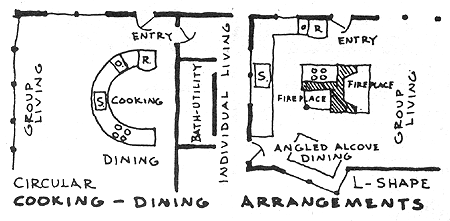
for convenient working. The L-shaped arrangement is better,
especially when the range is located at the corner, where
undisturbed cooking can be done. Probably the most
practical and efficient cooking arrangement is the U-shaped
plan. (A variation of the U shape–a circular cooking
arrangement–was found to require only 70 feet of
walking to prepare a meal; the same meal in an L-shaped
cooking area required 245 feet of walking.)
New House design concepts indicate a totally new and fresh
outlook on cooking-room arrangements. The traditional
window-over-sink, for instance, is now considered obsolete,
as so little time need be spent at the sink. Cooking space
is best lighted by clearstory or skylight, and the sink
should be located near the dining area. Eating space or the
mix center, however, might well utilize window exposure. In
a good plan the cooking area is convenient to the garage as
well as to the front entrance. Yet, entrances to the
cooking area should be grouped to minimize through traffic.
Another New House design tendency is to “open up” the
cooking area to form a sort of cooking-dining-family room
area. This single-space arrangement does not
isolate the housewife from the rest of the family or
visiting company. The formal dining room of the 1920’s has
now shrunk to dinette to alcove to nook. Actually, the
dining room can function better as a second group-living
area, with the dining table itself set in an angled alcove.
The dining table should be as close to food preparation as
possible. It is also desirable to locate the table close to
the sink for simplified cleanup. When food preparation and
cleanup are separated from dining, a utility cart can
become a useful device. The Cornell investigators designed
a neat cart that holds service for eight persons.
BIBLIOGRAPHY (books listed in order of
importance)
THE CORNELL KITCHEN:
Glen Beyer, Cornell University, 1952.
KITCHEN CUPBOARDS THAT SIMPLIFY STORAGE:
McCullough, Cornell Bulletin 703.
THE HOUSE: Agan & Luchsinger.
HUMAN ENGINEERING: McCormick, 1957.
MODERN KITCHENS: Sunset Magazine.






