


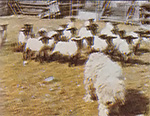
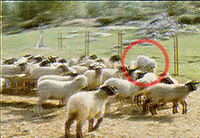
We’ve all heard the phrase “a wolf in sheep’s clothing,”
but not long ago I encountered a dog in sheep’s
clothing! The first time I saw a Komondor, I could scarcely
believe my eyes: The canine–which was covered with
long, white, matted hair–did look
remarkably like an overgrown ewe. In fact, as I watched it,
the animal even acted like a sheep: it moved
along quietly with the flock, keeping its head down in what
appeared to be a grazing position.
However, Komondors don’t for a moment imagine that they’re
sheep. Instead, as a result of centuries of breeding and
in-born instinct, the dogs guard “their” flocks
against predators. Since the breed’s introduction to North
America from its native Hungary just a few years back,
Komondor dogs have helped sheep ranchers in both Canada and the
United States to reduce–dramatically–losses to
marauding carnivores.
An “Old World” Solution
Predators probably pose the greatest single threat to a
sheep raiser’s livelihood. Wolves, coyotes, coydogs,
roaming domestic canines, and–in remoter
areas–even bears have been known to take a
devastating toll in the course of just one night’s attack
on a flock. Furthermore, if such slaughter continues
unchecked, predation can actually put a small-scale sheep
operation right out of business!
The traditional methods of dealing with the
problem–shooting, trapping, “denning” (killing newborn
coyote pups in the den), and using poisons or electric
fences–seem to be only marginally effective and in many cases have
deservedly received a lot of criticism.
Shooting and trapping are, at best, only temporary measures
because of the sheer impossibility of eliminating the bulk
of the predatory animals in a given area. Environmentalists for their part are concerned about the danger of poisons
to other forms of wildlife, and disapprove of the inhumane
practice of denning. Fencing can offer some protection
against predators, of course, but it’s doubtful whether
there exists a barrier strong enough and high enough to
repel a really determined invader.
In the face of such a dilemma, many sheep raisers have
rediscovered the traditional Old World method of protecting
flocks: guard dogs. Unlike the more common sheep-herding
breeds, guard canines don’t try to move their charges. They simply live with the flock 24 hours a day and
drive off any attackers that may approach. Middle European
shepherds have relied on the vigilant animals for centuries. Now some of the best breeds from Hungary, Yugoslavia,
Russia, Italy, and Turkey are now being imported for “trial
assignments” in this hemisphere. So far, one of the most
highly rated of the “immigrant” dogs is the
shaggy-coated Komondor.
A Case History
Canadians Tom and Joan Redpath are representative of the
modern shepherds who have happily “employed” Komondors as
protection for their flocks. The couple’s 300-acre farm,
located at the edge of the bush country about 50 miles
northwest of Ottawa, has been a full-time sheep-raising
concern for over three years. From their very first week of
operation, the Redpaths were faced with the problem of
stock being killed by packs of wild dogs and wolves.
Well, after hearing from other sheep farmers–folks who were
already satisfied guard dog owners–the Redpaths
acquired Pandy, a female Komondor. Once Pandy was put to
work, her owners were amazed–and delighted–to
find that the sheep slaughter immediately stopped. They haven’t lost a single member of their flock to
predators since the dog’s arrival.
How does the couple account for this “miraculous” turn of
events? It’s quite simple, Joan Redpath explains: “A
Komondor has a very strong protective instinct. It’ll
defend whatever livestock it’s with, as long as the animals
are inside its territory. In fact, the guard dogs have been
known to look after goats, horses, and even chickens.”
The Training Program
However, the dogs’ instinct alone isn’t enough to make them
good guardians. In fact, turning a puppy loose with
sheep and expecting it to guard them right away is inviting
disaster. An untrained (or improperly trained) Komondor
can–as a result of its size and speed–be a
danger to the flock, and even to its human masters. The
dogs have an acute sense of territory, you see, and a
strong urge to attack all intruders. If the puppy isn’t
allowed to become accustomed quite early to
living with its charges, it could view the sheep as
invaders.
Obviously, a thorough training program is crucial to the
development of an efficient guard dog. When the Redpaths
received their three-month-old pup, they immediately took
her to the barn to “introduce” her to the sheep, then left her there to eat and sleep with the flock. (Since
this bond between dog and sheep is so critical, some
breeders even encourage young pups to suckle nursing ewes.)
The next stage in a Komondor’s education is to develop and
refine the animal’s inherent territorial instinct. This is done by familiarizing the dog with the pasture
where it will work. Twice daily, for a number of weeks,
Joan walked Pandy around the boundary of the field.
Occasionally, Pandy was instructed to remain out in the
pasture while Joan returned to the house. In that
way, the animal gradually learned that her task was to stay
in the field with the sheep.
Another important aspect of the Komondor’s training is
socialization. When they’re mature, the dogs tend to be
somewhat aloof and suspicious of strangers, so it’s
important that a Komondor–from puppyhood–have
frequent contact with a variety of people. After all, you
don’t want a dog that will attack anything or anyone
happening to stray into its territory … including your
neighbors and friends! Therefore, a canine sentinel has to
be taught–by the example of the trainer–to
distinguish between friend and foe.
Although the Komondor is an intelligent creature and eager
to please the people it loves, there’ll be occasional
lapses or mistakes during the training process, and some
form of correction must be applied in such cases. Physical
punishment, however–hitting the dog on the muzzle,
for instance–is not recommended. Most Komondor owners
agree that this breed doesn’t respond well to such
conditioning, and may even turn on the trainer.
Fortunately, the Komondor–like most domesticated
animals–does respond readily to more subtle forms of
discipline. When they need to rebuke Pandy, the Redpaths
grasp her head firmly–just under the ears–and
shake it back and forth several times, while repeating
“No!” in a stern tone of voice. Once it has learned its
mission, however, a Komondor will be just about unsurpassed
in its ability to protect a flock. The dog will not
hesitate to react swiftly if it thinks the sheep are being
threatened, and its impressive speed (a Komondor can
easily outrun a coyote or wolf) and courage insure that the
canine guardian will almost always emerge as the victor in
a conflict with a marauding predator. Therefore, intruders
soon learn to be wary of crossing the invisible line that
separates the watchdog and its charges from the rest of the
world.
A Hungarian Beauty
An adult Komondor is a physically imposing dog: A
full-grown male will stand upward of 25 1/2 inches at the
shoulder, and can weigh as much as 120 pounds. However, in
my opinion, the Komondor’s coat is its most striking
feature. This is no street-variety “shaggy dog”! What might
appear (to the untrained eye) as unkempt mats of hair are
actually called “cords.” They have several
important functions. In addition to repelling rain and
snow, the dangling, furry “ropes” further protect the
animal by acting as a thick armor against the sharp teeth
of an attacker.
Maintaining that unusual coat is no easy matter, however.
The dogs are particularly difficult to bathe and dry, and
grooming, therefore, requires a lot of patience and
persistence on the part of the owner. Joan remembers one
especially arduous session with Pandy: Only after a
six-hour workover with a tangle splitter, brush, and comb
did the animal’s coat finally assume its characteristic
appearance of controlled disarray!
Satisfaction Guaranteed
Despite the extra effort involved in Komondor training and care, the Redpaths pronounce themselves
completely satisfied after the first three years with their
guard dog. Even though Pandy still occasionally leaves her
post to return to the house, she is doing her job in her
own way: The Redpath flock has remained unharmed since
Pandy’s arrival, while sheep farmers in the area who use
non-canine defense measures continue to suffer losses. “Many
a night,” says Joan, “I’ve been awakened from a dead sleep
to hear Pandy bulleting down the field, barking and keeping
the predators back.
“She’s worth the price of my entire flock,” Pandy’s owner
declares … and that’s a mighty good endorsement for the
Komondor!
EDITOR’S NOTE: While a Komondor can indeed be an amazingly
efficient “sheep patrol,” the dogs aren’t inexpensive:
Well-bred, registered Komondors start at $400. Nor are they
terribly easy to obtain; only about 30 registered
litters are produced in the U.S. each year. However, if
you’re interested in the breed, you can contact official Komondor organizations such as the
Komondor Club of America or the Mid Atlantic States Komondor Club for free information and a
list of breeders.






