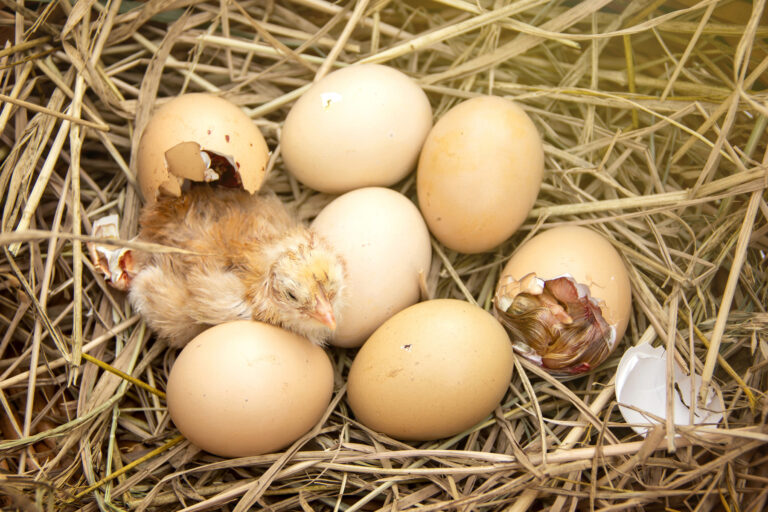
Though it may be hard to believe, spring is coming, and chick season with it. If you have never hatched your own chicks before, you might want to give it a go this year — and if you have hens that go broody, letting them sit and rear chicks the natural way may save you a whole lot of hassle in monitoring an incubator’s temperature and humidity. Neither will you need to provide a heating lamp later on. A good broody hen will have an excellent hatch rate and will care for the chicks, teach them to forage, protect them, and keep them warm.
Many guides advise letting a hen accumulate a clutch of eggs on which she will eventually sit, but this method has proven wasteful and ineffective to us. Though a hen may lay in the same spot and accumulate a clutch, there’s no guarantee she will actually go broody anytime. The eggs that are piling up in the nest may become spoiled or broken. Or the hen might try to cover too many eggs and the hatching rate won’t be that high. In the meantime, you’ll be wasting good eggs you could have used.
Here is a method we have been using successfully for several years:
- Collect all eggs every day. Discard any that are cracked, too dirty, or odd-shaped — those are not good for hatching and had better go into an omelet.
- Keep eggs that are meant for hatching in a cool, shady spot (not the refrigerator) and turn once a day. Maintain an ongoing rotation so that all the hatching eggs you have at any given time are not older than one week. Freshness will ensure best results. Eat any that had been laid over a week ago — it’s still much fresher than any store-bought egg.
- Place several dummy eggs in each nesting box. We have bought ours very cheaply in a toy store. You may also order a bunch online. This will make sure the broody instinct is not turned off by lack of eggs, though I have also seen hens sit on rocks or even over an empty spot.
- Keep an eye out for signs of broodiness. You’ll know easily with some practice: telltale clucking, feather puffing, and refusal to move from the nest even at night. Wait 24 hours until the broodiness is well established, then gently remove the dummy eggs and slip a few real eggs under your hen at night when she’s sleepy and less likely to be disturbed (or nip your finger). Make sure your hen can cover the clutch well — don’t give her too many eggs or the heat distribution will be uneven and some will fail to hatch.
- Provide access to food and water for the broody at all times, but don’t be distressed if she hardly seems to move from the nest at all. She might hop down briefly to eat, drink and poop once a day, and then go back to her eggs right away.
Happy hatching!
For more information on hatching chicks, visit:
- Chicken Egg Hatching Cycle
- How To Hatch Chicken Eggs With a Lightbulb
- Hatching Eggs in the Wintertime
Anna Twitto‘s academic background in nutrition made her care deeply about real food and seek ways to obtain it. Anna, her husband, and their four children live on the outskirts of a small town in northern Israel. They aim to grow and raise a significant part of their food by maintaining a vegetable garden, keeping a flock of backyard chickens and foraging.
All MOTHER EARTH NEWS community bloggers have agreed to follow our Blogging Guidelines, and they are responsible for the accuracy of their posts. To learn more about the author of this post, click on their byline link at the top of the page.