

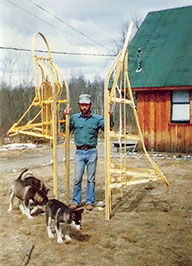

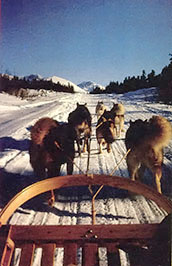
Here in Alaska, folks who need to travel in winter often end up “going to the dogs”… and loving it. After all, canine-powered snow-going is an enjoyable mode of transportation (dogs are a lot friendlier than are jeeps or snowmobiles), and dog sledding can be downright practical, besides. I often make 60 miles a day with my five-member team, for example, and also use dog sleds to haul lumber, groceries, firewood, and more out to my rural homestead.
If you live in an area that’s snowbound during part of the year, you can take advantage of dog power, too. You’ll have to secure good gear and beasts, and take the time to properly train your pullers, but you’ll find that the rewards of sleddin’ will be well worth the effort.
Choosing Your Work Dogs
Most people think that all sled dogs have to to be either Alaskan malamutes or Siberian huskies, but the fact is that Labrador retrivers, setters, Airedales, spaniels, and most other non-aggressive breeds make excellent pullers and are actually be suited to work in the milder climates of the lower 48 states than are their northern brothers. As a matter of fact, just about any Canis familiaris can be trained to pull and to pull well. I even know a fellow whose efficient running team consists of standard poodles!
Regardless of its breed, however, a good sled dog
must have an obedient temperament. Many fine teams
have been formed around a family pet whose devotion to its
owner sets a fine example for the others. Another character
trait to look for in a potential puller is an ability to
get along with its peers. Infighting simply cannot be
tolerated in a dog sled team.
When you set out to form a group of “tundra trekkers,”
you’ll obviously have to decide how many dogs to
get. I’ve seen impressive teams consisting of as many as 20
canines, but I’d suggest you start out with just three.
Many novice mushers (we Alaskans call such amateurs
cheechakos) quickly find that trying to handle and
train more than three dogs can be a most confusing and
at times frustrating task.
After you gain some experience, you’ll likely want to add
one or two more tail waggers to the team. Just be sure that
any untrained beasts undergo a five-day “getting
acquainted” period with the other dogs before you train them for harness. And remember: Never tolerate the
slightest show of aggressive behavior from those new
critters or, for that matter, from any of your
dogs. You will pay dearly if you let them get away with
such methods of “showing their enthusiasm”: As we say in
Alaska, vet bills are the medals of the cheechako!
Sleds and Sledges
Besides getting and training some dogs, you’ll need a sled
(or a “freight” sledge) and a set of harnesses and lines.
Commercially available sleds are pretty much standardized
(the classic “Alaskan gold rush model” is widely used) and
can be obtained through various equipment shops. An eight-foot snow runner makes the best
all-around sled for work and play, and can cost you
anywhere from $150 to $750. The wooden load luggers come in
two basic styles: The popular standard sled can–with the
help of three dogs–transport one person and five bags of
groceries, while the larger capacity freighter holds a
500-pound payload (not including the “musher”) but
does require a minimum of five strong dogs.
All store-bought sleds come “shoed” with some form
of plastic runner (the build-it-yourselfer will find that
less expensive sheet tin works almost as well) and all such
snow-contacting surfaces should be coated with a special
friction-fighting compound called P-Tex (available from
sledding equipment suppliers). The sleds are also equipped
with a brush bow–an expendable “front bumper”
(this piece of equipment will often get smashed in the
course of a season) that protects your sled from structural
damage when you meet up with the unusual but famous winter
tree that “pops up out of nowhere.”
The easy-to-build sledge (called a comitik by the
Eskimos) is an even better hauling device than is the
“classic” freighter sled. This flat slider consists of
little more than a platform attached to a set of runners,
and can be easily put together out of 2 X 8’s and plywood.
I’ve used my homebuilt comitik extensively and find it
perfect for hauling lumber and materials to remote cabin
sites.
Most ready-made sleds have a couple of hooked braking
devices, but the experienced dog sledder normally uses a
dragging foot and a verbal command to stop the vehicle. A
veteran musher won’t trust a brake hook to keep a harnessed
sled “parked” either, but instead trains the team
always to lie down when the dogs are not pulling. (The
cheechako will undoubtedly endure–at least once–the
unenviable experience of being left behind as his or her
team and sled disappear over a hill.)
Harness and Lines
Of course, well-trained dogs and a nicely built sled won’t
do you much good unless you have some means for “getting
the two together;” that is, some lines and harnesses.
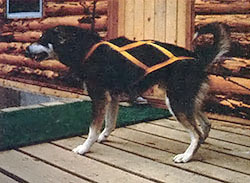
Each dog should have a properly fitting body yoke (these
are available for around $10 to $12 each from the same
firms that supply sleds). I use the versatile “fishback”
harness on my dogs, because it’s comfortable and well
suited to fast travel.
Your animals will also need strong collars so they can
be “staked out” on the dog lot. These “necklaces” also
secure the lines that keep your “sled steeds” parallel to
the central line. Let me emphasize, however, that a dog
should never be made to pull from his collar
alone! A “tail line” running from the back of the
harness to the central tow line should bear that stress.
Tail and neck ropes are usually 1/2′ thick, while the
central tow cord will have a 5/8″ diameter. All lines should be made from braided–not
twisted–nylon. Attachments can then be sewn through the
strands of such cord with a large plastic needle known as a
“fid.” So equipped, you’ll be able to make easy line
adjustments in the field without going through the finger
chilling hassle of untying frozen knots.
Train, Train, Train
Proper sled dog training takes a lot of time but is a
vitally important task. Start–one animal at a time–by
acquainting the beast with the feel of its tote gear. Treat
this harnessing act seriously so your critter won’t think
you’re playing around, then take the animal out for
a normal leash walk, hooking your line from the
back of the harness on your “return trip.”
Use subsequent walks to teach commands. Be consistent in
your choice of command words and the tone of voice you use.
Most dogs will quickly learn “HIKE” (or “MUSH” or “GET UP,”
if you prefer), “WHOA,” and “STAY.” But only the smartest
canines will respond to the turning commands, “GEE” (right)
and “HAW” (left).
The most obedient of your dogs should receive special
treatment (to develop “lead dog mentality”) and extensive
gee-haw training as well. Don’t choose the biggest, toughest
brute for your pack guide, but select instead the
quick-reflexed critter (often a female) that will follow
your commands without balking. A good leader is
indispensable for dog sledding, so spend a lot of time
training this animal. (Often, the foremost position is
shared by two critters. This arrangement is particularly
useful for training a second leader who could fill in
should your “main mastiff” become disabled.)
In a full “I set” the first two dogs behind the leader are
called “swing dogs” because of their ability to turn
the team. The pair of pullers just in front of the sled are
the “wheel dogs” and are usually the strongest canines in
the group. (Some dogs shy away from the wheel
position–and yours will if you’re not careful to keep
the sled from sliding into the critters–but it is a
nicely visible spot for training a newcomer.) Any
additional pullers are harnessed between the swing and
wheel pairs and known as team dogs.
On, You Huskies!
The actual amount of work you can get out of your dogs will
be determined by endless variables including the
animals’ experience and fitness, trail conditions, the size
of your load, the weather, and so forth. Most of the
dog-caused delays and difficulties (fighting, tangling,
etc.) will occur during training and, even then, probably
only take place within the first few miles on the trail.
My five “ace” dogs have often carried me over 60 miles in a
day, but it will probably take several months of training
and practice before your quintet can be expected to make
more than 40 (an average speed of six to seven miles per
hour is quite good for a team in its first season). I pace
my pullers on long trips by traveling at a
sustainable 8-10 MPH and giving the dogs a half-hour
rest after every two hours of work.
Most dogs enjoy being out on the trail and will give you
everything they’ve got, so don’t constantly berate your
pullers (only cheechakos yell commands just to hear
themselves talk). The dogs don’t like being shouted at
any more than you would. Oh, you’ll have an occasional,
obvious laggard, but good training will make physical
punishment unnecessary for most dogs. I never use or even
carry a whip. (Don’t hesitate, though, to get rid of the
“bad apple” who won’t respond after being given a fair
chance.)
If one of your dogs slows down considerably while on the
trail, you may have to “basket” the animal; that is, tie
it into the sled. (You should be prepared for this and
other minor mishaps by always carrying some spare short
cords and snaps.) If you do have to basket a
pooch, be sure to check its paws for cuts. In some
conditions–especially when you’re sledding over icy,
broken trails–it may be necessary to “boot” all your dogs.
Foot protectors can be made from denim and fastened in
place with masking tape. Keep an eye out for bad trail
conditions so you can boot your beasts before they begin to
limp!
There’re lots more sledding tips for a beginning musher to
learn, but most of them are either common sense or the kind
of knowledge that’s best picked up as you go along … so I
guess I should sign off now. However, I would like
to remind you of the most important rule for training and
working dogs: Never give a command that your pullers are
incapable of following, or one that you’re not prepared
to enforce! Follow this, and you’ll all have a doggone good
time!
Good mushing with your team! And by the way, if you’re
sledding out to the Nome gold fields sometime and happen to
pass through the Susitna Valley, stop in and say hello!
Dog Sledding Resources
Here are some sources of dog-sleddin’ hardware and
information:
LITERATURE
Mush: The Beginner’s Manual of SledDog Training edited by Bela
Levorsen, (Arner Publications) 250-page hard cover, $9.95 postpaid.
Training and RacingSledDogs by George Attla, (Arner
Publications) 205-page hard cover, $11.95
postpaid.
Racing AlaskanSledDogs (Alaska
Northwest Publishing Company), 133-page paperback.
$7.95.
CLUB






