

It’s 4A.M.in the deserted stable
area of a large thoroughbred race track. Except
for the monotonous drone of night insects and the
occasional trill of a waking bird, the area is silent.
Then, almost imperceptibly a slowly moving car and trailer
creep between the rows of horse stables. Shadowy figures
move from the trailer to the stables with full bags slung
otter their shoulders like summertime Santas.
Despite the early hours, the men described above actually
have an interesting and satisfying “down home” business
going for them. They’re delivering fresh-cut clover to the
owners of race horses . . . and a like operation can net
you $1,000-$3,000 for under 400 hours of summer work.
The “grass business”–as it was dubbed long ago — was
created in 1926 by my father-in-law, John Tienstra. Alone
or in partnership with others, he ran such an operation
each summer until 1965 . . . and every medium to large race
track in the country can support at least one similar
enterprise today.
The grass business is not for everybody. It entails ungodly
hours, hard work, threats from bumblebees and lightning
bolts . . . and little glory. Then again, if you like the
idea of being your own boss while you work in rhythm with
Mother Earth, the establishment of your own clover runs
might be just what you’re looking for. If there’s a race
track within a 50-mile radius of your home or homestead,
you’re sitting on a potential grass business . . . and that
potential is growing every year. At one time, prestige
racing (which means big money which means free-spending
owners) was mostly limited to thoroughbreds. Now that the
“big time” racing of standardbreds, Appaloosas, Arabians
and quarter horses is becoming more popular, however, the
demand for fresh-cut-and-delivered clover is showing a
corresponding increase.
The basic mechanics of the grass business are much like
those of a milk delivery route. Full bags of purple-topped
clover are dropped off at the stables each morning and
empty bags are picked up. Just as a good milkman makes his
rounds in the cool morning hours, so too does a good grass
man. Glover has a delicate nature and–once
cut–tends to wilt and sour in warm summer
temperatures.
How to Get Started
Your first step in setting up a grass route is easy: go to
the main office of a race track or tracks, ask for a permit
to deliver fresh feed and explain that you’ll be making
your rounds in the early morning. The track officials will
give you a pass and sticker for your vehicle. There may be
a slight charge for this permit but it’ll be worth it , . ,
the documents will allow you to travel within the stable
area unhampered by security personnel.
Once you’ve secured access to the track you’ll need a
source of fresh clover , . . and, since trainers and owners
are pretty particular about what they feed an expensive
horse, you’ll want to be sure your greens are at
least 75% purple-topped clover. Of course the foliage
should be free of insecticides. If you lease a field from a
farmer, emphasize that you’ll be selling the fresh feed to
horses and that you want absolutely no chemical fertilizers
or pesticides applied to the land.
Mr, Tienstra leased five acres of such clover near the
track he serviced. He only paid for what he actually
harvested and, depending on weather conditions, John
usually handled two cuttings of the fresh greens per acre
per season. His total expenditure was about $500 a year.
Needed Equipment
The equipment you’ll need is pretty simple and
straightforward: (A) a car in running condition, (B) twenty
or thirty 100 lb.-size burlap or cotton sacks obtained at
the track, from a feed mill or farmer, (C) a “German”
scythe, preferably with an aluminum handle and a pounded
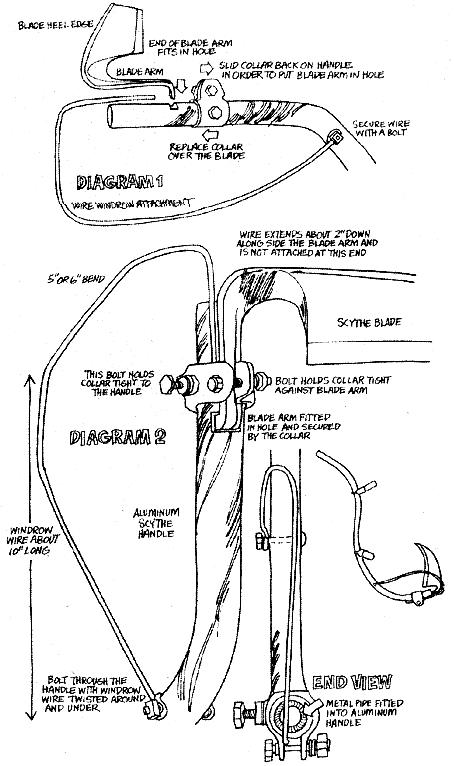
steel blade, (D) a handmade windrow attachment for the
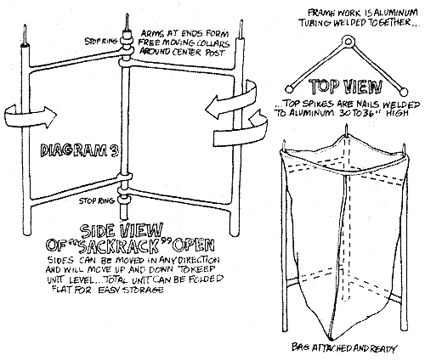
scythe, (E.) a homemade sack rack which enables one man to
bag clover quickly and efficiently and (F) a route book for
keeping daily records. Once you’re sure your new business
is going to pay off, you can invest in a flatbed trailer
and a trailer hitch for your car.
Familiarize yourself with the scythe before you make your
first grass run. It’ll take a little practice but the tool
has several advantage is over other forms of cutting
clover. First, it’s hand operated . . . eliminating even
the slightest possibility of noise or air pollution. By the
way, if you think that noise is a trivial concern, try
operating a Ford tractor and a cutting bar in an
otherwise-deserted clover field at four in the morning.
You’ll be amazed at the number of irate law officers you’ll
attract.
The second advantage a German scythe offers is its economy.
Most agricultural supply centers stock them for under $20.
Check the farm auctions in your area and you’re likely to
find one offered for as little as a dollar.
And finally, because a scythe is small and compact, it’ll
fit in the trunk of any car and is no problem to transport
or store.
John Tienstra preferred an aluminum handle–or snath–on his scythe. Such a lightweight snath is less
tiring to use . . , but aluminum scythe handles are
becoming increasingly hard to find and you may have to
settle for a wooden one.
The windrow attachment added to the scythe (see Diagrams 1
& 2) is a simple wire device designed to save a lot of
work. It “gathers” the cut greens as you make each swing
with the tool and “unloads” at the end of every swath as
you begin a backswing. In this way, the cut clover is
bunched into a windrow against uncut and still-standing
plants.
Each man works a scythe differently and there are few
“rules”. It is important to keep both feet flat on the
ground, however, and “shuffle” rather than stride forward
as you cut. Also–to avoid stabbing the ground with
the point of the cutting edge–the heel of the blade
must be kept on the ground with the tip pointing slightly
upward. Give yourself a few hours to work with your scythe.
When you’re skilled enough to cut a straight 20 foot swath
in foot-high grass, you’re probably ready to make your
first grass run.
Heading to the Track
Mr. Tienstra swears that early morning is the only suitable
time to make a run. Aside from the fact–mentioned
earlier–that clover is highly perishable, it’s only
before 5 A.M. that a race track’s stable area is clear of
horses and people. Soon after five, trainers and owners
start scurrying back and forth and stable boys begin
bringing the horses out for exercise. Finely bred race
horses are a nervous lot and they don’t take kindly to
strange cars and trailers creeping past their doors. It’s
better to be in, out and gone before the animals start
moving around.
The ground rules for your first trip to the
track–made to woo perspective clients–are a
little different, however. Since those clients won’t be up
and about before five, you’d better plan to reach each the
stables around 6 o’clock. Cut enough clover in advance to
titillate the horses and their owners (about 15 or 20
sacks) . . . then–preferably without car and
trailer–visit the horse barns with a bag of the dewy
fresh greenery slung nonchalantly over your shoulder.
It shouldn’t take much talking to convince the man in
charge of each mount that his horse is apt to feel better
and run faster if the animal’s diet is enhanced with a
portion of your fresh fodder, Then again, don’t be
discouraged if some of the track folks are wary and
suspicious at first. Racing has spawned a complicated
sub-culture which is sometimes difficult for an outsider to
penetrate. Underneath that seemingly tough exterior,
however, most successful owners and trainers are good
businessmen . . . who respect a straight operation and a
good product. Assure them that your clover is cut fresh
each morning (neither owners nor horses have any use for
day-old “specials”) and that you’ll deliver–rain or
shine–every day of the growing season. Tell them the
hour you plan to be at the stable each morning and when you
expect to collect your earnings. If you then deliver your
bills personally at the end of the month you’ll seldom have
problems collecting your fee.
Clover is a very rich food and should be administered to
horses sparingly, so your customers won’t want to buy much
more than one sack per day for every three horses in their
stable. For years Mr. Tienstra charged $1.00 a bag . . .
but prices have risen. Determine a fair price and stick to
it. No “special deals” to anyone.
Make Your Sales
After an hour of selling, break for a cup of coffee at the
track’s cafeteria. The brew may eat the enamel off your
teeth but you’ll find much morning business being
transacted at the tables. Watch and listen and you’ll
doubtlessly make the acquaintance of more owners and
trainers who’ll be interested in doing business with you.
After coffee, amble back to your rig (which you should have
taken pains to park in a highly visible spot) and busy
yourself with some of your equipment. If the car or trailer
is laden with bags of clover your activity will attract
attention and–hopefully–more customers.
That first morning at the track should be the last real
selling job you have to do. After you’ve contracted several
stables your best advertisement will be the word-of-mouth
that satisfied customers pass through the race track
grapevine. If you consistently deliver fresh clover at a
reasonable price you’ll likely have all the business you
want within a few weeks.
Working your Business
In the beginning you may well want to hold the operation
down to a one-man enterprise. As word of your service gets
around, though, you’re likely to be tempted to expand the
business in order to fill the increasing demand, Such
expansion is certainly possible, My father-in-law has made
his clover runs alone and with as many as three other men.
As long as everyone was working toward the same end, the
four-man operation was little more trouble to handle than
when John worked by himself. For sheer practicality,
however, a two-man partnership seems to be nearly ideal for
the grass business.
Two men can work harmoniously and effectively and balance
the work load (cutting the right amount of clover for the
number of bags needed at the track and getting the foliage
delivered to the correct stables) evenly.
In the field, one partner works as cutter and the other
bags the clover and stacks it in the car trunk or on the
trailer. As the cutter mows the first swath, the bagger
counts his sacks and lays them about six feet apart
alongside the windrowed clover. Then the second man walks
down the row, filling bags on the sack rack (Diagram 3) as
he goes. When the cutter has mowed enough of the foliage,
he may help finish filling and loading the clover.
At the track, one man drives the car and marks down
deliveries in a tally book as the other carries full bags
to the stalls and picks up the empties. Either
partner or both can collect the monthly payments . . . and
that’s about it.
If you give this business a try I recommend that you remain
as unobtrusive as possible when you make your deliveries.
Although the horses will be stabled when you’re there,
they’ll still be able to hear your vehicle. Service it
regularly and keep its muffler in good shape. Drive slowly
near the stables and limit your conversation to the inside
of the car. Fire is a constant threat to any barn and
smoking at the track is a bad idea. Bear them in mind that
the people you’re doing business with have invested a lot
of time and money (some of which you’re pocketing) in their
horses. Don’t blow, it. You’ve got a good thing going.
Good in more than just money… . . for this little grass
business has another dimension that can’t be measured in
dollars and cents. The men I’ve referred to in this article
haven’t delivered clover for over five years . . , but the
memory of their summer grass runs is still vivid to each of
them.
Perhaps it was the sleepy humor of those early trips to the
field (where a two-cell flashlight slipped under the
cutter’s belt was all the light needed or wanted) . . . or
the easy runs in to the track . . . or the mutual effort
needed to accomplish a physically demanding job. Maybe it
was just the basic desire that urban men have to feel dirt
on their hands and sweat on their brows as they braved
lightning bolts and bumblebees to reap the bounties of the
good earth. Whatever . . . it made the grass business an
unforgettable way to earn money.






