

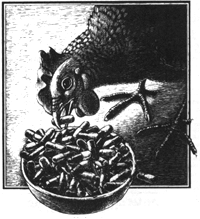
Antibiotics and the U.S. meat supply is an example of how modern agriculture is rushing us into an unintended but dangerous form of genetic engineering.
ANTIBIOTICS AND THE U.S. MEAT SUPPLY
Nowadays, it’s so simple and inexpensive to take an oral
dose of tetracycline or amoxicillin to fight off an
infection that most of us take antibiotics for granted. The
time may be rapidly approaching, however, when we’ll have
to learn what it’s like to do without these drugs . . . in
large part because of the way American agribusiness raises
meat!
UNDERSTANDING ANTIBIOTICS
To understand this bizarre connection, we’ll need to review
the nature of antibiotics themselves. Antibiotics are
chemicals derived from the toxins one microorganism
generates to fight off the assault of another.
Though we know that the Chinese used moldy bean curd to
treat carbuncles and boils several millennia ago, it wasn’t
until 1928 that Sir Alexander Fleming discovered that a
mold, penicillin, actually killed competing bacteria. When
penicillin was synthesized in useful, therapeutic
concentrations in 1941, many infectious diseases that had
been practically uncontrollable finally became treatable.
Between 1943 and 1960, the annual production of penicillin
soared–from 29 pounds to 860,000 pounds–and the
fatality rates associated with various diseases plummeted.
Truly, the description “wonder drugs” aptly reflected the
early success of antibiotics in treating disease. For the
first time, doctors had medicine that actually attacked the
cause of bacterial disease. However, not long after
antibiotics began to see widespread use, scientists
discovered an alarming trend. Some bacteria were developing
resistance to antibiotics . . . they were effectively
selecting for a stronger strain of microorganism! And these
resistant bacteria could run rampant when a constant
barrage of wonder drugs wiped out their nonresistant
competitors.
It was another decade, though, before the full effects of
bacterial resistance to antibiotics were felt. In 1968,
Shigella dysenteriae (a virulent strain of
dysentery) broke out in Guatemala and spread throughout
Central America over the course of three years. Doctors
assumed that they were dealing with amoebic dysentery when
the four antibiotics of choice–streptomycin,
tetracycline, chloramphenicol, and sulfonamide–had no
effect. By the time the real cause, resistant bacteria, was
discovered, tens of thousands had died.
HOW BACTERIA BECOME RESISTANT
Part of the reason that it took so long to recognize the
significance and extent of bacterial resistance to
antibiotics is that no one anticipated the means by which
resistance is passed from one cell to another. If resistant
strains developed only through the reproduction of strong
survivors and chromosomal mutation–as was initially
assumed–it would take a long time for large cultures
of resistant bacteria to develop.
Unfortunately, as Japanese researchers discovered in the
late 1950s and early 1960s, bacteria have a much more
efficient means of transmitting resistance. Dr. Tsutomo
Watanabe found that, in the case of some microbes, drug
resistance could be passed from one bacterium to another in
the form of R (resistance) plasmids, pieces of DNA not
directly linked to or affecting the chromosome. These
plasmids, which can number up to 2,000 per cell, are
directly transferred from cell to cell, through a
connection called a pilus, without otherwise affecting the
donor or recipient. Thus, instead of facing the extended
process of mutation (a probability of less than 1 in
10,000,000) and natural selection, resistance DNA can be
passed from one group of cells to another in a matter of
minutes. What’s more, the bacteria involved need not be of
the same species; for example, Escherichia coli (a
prevalent intestinal bacterium) readily becomes resistant
and transfers that resistance to salmonella or Shigella
dysenteriae.
CONCERN SPREADS
In the December 1967 issue of Scientific American,
Dr. Watanabe wrote, “Unless we put a halt to the prodigal
use of antibiotics and synthetic drugs, we may soon be
forced back into a pre-antibiotic era.” It was an outcry
that few heeded at the time. But by 1982, the
Lancet reported that 90% of Staphylococcus
aureus bacteria (which infect surgical incisions) were
resistant to penicillin and that 35% of E. coli
were resistant to ampicillin.
Though doctors and scientists don’t agree about the
severity of the problem, many physicians are now exercising
restraint in prescribing antibiotics. For example, the use
of antibiotics for cold and flu viruses, against which they
are entirely ineffective, has practically ended. Doctors
have recognized that antibiotics are a depletable resource
that needs to be saved for really serious health problems.
Meanwhile, new (and much more expensive) antibiotics are
under development to replace those that have become
ineffective. But trying to keep up with the expanding
inventory of resistant bacteria is a constant battle.
GENETIC ENGINEERING: ANTIBIOTICS AND LIVESTOCK
Unfortunately, even if all physicians exercised thorough
restraint in the use of antibiotics, there would still be a
tremendous influx of these substances into the environment.
Nearly half the volume of antibiotics produced in the U. S.
each year–about 15,000,000 pounds, worth almost
$250,000,000–is fed to animals. Penicillin,
tetracycline, and other such medications are routinely
mixed into the feed of the majority of livestock in this
country . . . not mainly to stave off disease but, instead,
in efforts to increase growth rates.
In 1949, Dr. Thomas Jukes–who then worked for Lederle
Laboratories, the company that discovered chlortetracycline
(Aureomycin)found that feeding the wastes from the
production of chlortetracycline to baby chickens increased
their growth rate by 10 to 20%. Continued research showed
that the effect was at least as pronounced on piglets and
calves. Companies such as American Cyanamid (the parent of
Lederle and the largest producer of veterinary
tetracycline) claim that giving doses of antibiotics well
below those that would be used to treat disease (a
procedure called subtherapeutic administration) can return
$3.00 in improved feed-conversion efficiency for every
dollar invested.
Dr. Jukes’ discovery did much to make a whole new sort of
farming possible. Antibiotics have made it more practical
to confine animals where they can be fed controlled doses
of commercial feeds, rather than allowing them to range.
And, because of the medicinal properties of the
antibiotics, animals can be kept in such crowded
conditions without serious outbreaks of disease.
Antibiotic-supplemented rations have made possible the
modern-day feedlot . . . an efficient method of raising
fowl, pigs, or cattle that has done much to make the small,
low-intensity family farm uneconomic.
At the same time, the volume of antibiotics and their
by-product, resistant bacteria, has burgeoned. According to
an Office of Technology Assessment report in 1979, 99% of
all poultry, 70% of beef cattle and veal, and 90% of swine
receive routine subtherapeutic doses of antibiotics. It’s
now nearly impossible to find livestock that don’t have
significant populations of resistant bacteria, whether or
not they’ve actually been fed antibiotics. The resistant
strains quickly pass from one animal to another in
confinement and have even been reported to mysteriously
travel several hundred yards between pens.
THE ANIMAL-HUMAN LINK
Those groups opposed to, and those in favor of,
subtherapeutic use of antibiotics in livestock spent most
of the 1960s and ’70s arguing about whether resistant
bacteria developed in animal populations could be
transferred to and infect humans. Today it’s fairly clear
that this does happen, but there’s still much argument
about how widespread the problem is.
Most bacteria present in cattle, for example, don’t seem to
do well in humans . . . each species has its own set of
microorganisms well adapted to their particular
environment. An exception, however, is the genus
Salmonella, with its ten common species. In
England, a rash of 305 cases of Salmonella
typhimurium in the ’60s and early ’70s–an
outbreak that resulted in the deaths of two adults and a
child–led that country to ban subtherapeutic use of
antibiotics. In 1976, there was a Salmonella
heidelberg outbreak in Connecticut. The bacteria were
found in calves, then in the farmer who kept the calves,
then in his pregnant daughter, then in his daughter’s baby
three days after birth, and finally in other babies kept in
the same hospital nursery. At the time, it wasn’t possible
to prove the existence of a direct path for the salmonella
from the calves to the babies in the nursery, but the
circumstantial evidence was very strong.
The most heralded example of salmonella transfer from
livestock to humans–the one that seems finally to
have proven the link to most scientists’
satisfaction–occurred two years ago but has only
recently received much publicity. A Minnesota couple became
seriously ill after taking penicillin for a cold and were
found to be infected by a resistant strain of
Salmonella newport. A Centers for Disease Control
researcher, Dr. Scott Holmberg, was brought in and used a
new technique called genetic fingerprinting to track the
salmonella to hamburger, back through a supermarket, and
finally to a South Dakota farm where a herd of cattle was
being fed subtherapeutic doses of chlortetracycline.
Dr. Holmberg eventually traced the same strain of
Salmonella newport to 18 other people in four
states. Eleven had been hospitalized, and one had died.
Most of the infected people had handled the meat from the
farm before it was cooked. Salmonella are killed by
heat–as yet, there’s little evidence that eating
cooked meat from livestock raised on antibiotics is in
itself unhealthy–but the bacteria are so
virulent that they were able to enter the bodies of the
people who had prepared or otherwise come in contact with
the raw meat. What’s more, 12 of the 18 had been taking
penicillin or other antibiotics for cold symptoms.
After 25 years of effort, the mechanisms that had long been
suspected were established: Antibiotics fed to animals had
created a resistant strain of bacteria for which the
fatality rate in humans was 21 times higher than for non
resistant strains . . . and antibiotics taken directly by
the people had cleared the way for the disease-causing
microorganisms.
THE OVERRIDING CONCERN
As alarming as it is that diseases made resistant by
antibiotics can be transferred from animals to people, that
threat to human health may be small compared with the
possibility–indeed, the likelihood–that
antibiotics are gradually becoming ineffective treatments
for many diseases as resistance is transferred from one
type of bacteria to another.
When England banned subtherapeutic use of antibiotics, the
decision was based in part on a study showing that while
30% of Salmonella typhimurium were resistant in
1963, fully 73% had become resistant by 1979. A more
alarming fact is that even if animals are fed only one
antibiotic, their bacterial cultures may develop resistance
to a variety of other antibiotics at the same time. Today
in the U.S. approximately 25% of the salmonella infections
in humans are resistant to drugs.
It may be that the overprescribing of antibiotics for
people bears a similar responsibility for the development
of resistant strains of bacteria, but the fact remains that
the use of antibiotics in animals certainly adds
to the problem. Though most of the bacteria that inhabit a
cow’s intestinal tract are different from those that live
in humans, there’s no distinguishable difference between
the carriers of resistance: the R plasmids. Even though E.
coli from cattle may be expelled by humans within a day,
these able carriers of resistance can work numerous
transfers during their stay. The routes of travel are
mind-boggling, and the bacteria’s persistence is
remarkable. Some of us may bear a bigger burden of R
plasmids than others, but it’s safe to say that nearly all
of us have some . . . and that the number is increasing.
REGULATORY STONEWALL
North American countries stand practically alone among
developed nations in allowing the indiscriminate use of
antibiotics in animals. Czechoslovakia, Denmark, England,
the Netherlands, Norway, Sweden, and West Germany all
require veterinary prescriptions for animal antibiotics. In
the U.S., however, the director of the FDA’s Center for
Veterinary Medicine, Lester M. Crawford, has been
unsuccessfully pursuing a ban on subtherapeutic use of
antibiotics since 1977. It seems that each year since 1979
the House of Representatives Appropriations Committee has
written a clause into the FDA budget which specifically
prohibited the agency from restricting antibiotic use in
animals until further research was completed!
The last of the research work requested, a study of food
poisoning in Seattle from poultry that was fed antibiotics,
was finished early this year. There now seems to be little
question that routinely feeding antibiotics to animals
presents a threat to human health. The remaining question
is, What exerts more pressure in Congress–corporate
pharmaceutical and farming interests, or a cry of public
outrage? Let Representative Jamie Whitten, Chairman, House
Appropriations Committee, Washington,
DC, know what you think.
As of July 1, 1985, the FDA had taken no direct action to
restrict the subtherapeutic use of antibiotics in
livestock. However, two bills have been introduced in
Congress. H.R. 616 would prohibit the use of antibiotics
that increase the resistance of pathogenic bacteria. H.R.
2379 would restrict the importation of meat from
antibiotic-treated animals.






