Evidence continues to accumulate that our industrial food system is not serving us well when it comes to the nutrient value of food. True, American agribusiness has given us one of the cheapest food supplies in the world, but science reveals this food is “cheap” in more ways than one. Here are some of the things we know at this point:
- Over the last 50 years, the amounts of protein, calcium, phosphorus, iron, riboflavin and vitamin C in conventionally grown fresh fruits and vegetables have declined significantly. We know this thanks to rigorous analysis of USDA nutrient data by biochemist Donald Davis of the University of Texas. Similar trends have been discovered in the United Kingdom.
- Wheat grown 100 years ago had twice as much protein as modern varieties.
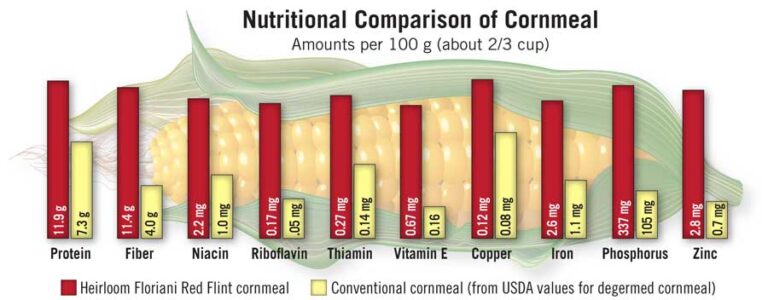
- Major declines in protein and several other nutrients have been documented in modern corn varieties (see the chart).
Davis lists the following causes for declines in the nutrient value of food:
Environmental Dilution Effects. Scientists have known for years that high rates of fertilizer and irrigation use can lead to higher yields, but sometimes at the expense of nutrient density of the crops. Nitrogen in particular is difficult to manage in the soil, and when farmers apply too much it causes plants to take up more water, resulting in high yields but giving us foods that have lower nutrient density.
Genetic Dilution Effects. As plant breeders develop “improved” varieties that give farmers ever higher yields, they are inadvertently causing food nutrient values to decline. Consider calcium in broccoli: Widely grown varieties in 1950 had about 13 mg/g of calcium, but today’s varieties provide only about 4.4 mg/g of calcium.
Similar declines are also being documented in meat, eggs and dairy products. Compared with industrial products, foods from animals raised on pasture are consistently richer in vitamins A, D and E, beta-carotene and beneficial fatty acids.
Prominent biochemist Bruce Ames argues that many Americans are not getting enough essential vitamins and minerals, and that the health consequences of these dietary deficiencies — increased cancer and accelerated aging — should be taken far more seriously than other problems such as pesticide residues in our food. In his paper, “Increasing Longevity by Tuning Up Metabolism,” Ames points out that the quarter of Americans who eat the fewest fruits and vegetables have twice the cancer risk of the quarter that eats the most.
For a great list of ways you can get food with better nutrient value and still not break your budget, see Senior Associate Editor Tabitha Alterman’s article Cut Cost, Not Quality: How to Afford Better Food.