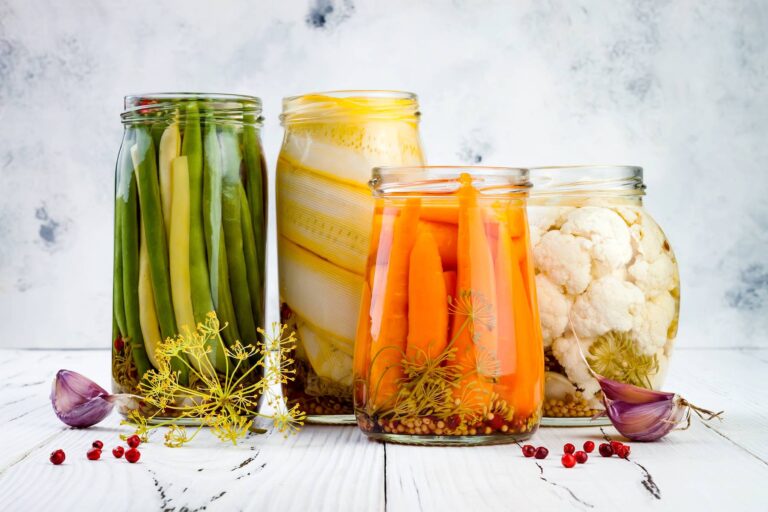
Explore pickling food preservation techniques to capture the riches of seasonal foods to last throughout the year.
I am not an enthusiastic cucumber pickle eater. I pretty much like two kinds: bread-and-butter pickles made into a relish to eat with hamburgers and hot dogs and little sour cornichons to eat with pâté. However, there are many dishes I eat that call for vinegar, as in sausages with cauliflower, and so there was a certain logic in preparing pickled cauliflower: Having it on hand meant that instead of adding vinegar when cooking the sausages and then blanching the cauliflower and adding it as well, I could simply dump the contents of my jar over the browned sausage and be done. So, besides the pleasure of preserving a food when it is cheap and seasonal — and there is nothing more tempting than a fresh, tight, white head of cauliflower and little more disappointing than watching it brown over the course of a week in the fridge — I have the added satisfaction of knowing all I need to make dinner is to pick up a pound or two of fresh sausages and a bunch of fresh parsley to prepare a delicious (and quick) meal.
What is pickling? Pickling is the process of preserving foods in a high-acid solution, either by adding vinegar or naturally by means of fermentation. Spoilers cannot grow in a high-acid environment. This state of high acidity is achieved in two ways: by means of salt and with vinegar (though when you pickle with vinegar, you add salt as well).
Pickling With Salt
Pickling with salt falls into two categories: dry salt and brined. The dry salt method combines dry salt with vegetables in quantities above what you would add for seasoning purposes. Liquid (watery juices) is pulled from the vegetables, and this liquid combines with the salt to create a brine — a salty, watery solution. With the premade brine method, a vegetable is placed in a combination of salt and water. In both cases, the vegetables are covered in brine for a prescribed amount of time. In this submerged, airless state (below the brine line), the vegetables ferment. Fermentation is the process by which the natural bacteria in the foods convert the sugars into lactic acid. Lactic acid is a natural preservative. Depending on its strength, microorganisms will not grow in lactic acid because of its low pH (high acidity). As a result, low-acid foods such as cabbage can be canned safely in a water bath canner and stored on the shelf for up to a year after fermentation is complete. Lactic acid also supplies that yummy sour taste — hence the name sauerkraut.
Pickling With Vinegar
Pickling with vinegar is a much quicker process. In vinegar pickling, the vegetable does not ferment. Usually, the vegetable rests for a short time in a brine (to add crispness and flavor), is drained, often brought to a boil in a vinegar solution, packed into jars, covered in the remaining hot vinegar solution, and water bath canned for long-term preservation. The acetic acid in vinegar brings up the acidity of the vegetable to a point where no microorganisms can thrive. Acetic acid, by the way, is flavorless and colorless. When a recipe calls for vinegar that is 5 percent acid, that means the vinegar is 5 percent acetic acid.

When making pickled foods, it is critical that you use very fresh ingredients. If you start out to make sauerkraut with an old, soft cabbage, your end product will be mushy. Basically, crisp into the brining pot means crisp out of the brining pot. (And this is true of all preserving: Don’t put up foods that are on their way out. Preserving is not a way to postpone eating something that has been aging in your refrigerator. Rather, preserving is capturing a food’s optimum freshness in time.)
The only ingredients necessary to pickling are the food you are planning to pickle, either salt or vinegar or a combination, and water. Salt is key, and it matters which kind you use. Use pickling or canning salt or kosher salt. Pickling salt (sometimes called canning and pickling salt) is pure granulated salt. It is free of anticaking agents, which can cause the pickling liquid to turn cloudy. Table salt with iodide (iodized salt) is not a good choice. It won’t hurt you, but it will undermine the appearance of your pickles, as the additives do not dissolve completely. I often use kosher salt because it just tastes saltier to me. However, kosher salt has large crystals, which do not dissolve as quickly as pickling salt. When making a premade brine, you have to either heat kosher salt and water together to ensure the salt is totally dissolved or combine the salt and water together in a bowl and swish it around until all the crystals are dissolved. Another factor regarding kosher salt is volume. The large crystals of kosher salt take up less space in your measuring spoon than the smaller pickling salt crystals.
Sea salt is produced by the evaporation of salt water. It comes in fine and coarse -textures and a variety of colors. The problem with pickling with sea salt is consistency. Because it is an unregulated product, you just don’t know what minerals are in there or how they are going to affect your pickling. Disregarding the fact that it is expensive, sea salt is not the best choice for pickling. Rather, on the occasions when I indulge myself with one of those lovely jars of pink sea salt, I use it to garnish foods.
Water is also important. During fermentation, hard water (mineral-rich water) and heavily chlorinated water can interfere with the formation of lactic acid. You can tell you have hard water if it stains the toilet and heavily chlorinated water if it smells like a swimming pool. In this case, you have two options: Either buy distilled water, or bring your tap water to a boil for 15 minutes, cover, and then let it sit for 24 hours. You will detect a scum on top and sediment on the bottom. Skim off the scum and pour the water into another container, leaving the sediment behind. However, if your water is good to drink, it is good to pickle with.
And finally, vinegar. Again, it’s all about that 5 percent acidity. I use Heinz distilled white vinegar, cider vinegar and white wine vinegar. Distilled white vinegar is made from grain alcohol. It is clear, pungent and flavorless. Because of its clarity, distilled white vinegar is preferred when appearance matters, especially when pickling pale vegetables. Cider vinegar is distilled from hard cider (fermented apple juice). It has a light golden color and a softly tart taste. It is milder than distilled white vinegar but causes the vegetables to darken somewhat. White wine vinegar is my favorite, probably owing as much to my Italian heritage as anything else. The taste is fruity and strong.
Other ingredients you will encounter in pickling are sugar (white and brown), herbs, spices and garlic. Of these, unrefined sugar is fine to use if you prefer it. Fresh herbs should be just that. Don’t use fresh herbs that are browning or slimy. Spices should be fresh, too. It’s a shame they are so expensive, because the fact is, after a year you should chuck your spices out, as they diminish in flavor. (Just sniff. If you can’t smell anything, the spice or dried herb is finito.) You should use aged, cured garlic. While very fresh garlic is a delight to eat, it will discolor during pickling. Garlic that has cured at room temperature for two to three weeks is best (and that is primarily what you get at the supermarket).
I don’t use firming agents (to crisp up vegetables), but for the record, there are two: lime and alum. Lime is calcium hydroxide. Obviously it must be the food-grade product and not that used for agriculture, which is not meant for consumption. In Le Marche, where my dad is from, the large green olive called the Uliva d’Ascoli is cured in lime. Highly prized by the ancient Romans, it is an incredibly sweet, mild olive that the locals peel like an orange and stuff with a meatball mixture and then fry.
Alum is potassium aluminum phosphate or ammonium aluminum sulfate. I know of some canners who lay a grape leaf in the bottom of their jars to firm up their fermented pickles, but I am not one for adding anything to a recipe that I don’t have to.
What Kind of Equipment Do I Need?
For dry salt fermenting, the most important item is a 1-gallon stoneware, glass or food-grade plastic crock. I bought mine — a ceramic crock — at a gourmet kitchen supply store. It has 1/2-inch-thick walls. I think it was being sold more for decorative purposes — and indeed, I store kitchen utensils in it when I am not using it for fermenting. You’ll need a glass, stainless steel or ceramic bowl for brining. Avoid all metal bowls besides stainless steel, as salt and vinegar can react negatively to them. You should also use stainless steel pots for heating vinegar solutions. Do not use aluminum, copper, brass, galvanized steel or iron pots for fermenting or heating pickling liquids.
When brining foods, such as cabbage, you must be sure the food stays submerged in the brine. A simple way to accomplish this is to place a food-grade, resealable bag filled with extra brine (the salt and water solution) directly atop the food. It is heavy enough to keep the vegetables below the liquid, and if you spring a leak, it’s no problem, because only brine will dribble into your crock.
To process jars, you just need a water bath canning setup.
The Basic Steps for Pickling
These are: brining (which draws water and air out of the vegetables), packing in jars, in some recipes covering with a hot vinegar solution, and in many recipes water bath processing.
Store pickled foods as you would other home-canned products: in a cool, dark place. Pickles should age for about 8 weeks to set the flavor.
I always cheat and open mine early.

Reprinted from Well-Preserved by Eugenia Bone. Copyright May 12, 2009. Published by Clarkson Potter, a division of Random House Inc.