
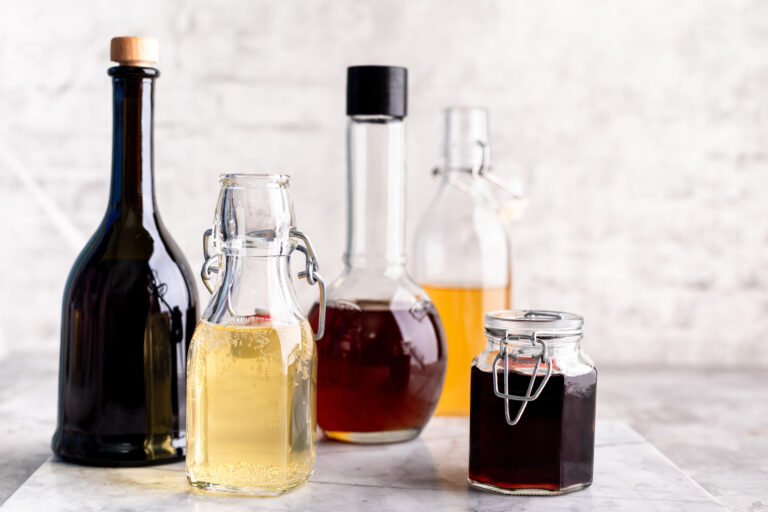
How is vinegar made? If you’ve wondered how to make vinegar at home, you’ll find everything you need to know right here. Homemade vinegar lets you control quality at every step of the process.
In Ruhlman’s Twenty, food writer Michael Ruhlman asserts that acid is second only to salt for elevating the flavors of your cooking. Just a few drops of acid in the form of citrus or vinegar can make a dish more complex — “brighter,” as Ruhlman says. To explore the power of acid, he suggests making a cream of broccoli soup and tasting it. Then stir in a drop of white wine vinegar and taste it again.
Ruhlman says the kind of vinegar you have doesn’t matter as much as the quality, and one way to ensure high-quality vinegars is to make and age them yourself. The DIY approach also saves money, as top-notch vinegars are pricey.
The options for using homemade vinegar are nearly endless. To make a simple sauce for meat or vegetables, bring vinegar to a rapid boil and reduce by about half. Add vinegar to braising liquids to tenderize meats. Vinegar also preserves foods — think dill pickles. And, of course, vinegar has many uses outside the kitchen.

What Is Vinegar?
The French word vinaigre means “sour wine.” In Wild Fermentation, author and fermentation expert Sandor Katz writes that his experience with vinegar-making began as winemaking gone awry. “Vinegar is an excellent consolation for your winemaking failure,” he writes. (To avoid getting vinegar instead of wine, you should store your vinegar-making projects far away from your homebrew batches.)
If a liquid has fermentable sugars or alcohol in it, the liquid can be turned into vinegar. Wine makes wine vinegar, cider makes cider vinegar and beer makes malt vinegar. Your kitchen is well-stocked if you have wine, cider, and possibly malt and sherry vinegars.

How is Vinegar Made?
When alcohol is exposed to oxygen, it is transformed by aerobic (oxygen-loving) acetobacter bacteria into acetic acid, more commonly known as vinegar. The ubiquitous acetobacter bacteria in the air find the alcohol in loosely covered wine, cider or beer and go to work. Katz says the simplest method — albeit sometimes faulty — to make both alcohol and vinegar is to let unpasteurized apple cider sit for a week until it becomes alcoholic, and then let it sit for another couple of weeks until it becomes vinegar.
What to Do with Mother of Vinegar?
To ensure your fermentation creates flavorful vinegar, however, use a “mother of vinegar.” The mother is a gelatinous mass of vinegar-making organisms that forms naturally in vinegar. You can order a starter of live vinegar containing particles that will clump together and form a mother during fermentation. Add the starter (or mother) to a new batch of alcohol — wine, cider or beer — and leave it there until the vinegar tastes right to you, at which point you may remove the mother and use it for a new batch.

How to Make Vinegar at Home: Step-by-Step Process
- Gather your vessel. Because acetobacter bacteria need oxygen to work, a wide-mouth crock, glass jar, food-grade plastic bucket, bowl, wooden cask or other non-metal container is best (vinegar corrodes metal). Do not fill the container more than about half-full to maximize the surface area ratio.
- Gather your starter. You can get a mother of vinegar from a friend who makes vinegar. Or, order a starter from wine and beer supply shops or online.
- Gather your ingredients. To make wine vinegar, you want 1 part starter (or mother), 1 part unchlorinated water and 2 parts alcoholic beverage. Use unsulfited organic alcohols if possible, because sulfites kill acetobacter bacteria. If your wine contains sulfites, let the mixture sit for a half-hour. (If your water is chlorinated, boil it first and let it cool, or let the water sit out on the counter overnight.) For cider and beer vinegars, omit the water. Add alcohol and water, if using, to your vessel. Stir. Pour in the starter (or gently add the mother).
- Cover the top. Place cloth or a few layers of cheesecloth over the container and secure with a rubber band.
- Store the vessel. Set the vinegar pot where the temperature stays between 65 and 90 degrees Fahrenheit. Keep the container out of sunlight and drafts.
- Monitor the vinegar. Over time, the mother on top of the vinegar will become thicker. It may develop a brownish cast, which is fine. If you see mold or smell a paint-thinner aroma, toss the batch. (This is rare.)
- Taste the vinegar. After a couple of weeks, sample a spoonful of the vinegar. Simply remove or lift the mother out of the way. It’s OK if the mother sinks. If the liquid tastes like vinegar, it’s ready. You may want to leave it to ferment longer for a stronger flavor. In warm temperatures, vinegar may be finished in two weeks. In cold temperatures, it may take a month or more — it’s OK to let it go longer. Vinegar is stable for a long time, though it will begin to lose its potency in time.
- Draw off your finished vinegar. Pour the liquid through a strainer. Decant almost all of it to a clean glass jar with a narrow neck and a top with a tight-fitting lid or new cork to reduce further oxidation. The vinegar will continue to age and mellow in the bottle.
- Save the mother. Put the mother back into the fermenting vessel and pour remaining vinegar over it. This is the mother of vinegar for your next batch. You can either start a new batch now or let your mother sit at room temperature for up to a month until you’re ready to use it again. If you plan to share the mother, now is the time to split it.
- Age the vinegar. Store the vinegar at 50 to 60 degrees for six months to mellow and let particles settle. The vinegar will improve for up to two years, then slowly decline. Use the vinegar as is, dilute it to your taste, or infuse it with herbs or other flavors.

To give the infused vinegar as a gift, add fresh flavoring ingredients so their colors are fresh and bright.
Want to learn more about vinegar? Read How to Make Infused Vinegar.
Want to learn how Vinegar can save your garden and lawn from carsogenic weed killers? Read Horticultural Vinegar for Weed Control, Part 1.
Frequently Asked Questions
What is vinegar made of?
When alcohol is exposed to oxygen, it is transformed by aerobic (oxygen-loving) acetobacter bacteria into acetic acid, more commonly known as vinegar. The ubiquitous acetobacter bacteria in the air find the alcohol in loosely covered wine, cider or beer and go to work.
What to do with mother of vinegar?
To ensure your fermentation creates flavorful vinegar, however, use a “mother of vinegar.” The mother is a gelatinous mass of vinegar-making organisms that forms naturally in vinegar. You can order a starter of live vinegar containing particles that will clump together and form a mother during fermentation. Add the starter (or mother) to a new batch of alcohol — wine, cider or beer — and leave it there until the vinegar tastes right to you, at which point you may remove the mother and use it for a new batch.







