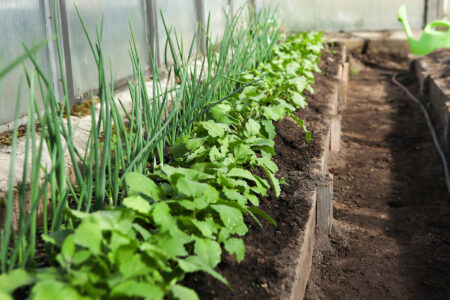
Protect your plants from the elements in early spring. Learn about the best methods used to protect plants in the garden.
Protect Plants From Wind, Rains and Frost in the Garden
The urge to knead the soil with our hands and tools, to
coax and nurse life from the earth, has been fueled by
months spent scanning seed catalogs. We’re spring’s
impatient gardeners anxious to get growing.
March winds won’t hear of it. They dry out transplants like
laundry on the clothesline. They chill and tear tender
stems and roots.
Then April rains drown plants, cool and compact the ground,
bruise seedlings, and wash out seedbeds.
And, in a final holding action, May frosts pass their cold
judgment on early gardening hopes. In one still night, they
fell seedlings that represent weeks of nurturing.
Spring gardening is back yard gambling: The sooner we act,
the worse our chances. But while no gardener can eliminate
bad weather, everyone can take steps, large and small, that
will protect plants and greatly reduce the misfortune that foul wind, rain,
and cold bring.
The Right Gardening Site
Let’s start with the biggest-and primary–decision:
where you put your garden. Location is one of the most
important factors affecting a plot’s weather resistance.
Buildings, slopes, bodies of water, and surrounding
vegetation can alter weather patterns so much that you may
have several different microclimates on your property-or
even within your garden. It may actually be worthwhile to
move an existing garden if doing so would dramatically
decrease the energy you expend confronting the elements.
Consider slopes. Generally speaking, the crest of a hill is
the windiest spot on it, and both water and cold air flow
downhill and accumulate at the bottom. The hillside itself,
then, is a better location than either the top or the
bottom.
Of course, a southern slope is best. It gets more sun than
most and is protected from cold north winds. A westerly
exposure heats up later in the morning than a direct
southern one, thawing frozen plants more slowly and
reducing possible damage. It also reaches higher overall
temperatures than an eastern exposure-which makes an east
or southeast spot better suited to heat-sensitive plants in
summer. Since northern slopes receive the least sunlight,
many people use them to raise fruit trees; the postponed
spring there retards early blooms that might get wiped out
by a late frost.
Buildings create microclimates of their own. The south side
of a home offers shelter from north winds, absorbs solar
energy during the day, and slowly releases that warmth at
night. So a permanent bed along the south wall is a great
place for your earliest starts.
Lakes and ponds reflect heat and light to plants grown
nearby, but they also allow an unobstructed pathway for
winds.
Garden Walls and Fences
Once you’ve picked the best site, consider building fences
to provide protection from the wind-an idea so old that the
very word garden comes from the Middle English
gardin, or “enclosure.” Remember: Wind increases
cold damage (and dehydration in dry weather) as well as
inflicting direct punishment. Reducing its effects is
essential to early-season growing.
Use a fence with slats or an open weave–such as a
picket, panel, woven wattle, or bamboo fence (even burlap
stretched over chicken wire). It’ll allow some airflow and
provide better wind protection than a solid wall. (An
unbroken barrier creates extra turbulence in its wake–(see Figure 1 in the image gallery)–while a somewhat permeable one slows wind speed
without creating extra currents.) A density of 50% is
ideal.
Living Curtains
Shelterbelts consist of one or more rows of trees
and shrubs arranged to offer wind protection, while tightly
grown walls of shrubs alone are known as
hedgerows. Both these “living curtains” (a literal
translation of the Japanese term for hedgerows) offer
erosion control, privacy, snowdrift protection, wildlife
habitat, food, bee forage, and ornamental value, but their
chief value is wind shelter.
A shelterbelt of trees should be perpendicular to the
prevailing winds. In most areas, this would mean along the
north and west borders. You may have different needs-for
instance, you may want protection from hot southern summer
winds. Whatever, be careful not to situate a windbreak
below a sloping garden, or you’ll trap a pocket of
cold air that would normally move on by.
Two or three rows of trees should make an adequate–and
still somewhat permeable–shelterbelt (see Figure 2 in the image gallery).
Evergreens are the most popular choices, since they provide
year-round protection, but deciduous trees lose only
40% of their effectiveness when bare. Plant shrubs on
the windward (upwind) side to protect young trees and to
fill in the gaps below mature ones.
You might want to plant deciduous trees on the windward
side of your evergreens. They generally mature faster and
can be cut for lumber or firewood once the evergreens grow
up. Windbreak trees should be planted fairly close together
so the branches will just touch when mature to form a
living canopy. Evergreens are commonly spaced from five to
15 feet apart, deciduous trees from five to 20 feet–but you
can plant them more closely at first and thin them as they
grow. (Your local soil conservation service or county
extension agent should be able to give you specific species
and spacing information for your area and soil type.)
Many shrubs provide beauty or food as well as shelter. Some
good choices are Rosa rugosa (rose hips),
high-bush cranberry, eastern sand cherry, lilac, Russian
olive, autumn olive, filberts, holly, tree honeysuckle,
forsythia, and rose of Sharon.
Diverting Run-off
Once you’ve done all you can to gardin your
garden, it’s time to provide internal protection. If
surface run-of from spring rains washes into your plot, dig
a horseshoe-shaped or three-sided moat around the top and
sides. Notice we said moat, not ditch. A narrow, steep
ditch would deepen with time, washing much of its own soil
away. A moat, on the other hand, is a wide trench with a
gradual slope on its uphill (outer) side and a sharper one
on the garden side (see Figure 3 in the image gallery). When planted with a thick sod,
this moat will resist its own erosion as well as protect
your garden.
Suppose your problem isn’t surface runoff, but groundwater
that turns part of your plot swampy during wet spells. In
this case, you’ll have to dig a trench, one foot wide and
two to three feet deep, running from the morass to an area
out below your plot. (If you have more than one wet spot,
you can build a series of trenches that run into a main one
like tributaries feeding into a river.) Put five inches of
clean three-quarter-inch gravel in the trench. Lay a
four-inch-diameter drainpipe (capped at its top) on this
and cover with soil. The drainpipe can consist of either
sections of unglazed clay tiles or corrugated black plastic
pipe with precut drain slots.
If your trench-drained water doesn’t flow into a natural
waterway, you should build a sump: a four-foot by four-foot
pit that’s three feet deep (see Figure 4 in the image gallery). Line its bottom with a
one-foot layer of fist-sized stones or brick pieces. Then
give it another foot of clean three-quarter-inch gravel,
and cover the area with topsoil.
Terracing
The basis of many ancient agricultural systems (and still
in wide use today), terracing is the art of constructing
strips of growing area that run horizontally along a slope,
contoured to the natural curve of the land. Terraces
make it possible to garden on a slope–even a very steep
one–with little danger of erosion. The heat stored by the
terrace wall above each strip can also provide some thermal
protection for the crops below.
Permanent walls of stone (the best heat retainer), timber,
or (if the slope is gradual enough) sod banks are all good
for terraces. In all cases, never leave any of the garden
soil bare and exposed to erosion. Replant or mulch an area
as soon as it is harvested, grow cover crops in the
off-seasons, and mulch between widely spaced plants.
Raised Beds
As our listing of weatherproofing methods moves from large
scale to small, it also moves from landscaping techniques
to gardening methods. Raised beds incorporate elements of
both. The long, three- to four-foot-wide mounds warm more
quickly and drain better than flat garden soil. If you use
the close plant spacing most often recommended for raised
beds–planting on hexagonal centers rather than in
straight rows–much less of your garden space will be wasted
on erodible pathways. The plants themselves will also form
a continuous canopy of leaves as they mature, and this
“living mulch” will hold warmth close to the soil surface,
help block wind erosion, and buffer rainfall.
You’ll be better off if you prepare your early-spring
growing beds the previous fall.
That way you won’t have to wait for the soil to dry out
when mud month rolls around, but can plant when you like.
(We know this advice comes too late to help this spring,
but next time around ….)
Garden Mulch
A thick layer of mulch-straw, leaves, wood chips, or other
dead plant material laid on your garden-will definitely
protect your plot from rain-caused erosion. But this
insulating layer can also keep your soil from warming up
quickly as well, so don’t mulch heavily where you want to
grow super-early spring crops. Still, a light mulch over a
seedbed will cushion the scattering force of pounding
raindrops, and a medium-depth mulch can prevent soil
splatter on seedlings.
Cover Cropping
Cover cropping-growing plants to cover idle soil-sharply
reduces wind and water damage. It also improves soil tilth,
increases organic matter in your plot, and helps the soil
retain nutrients. Hardy, fall-planted species such as hairy
vetch, winter rye, and fava beans will help spring plots
the most. Such cover crops can even help dry an
early-season garden by drawing excess moisture out of the
ground. (For more information, see “Green Manure Crops” by
John Jeavons and Bill Bruneau, MOTHER EARTH NEWS NO. 101.)
Individual Plant Protectors
Once you’ve done all you can to make your entire plot less
vulnerable to nature’s attacks, you can turn your attention
to protecting individual plants or beds. The portable aids
we’ll talk about here all buffer wind, cold, and rain well
enough to make a significant difference in how well your
crops weather bad weather.
The highly successful French market gardeners of the early
twentieth century used bell-shaped glass jars called
cloches (the French word for “bell”) to protect
their early crops. Nowadays, most people use plastic milk
jugs for the job. Just cut off the containers’ bottoms and
put one over each plant you want to shelter. The miniature
hothouses are free, durable, and-equally important-easy to
ventilate on sunny days (just unscrew the cap). If you live
in a windy area, be sure to tie them to stakes.
You can also buy or construct cone-shaped plant protectors
made of plastic or fiberglass. One such product, the Wall
0′ Water, has 18-inch-high, water-filled walls that absorb
heat by day and release it at night. Old black tires can be
used to shelter and warm seedlings-they work best with
space-hungry vining crops like tomatoes and squash. And if
you grow your tomato plants in welded wire cages, you can
wrap those supports with clear polyethylene during the
fickle-weather weeks. Anchor them well with stakes. You can
also add fiberglass or scrap-wood “lids,” but remember to
remove them on warm days to avoid overheating.
Garden Bed Protectors
Many times it’s easier to protect an entire garden bed than
to shelter individual plants. While you can make whole-bed
cloches out of glass plates or old windowpanes, such
structures are heavy and fragile. Portable garden tents are
now available that use lightweight polyethylene or
fiberglass sheeting. (Or build your own: Just make a
framework out of wood or PVC, and cover it.)
You can also take a large piece of fiberglass sheeting,
bend it into an inverted U, and secure its shape by placing
wire crosspieces across the bottom. (Cover the ends with
scrap fiberglass or plywood.)
All these bed protectors are wide enough to cover a garden
bed, but they’re not very long. Tunnel cloches made of six-
or eight-mil polyethylene laid over a series of hoops (see Figure 5 in the image gallery) can easily be made any length you’d ever need. Make the
support frames from eight- or nine-gauge wire, PVC (set on
rebar stakes), reinforced wire mesh, spring steel, and even
smooth, supple branches. For the covering, use hardware
store polyethylene–or special pre-slit poly for better
ventilation. Weight the material carefully at the sides and
ends with soil, rocks, or lumber, and be sure to open it up
as often as necessary to prevent overheating and
dampness-induced plant diseases.
Since plastic is not a good insulator, tunnel cloches offer
only a few degrees of direct frost protection.
(You might want to throw some blankets over your cloche on
extremely chilly nights.) But they block wind chilling and
dehydration and–most especially–help warm the earth. This
increases microorganism activity and nutrient availability,
as well as helping plants get through cold spells. The
cloches fend of invading birds and insects, too. And the
poly can be replaced by a shading material in summer to
cool heat sensitive crops.
There are other ways to warm spring soil, as well. You can
lay black plastic on a bed and poke holes in it for
individual transplants. (That mulch will eliminate a lot of
weeding problems, too.) You can even try “polarization”:
covering a future bed with clear plastic for a few weeks.
(Seal the edges tightly.) Tests have shown that this
dramatically prewarms soil and even kills some young weeds,
yet does not damage most beneficial soil microorganisms.
The newest space-age bed cover is spunbond polyester or
polypropylene. (Reemay is a popular brand.) Light and rain
easily penetrate this white, porous fabric. And it’s so
lightweight it can be laid loosely right on top of the
plants it protects (the ends and sides weighted in place by
soil) and then get pushed up by the crops as they grow (see Figure 6 in the image gallery). Like plastic, the “floating bed cover” doesn’t
provide much direct frost protection. But the enhanced,
sheltered environment it creates can extend either end of
the gardening season by a few weeks.
Since the material breathes well, you don’t need to
ventilate the bed often. And spunbond covers make excellent
insect barriers. (Want to be sure those flea beetles don’t
get on your eggplants?) Indeed, some gardeners use the
materials solely for this purpose. On the negative side,
you can’t weed under a floating bed cover-you have to take
it off. You also need to remove it when plants need wind-
or insect-pollination.
The creative grower will experiment with all these
garden-protecting tactics, or better yet, combine them.
Cover a bed with both spunbond material and a poly tunnel
cloche to get double frost protection. Lay black plastic as
a mulch under your spunbond cover to eliminate that weeding
problem. Put both black plastic and old tires out on your
pumpkin patch and you can start long-season vines weeks
earlier than normal. Build a tunnel cloche against a stone
terraced bed, and trap the heat those rocks give off.
Change the Odds in Your Garden
You can’t make your garden invulnerable to the assaults of
spring storms, gales, and frosts, but you’ll be pleased by
how well the plot-protecting tactics we’ve mentioned do
work. Let’s put it this way: Springtime gardening will
always be a gamble–who would really want it any other
way?–but you don’t have to just set out your plants and
take your chances.
You can tilt the odds in your garden’s favor.
GARDEN SOURCES
Spunbond Row Cover
Gardeners Supply Co.
Johnny’s Selected Seeds
Mellinger’s
Natural Gardening Research Center
Pinetree Garden Seeds
Polyethylene
A.M. Leonard, Inc.
Mellinger’s
Pre-slit Polyethylene
Gardeners Supply Co.
Johnny’s Selected Seeds
Mellinger’s
Industrial Grade Plastic (for portable
growing frames)
Mellinger’s
Windbreak Netting
Gardeners Supply Co.
Poly Tape (for use on garden
plastics)
A.M. Leonard, Inc.
Bulk Burlap
Mellinger’s
Wall O’ Water
Henry Field and Co.
Gardeners Supply Co.
Peaceful Valley Farm Supply
Pinetree Garden Seeds
Hotcaps
Burpee Seed Co.
Farmer’s Seed & Nursery
Harris Seeds
Mellinger’s
Portable Cold Frames
Burpee Seed Co.
Gardeners Supply Co.
Geo. W. Park Seed Co., Inc.
Peaceful Valley Farm Supply