Learn about heirloom melon varieties, as well as how to grow and prepare them.
Heirloom Vegetable Gardening by William Woys Weaver is the culmination of some thirty years of first-hand knowledge of growing, tasting and cooking with heirloom vegetables. A staunch supporter of organic gardening techniques, Will Weaver has grown every one of the featured 280 varieties of vegetables, and he walks the novice gardener through the basics of planting, growing and seed saving. Sprinkled throughout the gardening advice are old-fashioned recipes — such as Parsnip Cake, Artichoke Pie and Pepper Wine — that highlight the flavor of these vegetables. The following excerpt on heirloom melon varieties was taken from chapter 22, “Melons.”
Check out our collection of articles on growing and harvesting heirloom vegetables in Gardening With Heirloom Vegetables.
A Brief History of Heirloom Melon Varieties
The Egyptians were among the earliest peoples to cultivate melons, and they have left good documentation in the form of tomb paintings and actual archaeological specimens. What they raised was the so-called chate melon (Cucumis melo var. chate), a melon with a cucumber-like fruit. During the Roman period, the cultivation of melons spread to nearly all regions of the Roman Empire where climate conditions were favorable. Unfortunately, Roman melon varieties have proved elusive even from written documentation, because without names beside pictures, we have no real idea what they were like. The same is true of medieval sources and botanical works of the Renaissance, for melons were often equated with cucumbers and watermelons and, even later, confused with New World squash.
It is known that the Armenian Cucumber (a true melon) and the cantaloupe were introduced into Italy from Armenia in the 1400s. Green-fleshed melons similar to the Nutmeg Melon appear in Italian, Spanish, and French paintings in the 1500s, but there do not seem to have been distinct commercial varieties as we now know them. Mostly, melons were grouped according to the place where they were grown regardless of similarities or differences, as in the case of the Cavaillon melons in France. Constant crossing probably blurred varietal distinctions much as it did with fava beans, and since melons can deteriorate quickly if seed purity is not properly maintained, there seems to have been an active trade in seed from well-known melon-producing areas on both sides of the Mediterranean. This is certainly evident in the names of the melons first grown in this country, for Philadelphia seedsman Bernard M’Mahon, who listed thirteen melon varieties in 1806, offered seed from Minorca, Malta, Portugal, and North Africa. It is obvious that this seed was traveling across the Atlantic in company with wines, lemons, capers, and other culinary products from those areas.
There is not much written on melon culture in the eighteenth century, although a useful little tract written by Abbé Vilin under the title Traité de la culture du melon appeared at Amiens in 1774. It is practical for its insights into melon propagation of that period, the use of hotbeds and cloches, pruning vines for better productivity, and other hands-on considerations. Unfortunately, it is exceedingly rare, and the good abbé’s focus was not on the range of melon varieties then available. As a result, he did not include a list, which would have been helpful to horticultural historians today, especially since very few seed catalogs survive from that era. In fact, Vilin had been attacked in print by a satirist in one of those convoluted kitchen garden controversies that only Frenchmen can puff out to the limits of learned indignation. Preoccupation with those polemics imposed itself on his pamphlet, which served as his response.
The only other sources on melons, at least for the old French heirloom varieties still available, is volume 6 of Abbé Rozier’s Cours complet d’agriculture (1785, 472-89) and M. Jacquin’s Monographie complète du melon (1832). Rozier discussed many early varieties, their names, and peculiarities of cultivation based primarily on the writings of Descombes. Much of what is now known about the origins of many old French melons was preserved by Descombes, who may be relied upon as much for his facts as for his fantasies. The most scientific work, however, was Jacquin’s, which attempted to organize the melons botanically, describe them in minute detail, and most valuable of all, illustrate them in engravings.
Perhaps more apropos to the American situation is John William Lloyd’s Muskmelon Production (1928), a market gardener’s handbook written by a professor at the University of Illinois.

Lloyd’s emphasis was directed toward melon varieties of commercial importance, particularly melons that ship well, a trait that has little relation to kitchen gardening. His overview of the development of such well-known melons as Netted Gem and Rocky Ford can provide a useful perspective, but the lack of garden varieties is glaring. In the monograph scries The Vegetables of New York: The Cucurbits (1937), considerable attention was given to melons, but with the honest observation that their early history was murky. Documentation for the early varieties imported into this country exists in the form of seed lists and garden accounts, yet pictorial evidence is often lacking, so we have only guesswork in most cases when it comes to reconstructing what some of those melons were like. One of the exceptions is the Anne Arundel Melon of eighteenth-century Maryland, for which there is ample documentation in the paintings of Philadelphia artist Raphaelle Peale. It is interesting that the authors of the 1937 monograph presumed the Anne Arundel Melon to be an improved strain of Acme or Baltimore Market, introduced in the 1890s. Based on unreliable claims in seed catalogs, that might seem to be the case. More important, it highlights the lack of careful research that went into the work and leaves us wondering today how much of it can be relied upon.
It is evident from eighteenth-century accounts that melons were indeed raised in our kitchen gardens and that they were extremely popular with the Indians. Seed traveled quickly into the backcountry, to such an extent that melons appeared long before white settlers. Even to this day there are melons associated with certain Native American groups, especially in the West, and these melons have been cultivated so long that they have evolved into distinct varieties. Many of these descend from the three most popular muskmelons grown by early American gardeners, the Citron Melon, the Nutmeg Melon, and Murray’s Pineapple Melon. All of these historical varieties are still available today.
Growing Melons
Unfortunately, melons are so dependent on soil and hot weather for their best qualities that it is often difficult to grow them outside the regions in which they were developed. It is pointless to try and raise melons in potato country, although Montreal Market might offer a solution for gardeners in cool

summer regions. I have tried to make some suggestions in this regard with each of the heirlooms I have selected. Personally, by trial and error, I have found that in my garden it is baking hot, sandy soil that has the best effect on melons. Therefore, I have a bed in which I have mixed a large quantity of sand, situated in the sunniest, most exposed part of my garden. Without it my melons fail, or they are so miserable in size and flavor that it is hardly worth the effort to grow them. It is also useful to have a cold frame to get the melon plants well on their way before setting them out in the spring. If the plants are started in pots, so much the better, because their roots will not be disturbed when moved to the garden. I allow six plants to a hill. But getting them into production by mid-June is the secret to success, because most of us have only a 30-to-60-day window in the summer when the nights are sultry hot and therefore most agreeable to melons. For me, the hottest weather normally falls between July 15 and August 15, and this is when my best melons come to fruit. In the South this is extended on both sides, from June 15 to September 15, but the long period of humidity in that part of the country also takes its toll on the melon vines in the form of mildew, rust, and other heat-related maladies. Dry air is best, which is why melons do so well in Colorado, and why Rocky Ford became such a standard variety among American growers.
Productivity of individual vines is increased by pruning. Many gardeners are afraid to do this for fear of killing the vines, but pruning is essential, and when properly attended to, it does more good than fertilizer. When the vines are about 2 1/2 feet long, remove the end buds. This will encourage lateral buds to form, and the vine will soon branch. This does several things for the plant. It does not have to send nutrients so far from the roots, so it is not so heavily taxed by rampant growth. The energy of the plant is thus directed into the branches and the fruits that form on them. Only allow one or two fruits to form on each vine. A few perfect fruits are far better than a bushel basket of tasteless miniatures. In the old days, the little ones pulled from the vines were pickled as “mangoes,” but there are mango melons specifically for this purpose. Small, green melons can be used in stir-fries or sliced like cucumbers in salads. I use them for chutney.
Seed Saving
For seed saving, a few perfect melons will suffice. They should be chosen for their appearance and trueness to type. Furthermore, the melons that come on earliest ought to be earmarked for seed, since this will encourage the plants to produce earlier and earlier each season. The real catch, of course, is to save seed from the best-tasting fruit, but since seed stock must be allowed to stand 20 days after it ripens, it is difficult to know which fruit is the best flavored. To compensate for this, I save properly matured seed from the best and earliest melons, and mix with this seed from the best tasting ones I have eaten. This seems to strike a good balance.
Properly matured melon seed will remain viable for at least ten years. This is good for the gardener because it allows a program of growing different melons over a period of years without worrying about seed loss. Even though melons are arranged into seven botanical groups, it is not crucial to know these because all melons are the same species, and therefore they will readily cross. Growing one variety a year is the best way to ensure seed purity. Also, something else happens. The older seed is better than the new. Many gardeners in the eighteenth and nineteenth centuries preferred ten-year-old melon seed; others preferred four-year-old seed. Old seed was valued over fresh because it produced plants with shorter vines and more intensely flavored fruit. H. L. Barnum, in his Farmer’s Own Book (1836, 73), remarked that “seed is best after it has been kept two years. It will grow if twenty years old — and it should be carried in the pocket a week or two before planting.” I am not certain what the pocket treatment did to the seed, although it has been suggested that the warmth of the body may trigger enzymes that increase rates of germination.
Heirloom Melon Varieties
All of the melons that I have selected for this section were chosen from a long list of available varieties. My criteria were ease of culture, culinary interest, and, most important, availability of seed. Hans Buschbauer, in his Amerikanisches Carten-Buch (1892, 129), recommended a number of melons to German-American gardeners in the Midwest: Hackensack, Nutmeg, Netted Gem, Early Christiana, Delmonico. These are melons that will do well in most parts of the country, and most of them have found their way into this book for that one practical consideration.
‘Anne Arundel’ Melon
Cucumis melo var. reticulatus
The authors of The Vegetables of New York: The Cucurbits (1937, 62) stated that the Anne Arundel was first introduced commercially by the seed firms of Griffith & Turner of Baltimore and George Tait & Sons of Norfolk, Virginia. In fact, the melon had been grown in Anne Arundel County by a small circle of Maryland farmers for more than 150 years.

Anne Arundel may be a cross between a true smooth-skinned cantaloupe and a nutmeg-shaped muskmelon for it exhibits some traits of both. Its originator is unknown, although it was cultivated in the 1730s by a certain Dr. Hill, an avid horticulturist living in London town Maryland, not far from Annapolis. To the famous Peale family, which produced so many painters in the eighteenth and early nineteenth centuries, the Anne Arundel melon was viewed as a symbol of their Maryland roots. As such, it appeared in many Peale paintings, especially those by Raphaelle Peale.
The melon is green-fleshed and nutmeg-shaped like the old china melon molds, and when ripe, its skin turns bright yellow. There is some webbing, typical of the true muskmelon, but it varies from fruit to fruit and never completely covers the rind, as can be seen from the examples shown in. The purest strain of the old Anne Arundel melon was preserved by the Schramm family of Schramm’s Turkey Farm at Pasadena, Maryland. From them I obtained my seed. The melon is now in circulation among members of Seed Savers Exchange.
A similar muskmelon–known as Acme, Baltimore Market, Knight’s Early Maryland, and a host of other aliases–was introduced in 1884 by David Landreth & Sons of Philadelphia. It appears to be a form of Anne Arundel recrossed with an oval muskmelon. Fortunately, the Peale paintings of the Anne Arundel are botanically accurate, so we have them as reliable points of reference when comparing the melon with other closely related varieties. In flavor, the Anne Arundel resembles a honeydew (the White Antibes of French seed catalogs). The small unripe melons, about the size of a goose egg, were used in pickles. The ripe fruit was sometimes cut up like apples and baked in pies.
‘Armenian Cucumber’ or ‘Snake’ Melon
Cucumis melovar.flexuosus
Of all the melons on this list, this is one of the oldest of the heirlooms, yet one of the most neglected by our gardeners. It was introduced from Armenia into Italy in the 1400s along with the true cantaloupe and raised off and on by European horticulturists since then. It never became a market melon in Western Europe and never evolved into a vast array of subvarieties like the muskmelon. It has always been a curiosity, and those who do grow it treat it as a cucumber. In fact, many people think that it is a cucumber and go to great pains to keep it from crossing from other cucumbers in the garden. It will not cross with cucumbers, but it will lend a distinct cucumber taste to any melons it happens to cross with in the vicinity. Fearing Burr (1865, 196-97) treated it as a species separate from melons, listing it under the name Snake or Serpent Cucumber, which doubtless contributed to the confusion about its correct botanical status.

The melon is quite popular in Greece (the source of my seed) and the eastern Mediterranean, where it is usually harvested young when it resembles a small chayote in shape. As the melon matures, it grows in length and proceeds to coil about the ground in the manner of a snake. Individual melons can reach a length of 3 feet, although only 2 or 3 inches in diameter. The outer skin is pale green and covered with small ridges. The flesh is greenish white and resembles cucumber in flavor. It can be treated in cookery like a cucumber.
American gardeners in the past seem to have grown it more for display purposes than eating. The melon often appeared at county and state agricultural fairs to lend interest to harvest displays, or the melons were ornamented in some humorous fashion. Sometimes they appeared among competitions for cucumber pickles, but on the whole, the Armenian cucumber has never played an important role in our cookery. This may change because the melon is prolific and in some ways easier to grow than true cucumbers.
For seed-saving purposes, the melons must be allowed to fully ripen. The skin will turn yellow. As with all melons, this one must be further matured 20 days past peak ripeness to ensure that the seed undergoes a proper aging process. This precaution will increase rates of germination and the seed viability. The seed of this melon will remain viable for five to ten years.
‘Blenheim Orange’ Melon
Cucumis melovar.reticulatus
This is an English hothouse variety that has recently reappeared in seed lists of heirloom vegetables. The melon was developed in 1881 at Blenheim Palace in Oxfordshire, England, and took its name from an apple called Blenheim Orange also developed at the same place. The melon was quickly recognized by Vilmorin (1885, 335) as one of the leading English red-fleshed sorts. The melon was offered by a number of seedsmen in this country well into the 1930s. The R. & J. Farquhar Company of Boston carried Blenheim Orange and several other English forcing melons in its 1925 catalog, mostly for the benefit of gardeners with large, well-equipped hothouses. Yet of all the hothouse melons, this variety is probably one of the best for open culture in our kitchen gardens. It responds well to our climate and does not exhibit the weaknesses inherent to many other forcing types.
The rind of the fruit is thick, the flesh deep reddish orange and extremely fragrant. The fruit ripens in about 100 days and is therefore a good melon for cool, short-season regions of the country. The melons weigh about 2 pounds. If the weather is rainy during the height of the summer, this melon will develop the right color, but the fruit will be mealy and more like a pumpkin in taste than a muskmelon. However, it thrives under arid conditions provided it is kept well watered. The fragrance of the fruit is attractive to squirrels, field mice, and raccoons, so the fruit must be covered with wire screen or netting to protect it during the final stages of ripening.
‘Citron’ Melon or ‘Green Citron’ Melon
Cucumis melo var. reticulatus
This melon has at least twenty aliases, proof in itself of the enormous popularity the variety

once enjoyed. The American Journal of Horticulture (1868, 235) noted that it was an abundant bearer, an important criterion for kitchen gardeners. This melon was also one of the oldest varieties of muskmelon cultivated in this country, and prior to 1880 it was the most widely grown, particularly in the South. Philadelphia seedsman Bernard M’Mahon offered it for sale in 1806, but it appeared even earlier in the garden account books of many well-known Americans, including Thomas Jefferson.
The flesh is yellowish green, the melon shape globular, weighing from 2 1/2 to 3 pounds each. The netting on the skin resembles that on Jenny Lind, a melon developed from it. The skin is yellowish brown with green mottling. Of all the heirloom melons, this is not the best for flavor, although it can be quite sweet and aromatic. Its strength lies in its earliness, for it begins producing fruit well in advance of all the other varieties in this book. It therefore stands with Blenheim Orange as a good melon for short-season areas.
‘Delmonico’ Melon
Cucumis melovar. reticulatus
Named for the famous New York restaurateur Charles Delmonico, this melon was introduced in 1889 by Peter Henderson & Company and first served at Delmonico’s when it was located at Fifth Avenue and Twenty-sixth Street on Madison Square. The melon originated in Nebraska and later underwent improved breeding, which gave rise to the Perfected Delmonico. The original variety is smaller than the improved version, weighing from 4 to 5 pounds. The fruit is oval, about 8 inches long and 6 inches in diameter. It is heavily netted on a thick rind with prominent ribs. The flesh is salmon orange. Lately Thomas, in his journalistic history Delmonico’s (1967), made no mention of the melon, which has far outlived the restaurant of the same name.
‘Early Christiana’ Melon
Cucumis melovar.reticulatus
According to the Horticulturist (1847, 149), this melon was developed by Captain Josiah Lovett of Beverly, Massachusetts, by crossing the green-fleshed Maltese Melon with the Nutmeg Melon. The Malta melon was raised in this country as early as the 1780s as a winter melon because it could be stored well into January or February. In any case, by 1847 Lovett’s cross had become known among growers in Massachusetts, but it was not until the 1850s that the melon became generally available outside New England. Since then, it was generally considered one of the finest orange-fleshed melons of its type.
The fruit is globular but slightly flattened on both the stem and blossom ends, thus resembling in shape some of the old varieties of “apple”-shaped tomatoes. The melons usually weight from 2 to 2 1/2 pounds and are ribbed, but not deeply. The netting is mostly found on the ridges rather than in the furrows. The skin is greenish brown, with patches of golden brown. The skin is also quite thin, or rather, tender and easily damaged. For this reason, the fruit does not ship well and is best when allowed to ripen until it is ready to drop from the vine.
‘Emerald Gem’ or ‘Netted Gem’ Melon
Cucumis melovar.reticulatus
This melon became one of the most popular American muskmelons of the late nineteenth century. It appeared as a chance seedling in the garden of William G. Voorhees of Benzie County, Michigan.

Commercial rights were purchased from him by W. Atlee Burpee, who introduced the melon in 1886. In an article about the melon, the American Garden (1889, 124) considered it a “milestone” in melon breeding, for it exemplified the new type of muskmelon then being developed by American seedsmen: good quality of flavor and stability of type. Thus Emerald Gem remains even today one of the finest varieties of muskmelon for the American kitchen garden.
The fruit is relatively small, weighing 2 1/2 to 3 pounds and globular in shape. On perfectly shaped fruit, the ribbing is evenly spaced and the greenish skin heavily laced with fine webbing. The flesh is pale orange, soft, juicy, and very sweet, with a spicy aroma suggesting cardamom and cinnamon. The flesh immediately under the skin is bright green, even when the rest of the melon is ripe.
‘Green Climbing’ Melon (Melon Vert à Rames)
Cucumis melovar.reticulatus
These small green melons might be characterized as the French counterpart to our old Citron Melon, except that this is a vigorous climbing sort and quite different in skin texture.

The variety was preserved by INRA (the French National Institute of Agronomic Research) and came into seed-saving circles in this country through Seed Savers Exchange. The plants of this melon are cultivated as climbing vines, usually draped over fences, and from a distance the dark green fruit resembles acorn squash. The skin is hard enough that the late-season fruits may be picked before frost and stored as winter melons. They will keep into late December and therefore make ideal additions to the Christmas menu served fresh, in conserves, or pureed and used as fillings in tarts.
The fruit is oblong, about 4 inches to 5 inches in length and about 4 inches in diameter. The skin is flecked with pale green. The flesh is also green, very juicy and sweet, especially if the melons are trained over a fence that receives sun most of the day. An extremely handsome illustration of the melon appeared in the Album Vilmorin (1875, 26). Since it is an early melon that ripens quickly when raised off the ground, it is ideal for small gardens. This melon in particular is perfect for individual servings due to its diminutive size. I am surprised that is it not seen more often in our better restaurants, because it is the epitome of light cuisine.
‘Hackensack’ Melon
Cucumis melovar.reticulatus
Hackensack is a variety that evolved in New Jersey about 1870 as a selection of Green Citron, which it closely resembles. It was developed for Jersey farmers as a market melon designed to compete with the Green Citron shipped from the South. It became the most popular green-fleshed melon on the New York market, and in 1882 Peter Henderson & Company introduced the variety on a commercial basis. Up to that point, seed had been in circulation among only a small handful of growers.
The melons weigh from 5 to 6 pounds and are conspicuously ribbed, as can be seen in the woodcut. This same woodcut was pilfered by several seed companies and reused to represent other varieties. The J. W. Jung Seed Company of Randolph, Wisconsin, included it in the firm’s 1929 catalog to represent Early Fordhook, a new Burpee variety. Regardless, the woodcut represents a true picture of Hackensack, and it can be seen that the netting is coarse and heavily interlaced, one of the variety’s characteristics. The skin turns golden yellow mottled with green when ripe. The flesh is light green with a tinge of yellowish green near the placenta (seed mass). The outer skin is thick and tough, which makes this a good shipping melon.
‘Jenny Lind’ Melon
Cucumis melovar. reticulatus
The seed catalog of William Henry Maule for 1898 remarked, “It is astonishing that this, the most delicious small melon, is so little known outside the State of New Jersey.” Maule was not mistaken in this observation, for Jenny Lind was a melon grown almost exclusively for the Philadelphia and New York markets and not well known outside that region.
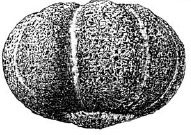
Fearing Burr did not even mention it in his Field and Garden Vegetables of America, and he certainly knew who Jenny Lind was. Today, this melon is one of the most popular among seed savers. It has an unusual shape, its flavor is first rate, and it seems to thrive in many places where other muskmelons prove difficult to grow.
The melon is said to have been developed from the Center Melon, an old Philadelphia variety dating from before 1840 and originating from Armenia. The actual developer of the Jenny Lind melon is not presently known, and the accepted date of its introduction (1846) does not tally with Jenny Lind’s famous tour of the United States. The Swedish singer did not arrive in this country until four years later (under contract with Phineas T. Barnum to sing), and her famous debut in Philadelphia did not take place until October 1850. This would suggest that if the melon did indeed exist before 1850, it probably had another name; while she was famous in Europe, Jenny Lind did not achieve superstar status in this country until after she came here. This is a case where popular mythology has run ahead of historical fact.
Miss Lind’s melon is often described as turban-shaped. The blossom end bears a “button” or knob, which is considered one of the determining features of this variety. When the melon is ripe, the skin is brownish orange, mottled with green. The flesh is light green, and soft and sweet like the voice of the “Swedish Nightingale” in whose honor it was named.
‘Mango’ Melon or ‘Garden Lemon’
Cucumis melovar. chito
This is both a varietal name and a generic term for a collection of similar melons variously called Orange Melon, Vegetable Orange, Melon Apple, Garden Lemon, and Vine Peach. The American Garden (1890, 304) considered all of these to be variant forms of the same thing rather than distinct varieties. Indeed, the only difference between the Garden Lemon and the others is that it ripens with a yellow skin, whereas the others often ripen with an orange skin. In shape, the Garden Lemon is usually oblong or egg-shaped; the others are often round. Pure seed is rare, since all of these are allowed to run together, and it is often the case that the melons have acquired stripes, mottling, or traces of netting by crossing with muskmelons or with the fragrant and completely inedible Queen Anne’s Pocket Melon (Cucumis melo var. dudaim).
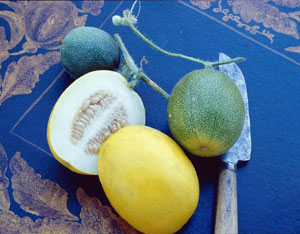
Because the mango melons were used in cookery and not eaten raw, their texture was far more important than sweet flavor. They were prepared in preserves like citron watermelons, in sweet pickles, fried like eggplant, or “mangoed” as a condiment for roast meats. They can also be used in stir-fries or sliced and baked in pies like apples. For such applications a firm, crisp flesh is critical. In flavor, all of these variant forms taste a bit like cucumbers lightly brushed with lemon juice.
The melons originated in China and were introduced into this country from there in the 1880s. Samuel Wilson, a seedsman in Mechanicsville (Bucks County), Pennsylvania, offered seed in the Farm Journal in February of 1889. He was one of the first to advertise these melons, calling them Vegetable Peach. The Pennsylvania Dutch were particularly fond of mango melons because they worked well in sweet-sour preserves, very similar to the way they were pickled in the Orient. The most popular method of pickling, however, was to mango them, a process that gave the melon its most common name. The following recipe is taken from Mrs. M. E. Peterson’s Preserving, Pickling and Canning (1869, 28). Any small green melon the size of a goose egg can be used.
Musk Melon Mangoes
Take small musk melons and cut an oval piece out of one side: take out the seeds with a teaspoon, and fill this space with a stuffing of chopped onions, scraped horseradish, mustard-seed, cloves, and pepper corns, and sew in the piece with a needle and coarse thread. Put them in a jar, and pour boiling vinegar, with a little salt in it, over them. Do this two or three times, then put in fresh vinegar. Keep in stone jars, or pots tightly covered.
‘Montreal Market’ Melon
Cucumis melovar. reliculatus
W. Atlee Burpee discovered this melon at the St. Anne’s Market in Montreal during a visit there in 1880. In 1881 he offered the seed commercially, and the melon was an instant success. It became the most widely grown muskmelon in New England, Canada, and the Upper Midwest, not only because of its large size but because it yielded the best-flavored melons for short-season gardens.
The fruits resemble Hackensack but are larger, heavier, more uniformly netted, and more uniformly green in the flesh. The melons normally weigh 9 to 10 pounds, with prominent ribs about 2 to 2 1/2 inches apart. The outer skin is green, mottled with greenish yellow. The flavor is aromatic, reminding me of crushed ginger leaves. A little shredded zest of lime greatly enhances the taste.
‘Murray‘s Pineapple’ Melon
Cucumis melo var. reticulatus
The pineapple melon presents us with a rather convoluted history. The earliest reference to it thus far has surfaced in the papers of Thomas Jefferson, who planted it in 1794. It was not a foreign variety, but a muskmelon developed or at least perfected on these shores. It was first offered commercially in a seed catalog of Grant Thorburn & Sons of New York in 1824. The originator of the melon has not been identified.
There are two variant forms, a green-fleshed sort known also as the Jersey Citron Melon, and a red-fleshed one. Both of these were exported to Europe where they became well known as the melon ananas d’Amerique à chair rouge and chair vert of the Vilmorin garden books. The green one was illustrated in color in the Album Vilmorin (1854, 5). Both varieties are still available today. The fruit is roughly the size of a large softball, the green-fleshed sort usually about 6 inches in diameter, the red about 4 inches in diameter. The shape is generally round, and because the fruit is small, this melon is ideal for cultivation on a fence or trellis, thus saving a great deal of space.
The red variety has slightly marked ribs, with distinctive green furrows and light netting. The flesh is bright watermelon-red and fragrant, with a seed cavity about the size of a walnut. The green variety has pale green flesh with a yellowish tinge about the seed mass. Its leaves, like the fruit itself, are slightly larger than those of the red. Its skin is also more heavily netted. The vines of both types are heavy producers, each plant yielding as many as 6 to 8 melons.
Because of their size, the melons are perfect for dessert cups, since the small seed cavity can be filled with a scoop of sherbet or a shot glass of Madeira. Nineteenth-century Philadelphia chef and restaurateur James Parkinson once served them filled with champagne “snow” garnished with caviar. The diminutive proportions of the melons provide a highly decorative aspect to any table setting and lend an interesting touch to fruit arrangements. The small, unripe melons are also excellent for pickling or candying. Amelia Simmons (1796, 13) recommended them for melon mangoes.
‘Prescottfond blanc’ Melon
Cucumis melovar. cantaloupensis
This melon is the only true cantaloupe on this list. The American custom of referring to all muskmelons as cantaloupes developed in the 1880s as a marketing term for any melon shipped in crates. This usage has since spread to all parts of the country in an attempt to give the muskmelon a less awkward-sounding name. True cantaloupes are smooth-skinned or warty, require a long growing season, and are not grown to any large extent in the United States, even though their hard skin makes them ideal for shipping. The name cantaloupe, as we use it, is the French spelling of Cantaluppi, a papal estate near Rome where the first of these melons were grown in the 1400s.

The Prescott fond blanc belongs to a group of cantaloupes that the French call “rock melons,” and there are many variant forms. Bernard M’Mahon of Philadelphia began importing several of the standard varieties as early as 1800. His Large African was the Algerian of Vilmorin, his Black Rock Vilmorin’s melon cantaloup noir des Carmes (an eighteenth-century variety that originated at Saumus in Narne-et-Lorie) and his Black Portugal and the pear-shaped Mogul cantaloupe were still available in France in the 1880s. Most of these melons, being desert melons to begin with, need a hot, dry climate to come to perfection. They were raised in this country by the wealthy who could afford greenhouses and hotbeds and full-time gardeners to attend them. Fearing Burr (1865, 177) commented on the Prescott fond blanc and, of all the melons of this type, considered it the best, although the French consider the Black Rock the easiest to grow. Both are 80-to-85-day melons.
The white Prescott melon, however, is quite a curiosity and well worth the effort of coddling it to fruit. The melon is flattened on both the top and bottom as though it had been dropped when soft, like a ball of bread dough. Thus the melon is normally about twice as wide as it is tall, weighing from 5 to 9 pounds. It is usually 5 to 6 pounds in my climate, which is similar to that of Burgundy. The ribs are large, uneven, wrinkled, and covered with knobs or warts. The warts are dark and light green on a whitish skin. The flesh is dark salmon-orange, quite a contrast to the rind, thick, juicy, and a delight to eat. For best results, only allow one melon per vine.
The French made ice cream molds imitating the Prescott melon. A variety of ice cream colors and flavors were used to recreate the carnival affect that the melon presents when ripe and freshly cut. I happen to own one of those old molds, dating from the 1870s; because it is life-size, it helped me guess when the melon was ready to pick the first time I grew the Prescott. Cantaloupes do not slip from the vine when ripe. Rapping on them like watermelons seems to be a reliable method; then wait two days to pick them. Then wait again. Place the harvested melons on a sunny windowsill until the rinds become pliant when pressed with the thumb. Left to ripen on the ground, these melons will take on an earthy taste rather than build up an intensely sweet flavor. Always serve melon at room temperature. Chilling any type of melon destroys the flavor. It is like putting ice cubes in red wine.
‘Rocky Ford’ Melon
Cucumis melovar. reticulatus
Rocky Ford is a place in southern Colorado where the arid climate is ideal for melon culture. Once the railroads were built into the state to serve the mining industry, the same trains returning to Chicago and other points East also provided the means for a lucrative trade in Colorado produce, especially melons.
W. Atlee Burpee’s Netted Gem muskmelon was planted at Rocky Ford in the 1880s. J. W. Eastwood raised the melon in 1885 and is credited with the creation of the strain of Netted Gem that eventually became Rocky Ford. Other growers in the area also selected promising strains so that the Netted Gem gradually evolved from an oblong melon to a round one with heavy netting. In his book Muskmelon Production (1928, 15), John Lloyd provided a photograph showing the old Netted Gem beside its Rocky Ford progeny. Rocky Ford was long considered a synonym for a type of Netted Gem, but under the careful guidance of the Rocky Ford Cantaloupe Seed Breeders Association, the melon finally became fixed as a recognized variety.
The fruit weighs from 1 1/2 to 2 pounds, with dark green skin that turns yellow-bronze when ripe. The flesh is green with a band of golden yellow near the seed cavity. The seed cavity is small and triangular shaped in cross-section. Rocky Ford thrives in areas with climates similar to southern Colorado. In the East the melon tends to deteriorate over a few generations and revert to something resembling Netted Gem.
‘Turkish Casaba’ Melon
Cucumis melovar.inodorus
The melon takes its name from Casaba (Kassabah) in Anatolia, some thirty miles northeast of Smyrna (Izmir) in Turkey. The original casaba melon could only be raised to perfection in the vicinity of that place. Even in the nineteenth century, when the melon had become well known, casabas were rare in Istanbul and considered a great luxury. The growing season of the melon is so long that in this country it can only be raised on a commercial basis in California and parts of the Southwest.
Nevertheless, there were several attempts to grow the melon in this country, for it is known that the U.S. Patent Office distributed seed for a casaba-type melon in 1850. Henry Dreer of Philadelphia offered a true casaba for sale in his 1867 seed list, and this appears to be the first real attempt to commercialize the melon. The melon that he introduced was sometimes called Winter Pineapple by other seedsmen. Its original Turkish name is not known.
The casaba belongs to a group of melons divided roughly into two types, one with smooth skin, as in the Winter Valencia, and one with wrinkled skin, which is the mark of the casaba. Most of the true casabas ripen with a yellow skin, although the Winter Pineapple of Dreer was light green. The flesh of all of these sorts is snowy white and extremely sweet.
I grow a variety of casaba called Hasan Bey, but it is not an heirloom variety as far as I can determine. It was found in the Egyptian Market in Istanbul and differs from the typical casaba in that its skin is black-green when ripe. It stores well like a winter melon, but in Pennsylvania it must be started in a hotbed in order to bear fruit. I place black plastic picnic plates (the sort that come out at Halloween) under the melons as they mature. This greatly reduces insect and worm damage from underneath, a problem with all melons, and warms the ground around each melon so that it imagines it is in Turkey.
‘Winter Valencia’ Melon
Cucumis melo var. inodorus
Related to the so-called honeydew (the White Antibes of the French), this old-fashioned winter melon was listed by American seedsmen as early as the 1830s. Fearing Burr (1865, 180) called it the Green Valencia, and it was discussed in some detail by Charles Mcintosh in his Book of the Garden (1853-55).
In 1805 Thomas Jefferson raised a similar melon called the Malta Melon or Green-Fleshed Malta Winter Melon, the melon de Malle d’hiver à chair verte of Vilmorin (1885, 330). The Malta melon and its various subvarieties were also discussed in some detail by the Abbé Rozier (1785, 476), who noted that they were cultivated primarily in Italy, Provence, and Languedoc. In this country, the melon was planted about July 15 so that it would ripen late, for harvesting right before frost. The melons were then placed in storage to mellow and used through the months of December, January, and February. Properly harvested, these melons increase in flavor and sweetness during storage and are a welcome delicacy when compared with the green and grassy-tasting fruits shipped to most parts of the country during the winter.
The Winter Valencia is cultivated in the same manner as the Malta Melon. It has dark green, wrinkled skin with creamy white flesh. Like the Malta Melon, the seeds are not loose but embedded in the flesh, like those of a cucumber. The meat of the melon can be preserved in sugar like the citron watermelon, or cooked to a purée consistency and turned into a species of green marmalade. It can also be sliced and baked in pies or shredded and baked in custards with dried figs and chopped fennel.
Photos and Illustrations Courtesy William Woys Weaver.