

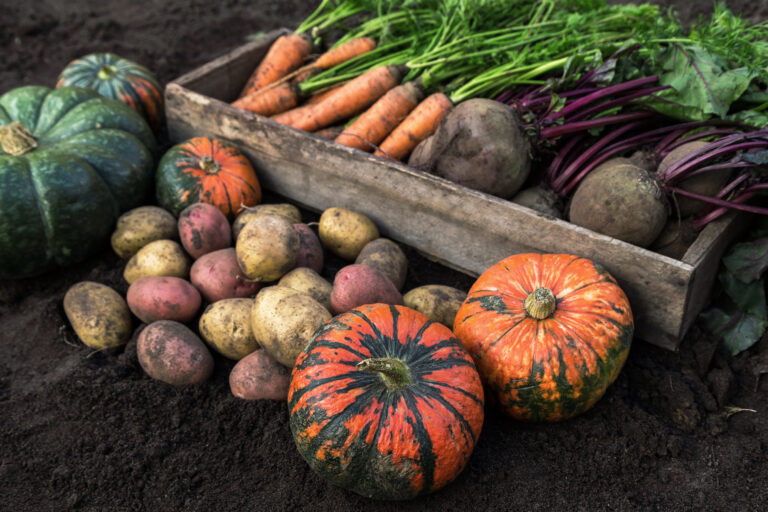
If you’re interested in getting started with fall gardening vegetables, late summer is the perfect time to plan. Here are some of the best cold hardy vegetables for fall and how to help them thrive.
With tomatoes, peppers and melons now hitting their late summer stride, it’s easy to forget that autumn and early winter can be as abundant as spring and summer. Those who seize the opportunity for a second season of growth will find the planning and planting well worthwhile.
The steps to a bountiful fall garden are simple. Choose crops suited to fall growing conditions (see the list of crops and recommended varieties at the end of this article). Ensure your chosen site has organically enriched soil and adequate water. And start now.
You can replace spring-planted lettuces, peas and brassicas (broccoli and its relatives) with new plantings that mature in fall. Seeds and transplants will take off quickly in the warm summer soil. They’ll appreciate cooler nights, too.
Look forward to peak flavor and performance for many crops that do not prosper in summer heat. Lower temperatures are ideal for producing crisp lettuces without the bitterness or bolting that can occur in hot weather. Frost-kissed kale, Brussels sprouts and cabbage have a special sweetness. Carrots, beets and turnips also thrive in the fall garden and, after harvest, can be kept in a pantry or root cellar so you can enjoy their goodness well into winter. Collards, mustard and other greens also like cool weather.
Favored Crops for Fall
When deciding what to plant now for fall harvest, gardeners throughout most of the country should think greens and root vegetables, advises John Navazio, a plant-breeding and seed specialist at Washington State University and senior scientist for the Organic Seed Alliance in Port Townsend, Wash., which conducts annual tests of crops and varieties to evaluate their cold hardiness.
Leafy greens (such as lettuces, spinach, arugula, chard and mâche) and root veggies (such as beets, carrots, turnips, radishes and rutabagas) as well as brassicas (including broccoli, cabbage, cauliflower, collards, kale and Chinese cabbage) and peas will all thrive in the cooler weather and shorter days of fall. In many regions, some of these cold-hardy crops will even survive the winter to produce a second harvest in spring. (See “Stretching the Season,” below.)
If you garden in the South or other areas with mild winters, you can grow all of those crops as well as heat-loving favorites. “Here, we can set out tomato transplants in late August,” says David Pitre, owner of Tecolote Farm, a certified organic farm near Austin, Texas. Pitre also plants okra, eggplant, peppers, winter squash, cucumbers and potatoes in August and September for winter harvest. Plant cool-season crops in the garden after temperatures cool — late September or later.
Fall is also prime garden season in the Pacific Northwest, where abundant rain and cool (but not frigid) temperatures are ideal for growing brassicas, root crops and leafy greens planted in mid- to late summer. The hardiest of these crops often hang on well into winter if given protection, such as row covers or cold frames.
(For full details on which crops to plant now in your region for fall and winter harvests, check out our What to Plant Now pages, or sign up for a free, 30-day trial of our online Vegetable Garden Planner — MOTHER)
Hardy Fall Varieties
After you’ve decided which crops to grow for fall harvest, zero in on specific varieties. “There are big differences in cold hardiness among varieties,” Navazio says. “Some are better able to photosynthesize at cooler temperatures.”
For the past several years, the Alliance has been conducting trials of as many as 170 varieties of 11 different crops for their quality and performance in fall and winter. Among them, kale, radicchio and Swiss chard have been tested extensively and confirmed cold hardy to 14 degrees Fahrenheit with no protection. Several varieties stood out for the Alliance and market gardeners.
Broccolis. Opt for varieties that produce plenty of side shoots, rather than a single large head. “‘Diplomat’ and ‘Marathon’ can survive the heat of late summer and thrive when cool weather arrives in fall, producing a second cutting as late as Thanksgiving,” says Elizabeth Keen, co-owner of Indian Line Farm, a 17-acre organic operation in Great Barrington, Mass. In Austin, Texas, Carol Ann Sayle, co-owner of Boggy Creek Farm, grows ‘Packman’ and ‘Diplomat’ for harvest by Thanksgiving and cuts ‘Marathon’ by Christmas.
Carrots. Consider storage ability when choosing carrots for your fall garden, says Thomas Case, owner of Arethusa Farm, a certified organic farm near Burlington, Vt. Both Keen and Case like ‘Bolero’ for fall growing and winter storage.
Lettuces. Whether you garden in the North or South, lettuces are a mainstay of the fall garden. Several European heirloom varieties are especially durable: ‘Rouge d’Hiver’ (a flavorful romaine whose leaves blush red in cool weather), ‘Marvel of Four Seasons’ (also called ‘Merveille de Quatre Saisons,’ a sweet and tender butterhead with red-edged outer leaves) and ‘Winter Density’ (also called ‘Craquerelle du Midi,’ a compact bibb type with deep green leaves) are good bets. Even in Zone 5, these lettuces will hang on into December and, with the protection of heavy mulch or a cold frame, will often return with renewed vigor in early spring.
When the lettuces go dormant in winter, you can count on mâche to fill your salad bowl. Mâche (or corn salad) is delicious and will survive and continue to grow in colder weather longer than any other salad green, says Eliot Coleman in his classic book Four-Season Harvest. In his Zone 5 Maine garden, Coleman seeds mâche inside a cold frame from September through early November for harvest until April, when overwintered lettuce resumes its growth.
Kale. Of the popular Lacinato-type kales, ‘Black Tuscan’ consistently rated best in the Alliance tests for cold hardiness, vigor, flavor and stature. The Alliance also recommends ‘Winterbor’ (a tall Dutch kale), ‘Red Russian’ and ‘White Russian’ (two tasty Siberian kales). It’s hard to go wrong with kale in fall, no matter the variety: All have superior flavor when temperatures drop into the 20s or below. “Sugar is the plant’s natural antifreeze, so as the temperature drops, more starches are converted to sugar, sweetening the flavor of kale and other brassicas,” Navazio says.
Radicchio. Still considered a specialty vegetable by many, radicchio thrives in the cool conditions of fall and offers a wealth of possibilities in the kitchen. Of the more than 20 varieties tested by the Alliance in the past two years, a few Italian open-pollinated varieties proved most cold-hardy. ‘Variegata di Luisa Tardiva’ and ‘Variegata di Castlefranco’ produce upright, variegated heads similar to romaine lettuce, with beautiful hearts and radicchio’s signature bitterness.
“Grown in cool weather, they are delightful, with a mild spicy flavor,” Navazio says. Although some of the plants’ outer leaves were “toasted” at 14 degrees in the Alliance trials, you can strip off any damaged leaves and enjoy the tasty interior.
Navazio suggests slicing the heads, then wilting the leaves in a pan with cipollini onions, as cooks do in Italy, or dressing the heads lightly with olive oil and roasting them on the grill or a campfire. For cold hardiness and flavor, Navazio also recommends ‘Rossa di Verona’ and ‘Grumolo Rossa.’
Swiss Chard. The Alliance has found that chard hardiness generally corresponds to leaf color. Green varieties tend to be most cold hardy, followed by gold, then pink, magenta and red varieties, which tend to be the least tolerant of cold. “Old-fashioned ‘Fordhook Giant’ is very cold hardy,” Navazio says.
Based on their most recent (2009) trials — which evaluated vigor, stature and flavor — the Alliance staff also recommends the following varieties for fall.
- Arugula: ‘Astro,’ ‘Sputnik’
- Beets: ‘Chioggia Guardmark,’ ‘Red Ace,’ ‘Shiraz,’ ‘Touchstone Gold’
- Collards: ‘Champion,’ ‘Flash’
- Spinach: ‘Olympia,’ ‘Space,’ ‘Tarpy’
See the complete 2009 Organic Seed Alliance vegetable variety trials report.
The Matter of Timing
Right now — late summer — is prime time for starting your fall garden. To determine starting dates for each variety you plan to grow, first check the “days to maturity” listed in the seed catalog or on the back of the seed packet. Add an extra week or two to factor in the shorter day lengths of fall, which delay plant maturity. Then count backward, subtracting that number of days from your average first fall frost date.
Find your average frost date by visiting the National Climatic Data Center website’s U.S. Climate Normals Freeze/Frost Data. Keep in mind that these dates are based on meteorological data recorded at weather stations around the United States from 1951 to 1980. The NCDC is developing new frost/freeze maps to reflect more recent data and hopes to have these maps available by the end of the year. “We are seeing a general warming at a lot of our stations and are recomputing the ‘normals’ for fall frost dates,” says Anthony Arguez, a physical scientist for the NCDC in Asheville, N.C.
Sow and Grow
Start seeds of broccoli and cabbage in flats or pots indoors (outdoor soil temps may be too high for good germination), then transplant the seedlings to the garden about four weeks later, when temperatures are cooler and seedlings are large enough to compete against weeds. Direct-seed carrots, beets and other root crops, as well as greens, into prepared beds.
Because you’re likely planting your fall crops in soil that has already fed a spring planting, be sure to replenish the beds with a generous helping of organic fertilizer and/or compost before planting. “People often forget you need to prepare the soil and you should do it a little earlier than you think,” Pitre says. He mixes compost into fall garden beds a few weeks before he plants.
Sayle reshapes her farm’s beds in fall, using a hilling disc to move soil from pathways up onto the surface of the raised beds. “We hill the beds higher in fall to improve the drainage of our clay soil during the cooler, wetter fall and winter conditions,” she says.
Before fall planting, incorporate soil amendments, such as sulfur and gypsum (as needed), as well as compost.
Seeds and transplants take off quickly in the warm soil if they have adequate water. To help retain soil moisture, surround seedlings with a thick layer of mulch. Finely shredded leaves or straw will keep soil moist while slowly contributing organic matter to the soil as they decompose.
Keep plants growing strong as temperatures drop by giving them a mid-season nutrient boost. Sayle makes her own foliar fertilizer by mixing 1 tablespoon each of fish emulsion, seaweed and molasses in a gallon of water, then sprays it on using a backpack sprayer. A spray bottle works, too.
Elizabeth Keen of Indian Line Farm simply side-dresses plants with compost. “With brassicas, especially, the compost really helps,” she says. “We’ve found the best time to apply it is when plants are in the teenager stage — about four weeks after transplanting. It’s foolproof.”
Another tip for your most bountiful fall garden: Harvest early and often. Frequent cutting stimulates continual new growth and gives you plenty of chances to enjoy the fruits of your labor.
Stretching the Season

Extend your fall harvest an extra month or more by shielding plants from hard freezes. Simple methods include blanketing low-growers with a thick layer of straw mulch or leaves (pull it aside during the day), a clear plastic tarp or a floating row cover. Lightweight floating row covers protect crops down to about 28 degrees; heavier-weight covers will protect to 24 degrees. Go further with a simple cold frame, like the one above. See a reader’s simple cold frame warmed with a birdbath heater or crock pot, or paint gallon jugs black and tuck them inside your cold frame to absorb warmth during the day and radiate it at night.
Plastic-covered tunnels supported by hoops are also excellent for stretching the fall growing season into winter (and also for getting a jump-start in spring). See details on building and using low tunnels.
Master gardeners Eliot Coleman and Barbara Damrosch in Harborside, Maine, give greens, broccoli, carrots, beets and other cool-weather crops a double layer of protection from the cold by growing them in a cold frame inside a high, plastic-covered tunnel.
Coleman estimates that “each layer of covering is equivalent to growing your plants one and a half USDA zones to the south.” Thus, for Coleman in Zone 5, a single layer moderates the temperature to that of Zone 6-plus; a double layer moderates the climate to that of Zone 8.
For more on the topic, see Garden Know-How: Extend Your Growing Season.
These tips should help you see that your garden’s useful time is only half over at summer’s end. Don’t miss one of your garden’s most productive seasons!
Breed Your Own Fall Garden Superheroes
Create more-cold-hardy varieties by growing different open-pollinated varieties of the same crop in your garden, then saving the seeds of the best performers, suggests John Navazio, of the Organic Seed Alliance.
“After you find the most cold-hardy varieties of the same crop, give ’em hell?–?don’t use any row covers?–?then save the seeds of any that survive 14 degrees Farenheit freezes” (about the coldest temperature most cold-hardy plants will tolerate without a cover).
Get A Seed Saving Guide for Gardeners and Farmers, a free publication about selecting plants for your conditions and saving seeds.
Seed Sources
Suppliers:
Gourmet Seeds International (GSI)
High Mowing Organic Seeds (HM)
Johnny’s Selected Seeds (JSS)
Seeds from Italy (SI)
Seeds of Change (SC)
Territorial Seed Co. (TSC)
Uprising Seeds (US)
Arugula: ‘Astro’ (HM, JSS, US); ‘Sputnik’ (SC)
Beets: ‘Chioggia Guardmark’ (HM, JSS); ‘Red Ace’ (HM, JSS, TSC); ‘Shiraz’ (SC); ‘Touchstone Gold’ (HM, JSS, SC, TSC, US)
Broccoli: ‘Diplomat’ (JSS); ‘Marathon’ (JSS); ‘Packman’ (TSC)
Carrots: ‘Bolero’ (JSS, TSC)
Collards: ‘Champion’ (HM, JSS, TSC, US); ‘Flash’ (JSS, TSC)
Kale: ‘Black Tuscan’ (GSI, US); ‘Red Russian’ (HM, JSS, SC, US); ‘White Russian’ (HM, TSC); ‘Winterbor’ (JSS, TSC)
Lettuce: ‘Marvel of Four Seasons’ (GSI); ‘Rouge d’Hiver’ (HM, JSS, SC); ‘Winter Density’ (HM, JSS, SC, TSC)
Mâche: (GSI, JSS, TSC)
Radicchio: ‘Grumolo Rossa’ (GSI, SI); ‘Rossa di Verona’ (GSI, SI); ‘Variegata di Castlefranco’ (GSI, SI, US); ‘Variegata di Luisa Tardiva’ (SI)
Spinach: ‘Olympia’ (TSC); ‘Space’ (JSS, TSC);’Tarpy’ (HM, SC)
Swiss Chard: ‘Fordhook Giant’ (HM, JSS, SC, TSC)
Vicki Mattern is a contributing editor for MOTHER EARTH NEWS magazine, book editor and freelance magazine writer. She has edited or co-authored seven books on gardening, and lives and works from her home in northwestern Montana.






