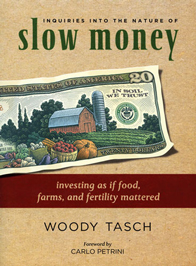
The following is an excerpt from Inquiries into the Nature of Slow Money: Investing as if Food, Farms, and Fertility Mattered by Woody Tasch (Chelsea Green, 2008). Tasch presents an essential new strategy for investing in local food systems, and introduces a group of fiduciary activists who are exploring what should replace the outdated concepts of industrial finance and industrial agriculture. This excerpt is from the prologue.
Civilization is a big idea. So is the idea that as soil goes, so goes civilization. So is the idea that as money goes, so goes the soil. We don’t need any more big ideas.
We need small ideas. Beautiful ideas. Beautiful because they lead to a large number of beautiful, small actions — the kind alluded to by Wendell Berry: “Soil is not usually lost in slabs or heaps of magnificent tonnage. It is lost a little at a time over millions of acres by careless acts of millions of people. It cannot be solved by heroic feats of gigantic technology, but only by millions of small acts and restraints.”
There is another kind of erosion at work, just as surely, here: erosion of social capital, erosion of community, erosion of an understanding of our place in the scheme of things.
Peak Soil
It takes roughly a millennium to build an inch or two of soil. It takes less than 40 years, on average, to strip an inch of soil by farming in ways that are more focused on current yield than on sustaining fertility. A third of America’s topsoil has eroded since 1776. In the 1970s, the United States lost 4 billion tons of soil per year. Roughly a third of all farmland in the world has been degraded since World War II, with annual soil erosion worldwide equivalent to the loss of 12 million hectares of arable land, or 1 percent of total arable land. About a third of China’s 130 million hectares of farmland is seriously eroded, and Chinese crop yields fell by more than 10 percent from 1999 to 2003, despite increasing application of synthetic fertilizers.
Awareness of the centrality of soil health is nothing new. Aristotle laid the foundation for the humus theory of plant nutrition, and his student, Theophrastus, is often called “the father of botany.” The homo of Homo sapiens is derived from the Latin, humus, for living soil. Leonardo da Vinci observed, “We know more about the movement of the celestial bodies than about the soil underfoot.” Darwin spent the last years of his life studying the role of earthworms in soil fertility. After World War I, Sir Albert Howard, perhaps the father of 20th-century organic agriculture, heralded the problems that would follow the manufacture of synthetic fertilizers by munitions factories looking for new postwar markets for nitrates: Fertilizers offered farmers boosts in yield but had deleterious effects on the health of microorganisms and the processes of growth and decay that are vital to the preservation of humus. In the first decade of the 21st century, despite beyond-explosive growth in our knowledge of everything from atomic energy to galactic motion, our ignorance with respect to life teeming in the soil remains humbling: It is estimated that in a gram of soil, there are billions of single-celled organisms and millions more multicelled ones, as well as more than 4,000 species, most of them not yet named or studied by scientists.
Yet we have slipped during the past half century — as if pulled by the gravitational or centripetal forces of population growth, technological innovation, consumerism and free markets— into a food system that treats the soil as if it were nothing more than a medium for holding plant roots so that they can be force-fed a chemical diet.
We have become dependent on technology and synthetic inputs, subsidized by what was, until very recently, cheap oil, which facilitated not only the production of nitrogen fertilizer, but also the management of large-scale, mechanized farms and the energy-intensive system of processing and long-range transportation necessary to bring agricultural products to distant markets. Agriculture accounts for more than 20 percent of U.S. greenhouse gas emissions— all the more shocking when one realizes that recent science indicates that fertile soil is a potent carbon sink, holding the potential to play a significant role in remediating global warming.
The problems of our food and agricultural systems go beyond Peak Oil and Peak Soil, however. Aquifer depletion, biodiversity decline, widespread use of pesticides and other toxics, industrial feedlots that pose health and waste-management problems, nutrition and food safety challenges that attend centralized processing, the decline of rural economies, price volatility in global commodities markets: It is quite a litany, surprising in its breadth and even more surprising in the degree of its invisibility when seen through the lens of the modern economy.
A Flawed System
You wouldn’t use a 747 to go to the corner store for a quart of milk. You wouldn’t use a backhoe to plant a garlic bulb. You wouldn’t use a factory to raise a pig. You wouldn’t spray poison on your food. You wouldn’t trade fresh food from family farms down the road for irradiated or contaminated or chemical-laden or weeks-old food from industrial farms halfway around the world. You wouldn’t create financial incentives for farms to become so large that they need GPS technology to apply chemical inputs with quasi-military precision. You wouldn’t design a system that gets only 9 cents of every food dollar to the farmer. You wouldn’t allow topsoil to wash down the Mississippi River, replete with pesticides and fertilizer residues, creating a dead zone the size of Rhode Island in the Gulf of Mexico. You wouldn’t use 57 calories of petro-energy to produce one calorie of food energy.
No, no one ever sat down and designed such a system. Yet it is precisely such a technology-heavy, extractive, intermediation-laden food system that we now need to remediate and reform.
This is the system that has evolved in the wake of global capital markets and the investors who use them, much as industrial farmers use their land–as a medium into which to pour capital in order to harvest maximum yield.
Slow Money
In August 2007, at the 25th Anniversary Gala for the Rocky Mountain Institute, eminent panelists tried to answer questions posed by moderator Thomas Friedman: “If this is a win-win-win, if these new technologies and design solutions are so elegant and so profitable and so clean, what is holding them back? Where is the resistance to these innovations coming from?” Unexpectedly, because this was not a finance conference, the group discussion zeroed in on CEO compensation, short-term financial incentives, and the structure of capital markets.
Inventor Dean Kamen opined from the dais: “Venture capitalists have great enthusiasm but short attention spans. We are stuck in a 19th-century way of thinking that leads to large-scale, centralized production and power generation. We don’t have the mindset to really invest for the long-term in small-scale solutions that would improve life for billions of people.”
Such questions and observations lead to the premise for a new kind of financial intermediation, going by the improbable name of “slow money.”
That premise is this: The problems we face with respect to soil fertility, biodiversity, food quality and local economies are not primarily problems of technology. They are problems of finance. In a financial system organized to optimize the efficient use of capital, we should not be surprised to end up with cheapened food, millions of acres of GMO corn, billions of food miles, dying Main Streets, kids who think food comes from supermarkets, and obesity epidemics side by side with persistent hunger.
Speed is a big part of the problem. We are extracting generations’ worth of vitality from our land and our communities. We are acting as if the biological and the agrarian can be indefinitely subjugated to the technological and the industrial without significant consequence. We are, as the colloquial saying puts it, beginning to believe our own bullshit.
Which reminds me of a story.
About 15 years ago, I was turning a horse stall into my office. My first project was to shovel out the dried horse manure and shovel in sand, in advance of the construction of a wooden floor.
One day, reflecting on the transition from equine to intellectual, I realized, “How appropriate: from horseshit to bullshit.”
No discussion of the disconnect between capital markets and the land is complete without at least one reference to manure.
Let’s throw in a few bees and pigs, too:
“The story of colony collapse disorder and the story of drug-resistant staph are also the same story: Both are parables about the precariousness of monocultures. Whenever we try to rearrange natural systems along the lines of a machine or a factory, whether by raising too many pigs in one place or too many almond trees, whatever we may gain in industrial efficiency, we sacrifice in biological resilience. The question is not whether systems this brittle will break down, but when and how, and whether when they do, we’ll be prepared to treat the whole idea of sustainability as something more than a nice word.” — Michael Pollan
A Hot Potato
There is such a thing as money that is too fast.
Money that is too fast is money that has become so detached from people, place, and the activities that it is financing that not even the experts understand it fully. Money that is too fast makes it impossible to say whether the world economy is going through a correction in the credit markets, triggered by the subprime mortgage crisis, or whether we are teetering on the edge of something much deeper and more challenging, tied to petrodollars, derivatives, hedge funds, futures, arbitrage and a byzantine hyper-securitized system of intermediation that no quant, no program trader, no speculator, no investment bank CEO, can any longer fully understand or manage. Just as no one can say precisely where the meat in a hamburger comes from (it may contain meat from as many as hundreds of animals), no one can say where the money in this or that security has come from, where it is going, what is behind it, whether — if it were to be “stopped” and, like a hot potato, held by someone for more than a few instants — it represents any intrinsic or real value. Money that is too fast creates an environment in which, when questioned by the press about the outcome of the credit crisis, former treasury secretary Robert Rubin can only respond, “No one knows.”
This kind of befuddlement is what arises when the relationships among capital, community and bioregion are broken:
“There is an appropriate velocity for water set by geology, soils, vegetation and ecological relationships in a given landscape. There is an appropriate velocity for money that corresponds to long-term needs of communities rooted in particular places and to the necessity of preserving ecological capital. There is an appropriate velocity for information, set by the assimilative capacity of the mind and by the collective learning rate of communities and entire societies. Having exceeded the speed limits, we are vulnerable to ecological degradation, economic arrangements that are unjust and unsustainable, and, in the face of great and complex problems, to befuddlement that comes with information overload.” — David Orr
As long as money accelerates around the planet, divorced from where we live, our befuddlement will continue. As long as the way we invest is divorced from how we live and how we consume, our befuddlement will worsen. As long as the way we invest uproots companies, putting them in the hands of a broad, shallow pool of absentee shareholders whose primary goal is the endless growth of their financial capital, our befuddlement at the depletion of our social and natural capital will only deepen.
Reprinted with permission from Inquiries into the Nature of Slow Money: Investing as if Food, Farms, and Fertility Mattered, published by Chelsea Green, 2008.