

Learn about the dangers of genetic engineering.
Reflections on Genetic
Engineering and Manipulation of Life
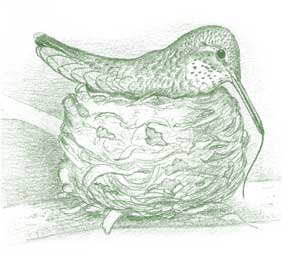
In the slender shoulders of the myrtle tree outside my
kitchen window, a hummingbird built her nest. It was in
April, the sexiest month, season of bud and courtship
displays, though I was at the sink washing breakfast dishes
and missing the party, or so you might think.
Then my eye caught a flicker of motion outside, and there
she was, hovering uncertainly. She held in the tip of her
beak a wisp of wadded spiderweb so tiny I wasn’t even sure
it was there, until she carefully smoodged it onto the
branch. She vanished then, but in less than a minute she
was back with another tiny white tuft she stuck on top of
the first. For more than an hour she returned again and
again, increasingly confident of her mission, building up
by infinitesimal degrees a whitish lump on the
branch — and leaving me plumb in awe of the supply of
spiderwebbing on the face of the land.
I stayed at my post, washing everything I could find, while
my friend did her own housework out there. When the lump
had grown big enough — when some genetic trigger in her
small brain said, “Now, that will do” — she stopped
gathering and sat down on her little tuffet, waggling her
wings and tiny rounded underbelly to shape the blob into a
cup that easily would have fit inside my cupped hand. Then
she hovered up, inspected it from this side and that,
settled and waddled with greater fervor, hovered and
appraised some more, and dashed off. She returned with fine
filaments of shredded bark, which she wove into the webbing
along with some dry leaflets and a slap-dab or two of
lichen pressed onto the outside for curb appeal.
When she had made of all this a perfect, symmetrical cup,
she did the most surprising thing of all: She sat on it,
stretched herself forward, extended the unbelievable length
of her tongue and licked her new nest in a long,
upward stroke from bottom to rim. Then she rotated herself
a minute degree, leaned forward and licked again. I watched
her go all the way around, licking the entire nest in a
slow rotation that took 10 minutes to complete and ended
precisely back at her starting point.
Passed down from hummingbird great-grandmothers immemorial,
a spectacular genetic map in her mind had instructed her at
every step, from snipping out with her beak the first
spiderweb tuft to laying down whatever salivary secretion
was needed to accrete and finalize her essential creation.
Then, suddenly, that was that. Her busy urgency vanished,
and she settled in for the long stillness of laying and
incubation.
If you had been standing with me at my kitchen sink to
witness all this, you would likely have breathed softly, as
I did, “My God.” The spectacular perfection of that nest,
that tiny tongue, that beak calibrated perfectly to the
length of the tubular red flowers from which she Sucks
nectar, taking away pollen to commit the essential act of
copulation for the plant that feeds her every piece of it
all, my God. You might be expressing your reverence for the
details of a world created in seven days, 4,004 years ago
(according to some biblical calculations), by a divine
being approximately human in shape. Or you might be
revering the details of a world created by a billion years
of natural selection acting utterly without fail on every
single life-form, one life at a time.
For my money the latter is the greatest show on Earth and a
church service to end all. I have never understood how
anyone could have the slightest trouble blending religious
awe with a full comprehension of the workings of life’s
creation.
Charles Darwin was a religious man, blessed with an
extraordinary patience for observing nature’s details, as
well as the longevity and brilliance to put it all
together. In his years of studying animate life he noticed
four things. which any of us could notice today if we
looked hard enough. They are:
1. Every organism produces more seeds or offspring than
will actually survive to adulthood.
2. There is variation among these seeds or offspring.
3. Traits are passed down from one generation to the next.
4. In each generation the survivors succeed — that is,
they survive — because they possess some advantage over
the ones that don’t succeed. Because they survive they will
pass that advantage on to the next generation. Over time
therefore, the incidence of that trait will increase in the
population.
Bingo: The greatest, simplest, most elegant logical
construct ever to dawn across our curiosity about the
workings of natural life. It is inarguable, and it explains
everything.
Most people have no idea that this, in total, is Darwin’s
theory, of natural selection. Furthermore parents who tell
their children not to listen to such talk because “it’s
just a theory” are ignorant of what that word means. A
theory, in science, is a coherent set of principles used to
explain and predict a class of phenomena. Thus,
gravitational theory explains why objects fall when you
drop them, even though it, too, is “just a theory.”
Darwin’s has proven to be the most robust unifying
explanation ever devised in biological science. It’s
stunning that he could have been so right — scientists
of Darwin’s time knew absolutely nothing about genetics.
After a century and a half, during which time knowledge
expanded boundlessly in genetics, geology, paleontology and
all areas of natural science, his simple, logical construct
continues to explain and predict perfectly the existence
and behavior of every Earthly life-form we have ever
studied. As the unifying principle of natural sciences, it
is no more doubted among modern biologists than gravity is
questioned by physicists.
Nevertheless, in a bizarre recent trend, a number of states
have limited or even outright banned the teaching of
evolution in high schools, and many science textbooks, in
turn, have wimped out on the Subject. As a consequence, an
entire generation of students is arriving in college
unprepared to comprehend or pursue informed science. Many
science teachers I know are nostalgic for at least one
aspect of the Cold War days, when Sputnik riveted us to the
serious business of training our kids to real science,
instead of allowing it to he diluted or tossed out to
assuage the insecurities of certain ideologues.
We dilute and toss at our peril. Scientific illiteracy in
our population is leaving too many of us unprepared to
discuss or understand much of the damage we are wreaking
upon our atmosphere, our habitat and even the food that
enters our mouths. Friends who opted in school for English
lit instead of microbiology (an option I myself could
easily have taken) sometimes come to me and ask, “In 200
words or less, can You explain to me why I should be
nervous about genetic engineering?” I tell them, “Sit down,
I’ll make you a cup of tea, and then get ready for more
than 200 words.”
A sound-bite culture can’t discuss science very well.
Exactly what we’re losing when we reduce biodiversity, the
causes and consequences of global — warming these
traumas can’t be adequately, summarized in an evening news
wrap-up. Arguments in favor of genetically engineered food,
in contrast, are dangerously simple: A magazine ad for an
agribusiness touts its benevolent plan to “feed the world’s
hungry with our vitamin-engineered rice!”
To which I could add in reply my own snappy motto: “if you
thought that first free hit of heroin was a good idea . . . .”
But before you really can decide whether or not you agree,
you may need the words above and a few thousand more. If
so, then sit down. I have a cup of tea, and bear with me.
This is important.
At the root of everything. Darwin said, is that wonder of
wonders, genetic diversity. You’re unlike your sister, a litter of pups is its own small Rainbow Coalition, and
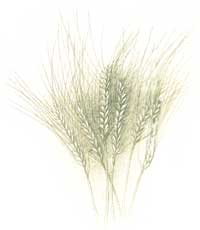
every grain of wheat in a field holds inside its germ a
slightly separate destiny. You can’t see the differences
until you cast the seeds on the ground and grow them out,
but sure enough, some will grow into taller plants and some
shorter, some tougher. Some sweeter. In a good year all or
most of them will thrive and give you wheat. But in a had
year a spate of high winds may take down the tallest stalks
and leave standing at harvest time only. Say, the 10
percent of the crop that had a “shortness” gene. And if
that wheat comprises your winter’s supply of bread plus the
only seed you’ll have for next year’s crop, then you’ll be
almighty glad to have that small, short harvest.
Genetic diversity, in domestic populations as well as wild
ones, is nature’s sole insurance policy. Environments
change: Wet years, are followed by droughts, fakes dry up,
volcanoes rumble ice ages dawn. It’s a big bad world out
there for a little strand of DNA. But a population will
persist over time if, deep within the scattered genetics of
its ranks, it is literally prepared for anything. When the
windy years persist for a decade, the wheat population will
be overtaken by a preponderance of shortness, but if the
crop maintains its diversify, there will always be
recessive aspirations for height hiding in there somewhere
waiting to have their day.
How is the diversity maintained? That old black magic
called sex. Every seed has two parents. Plants throw their
sex to the wind to a hummingbird’s tongue to the knees of a
bee — in April you are inhaling sex, and sneezing. In
the process, each two parents put their scrambled genes
into offspring that represent whole new genetic
combinations never before seen on Earth. Every new outfit
will be ready for something, and together — in a
large-enough population — the whole crowd will be ready
for anything. Individuals will die, not at random but
because of some fatal misfit between what an organism has
and what’s required. But the population will live on,
moving always in the direction of fitness
(however fitness” is at the moment defined), not
because anyone has a master plan but because survival
carries fitness forward and death doesn’t.
People have railed at this reality, left and tight, since
the evening when a British ambassador’s wife declared to
her husband, “Oh dear, let us hope Mr. Darwin isn’t right,
and if he is, let us hope no one finds out about it!”
Fundamentalist Christians seem disturbed by a scenario in
which individual will is so irrelevant. They might be
surprised to learn that Stalin tried to ban the study of
genetics and evolution in Soviet universities for the
opposite reason, attacking the idea of natural
selection—which acts only at the level of the
individual — for being anti-Communist. Through it all,
the little engines of evolution have kept on turning as
they have done for millennia, delivering us here and
passing on, untouched by politics or what anybody thinks,
Nikolai Vavilov was an astounding man of science, and
probably the greatest plant explorer who has ever lived. In
his travels through 64 countries between 1916 and 1940, he
recorded more crop diversity than anyone had known existed,
and founded the world’s largest seed collection.
As he combed continents looking for primitive crop
varieties, Vavilov noticed a pattern: Genetic variation was
not evenly distributed. In a small region of Ethiopia lie
found hundreds of ancient wheat varieties known only to
that place. A single New World plateau was astonishingly
rich in corn varieties, while another one was rolling in
different kinds of potatoes. Vavilov mapped the
distribution of his findings and theorized that the degree
of a crop’s diversity indicated how long it had been grown
in a given region, as farmers saved a their seeds through
hundreds and thousands of seasons. They also saved more
types of seed for different benefits. Popcorn, tortilla
corn and roasting corn were derived, over centuries, from
one original strain. Within each crop type, the generations
of selection also yield a breadth of resistance to all
types of pest and weather problems encountered through the
years.
By looking through his lens of genetics, Vavilov began to
pinpoint the places in the world where human agriculture
had originated. Modern genetic research has largely borne
out his hypothesis that agriculture emerged independently
in the places where the most diverse and ancient crop
types, known as land races, are found: in the Near East,
northern China, Mesoamerica and Ethiopia.
The industrialized world depends entirely on crops and
cultivation practices imported from what we now call the
Third World (though evidently it actually was first). In an
important departure from older traditions, the crops we now
grow in the United States are extremely uniform
genetically, due to the fact our agriculture is controlled
primarily by a few large agricultural corporations that
sell relatively few varieties of seeds. Those who know the
seed business are well aware that our shallow gene bank is
highly vulnerable: When a crop strain succumbs all across
the country, all at once to a new disease (as happened with
U.S. corn in 1970), researchers must return to the more
diverse original strains for help, So we still rely on the
gigantic insurance policy provided by the genetic
variability in the land races, which continue to be
hand-sown and harvested, year in and year out, by farmers
in those mostly poor places from which our crops arose.
Unbelievably, we are now engaged in a serious effort to
cancel that insurance policy.
It happens like this. Let’s say you are an Ethiopian farmer
growing a land race of wheat — a wildly variable, husky
mongrel crop that has been in your family for hundreds of
years. You always lose some to wind and weather, but the
rest still comes through every year. Lately, though, you’ve
been hearing about a kind of Magic Wheat that grows six
times bigger than your crop, is easier to harvest and
contains vitamins not found in ordinary wheat. And
amazingly enough, by special arrangement with the
government, it’s free.
Readers who have even the slightest acquaintance with fairy
tales will already know there is trouble ahead in this
story, The Magic Wheat grows well the first year, but its
rapid, overly green growth attracts a startling number of
pests. You see insects on this crop that never have eaten
wheat before, in the whole of your family’s history. You
watch, you worry. You realize that you’re going to have to
spray a pesticide to get this crop through to harvest.
You’re not so surprised to learn that by special
arrangement with the government, the same company that gave
you the free seed can sell the pesticide you need. It’s a
good pesticide, they use it all the time in America, but it
costs money you don’t have, so you’ll have to borrow
against next year’s crop.
The second year, you will be visited by a terrible drought
and your crop will not survive to harvest at all. Every
stalk dies. Magic Wheat from America doesn’t know beans
about Ethiopian drought. The end.
Actually, if the drought arrived in Year Two and the end
came that quickly, you’d be very lucky, because chances are
good you’d still have some of your family-line seed around.
It would be much more disastrous if the drought waited
until the eighth or ninth year to wipe you out, for then
you’d have no wheat left at all, Magic or otherwise. Seed
banks, even if they’re 11,000 years old, can’t survive for
more than a few years on the shelf if they aren’t grown out
as crops year after year. they die — or else get ground
into flour and baked and eaten — and then this product
of a thousand hands and careful selection is just gone,
once and for all.
This is no joke. The infamous potato famine or Southern
Corn leaf Blight catastrophe could happen again any day
now, in any place where people are once again foolish or
poor enough to be coerced (as was the case in Ireland) to
plant an entire country in a single genetic swain of a food
crop.
While agricultural companies have purchased, stored and
patented certain genetic materials from old crops, they
cannot engineer a crop, ever, that will have the resilience
of land races under a wide variety of environmental
conditions. Genetic engineering is the antithesis of
variability because it removes the wild card—that
beautiful thing called sex—from the equation.
This is our new magic bullet: We can move single genes
around in a genome to tender a specific trait that nature
can’t put there, such as ultra-rapid growth or vitamin A in
rice. Literally, we could put a wolf in sheep’s clothing.
But solving agricultural problems this way turns out to be
far less broadly effective than the old-fashioned
multigenic solutions derived through programs of selection
and breeding. Crop predators evolve in quick and mysterious
ways, while gene splicing tries one simple tack after
another, approaching its goal the way Wile E. Coyote tries
out each new gizmo from Acme only once, only to be
outwitted by Roadrunner. Crestfallen, Wile E. goes back to
the drawing board.
Wendell Berry, with his reliable wit, wrote that genetic
manipulation in general and cloning in particular: ” . . .
besides being a new method of sheep-stealing, is only a
pathetic attempt to make sheep predictable. But this is an
affront to reality. As any shepherd would know, the
scientist who thinks he has made sheep predictable has only
made himself eligible to be outsmarted.”
I’ve heard less knowledgeable people comfort themselves on
the issue of genetic engineering by recalling that humans
have been pushing genes around for centuries, through
selective breeding of livestock and crops. I even read one
howler of a quote that began, “Ever since Mendel spliced
those first genes . . . .” These people aren’t getting it, but
I don’t blame them — I blame the religious fanatics who
kept basic biology out of their grade-school textbooks.
Mendel did not splice genes; he didn’t actually control
anything at all. He simply watched peas to learn how their
natural system of genetic recombination worked.
The farmers who select their best sheep or grains to mother
the following year’s crop are working with the evolutionary
force of selection, pushing it in the direction of their
choosing. Anything produced this will still work within its
natural evolutionary context of variability, predators’,
disease resistance and so forth. But tampering with genes
outside the checks and balances you might call the rules of
God’s laboratory is an entirely different process. It’s
turning out to have unforeseen, sometimes stunning,
consequences.
To choose one example among many, genetic engineers have
spliced a bacterium into a corn plant. It was arguably a
good idea. The bacterium is Bacillus thuringensis (Bt) a
germ that causes caterpillars’ stomachs to disintegrate. It
doesn’t harm humans, birds, or even ladybugs or bees, so
it’s one of the most useful pesticides we’ve ever
discovered.
Organic farmers have worked for years to expedite the path
of the naturally Occurring lit spores from the soil, where
the bacterium lives, Onto their plants. YOU Can buy this
germ in a can at the nursery and shake it onto your tomato
plants, where it makes caterpillars croak before sliding
hack into the soil it came from farmers have always used
nature to their own ends, employing relatively slow methods
circumscribed within tile context of natural laws. But
genetic engineering took a giant step and spliced pail of
the bacteriums DNA into a corn plants DNA chain so as tile
corn grew, each of its cells would contain the bacterial
function of caterpillar-killing. When each grain produced
pollen, it would have a secret weapon against tile corn
worms that like to crawl down silks to ravage the crop. So
far, so good.
But when Bt corn sheds its pollen and casts it to the wind,
as corn has always done (it’s pollinated by wind not by
bees), it dusts a fine layer of fit pollen onto every tree
and bush in the neighborhood of every farm that grows it
which is rapidly, for this popular crop, becoming the
territory known as the United States. There the Bt pollen
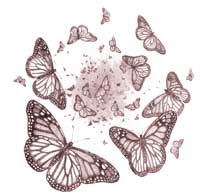
may infect any butterfly larva in its path. Populations of
monarch butterflies those hold little pilgrims who migrate
all the way to Mexico and back by their tissue-thin wings,
are plummeting fast. While there are many reasons for this
(for example, their winter inter forests in Mexico are
bering burned), no reasonable person can argue that dusting
them with a lethal bacterium is going to help matters, So,
too will be the fate of other butterflies more obscure, and
more endangered.
And if that doesn’t happen to break your heart, just wait
awhile, because some filling that pollinates your food or
builds tile soil also may be destined for extinction. And
there’s another practical problem: The massive exposure to
Bt now contained in every cell of this corn, is killing off
all crop predators except those few that have mutated a
resistance to this long-useful pesticide. As a result,
those super-resistant mutants are taking over in exactly
the same way that overexposure to antibiotics is
facilitating the evolution of antibioticresistant diseases
in humans.
In this context of phenomenal environmental upsets. with
even larger ones just Offstage awaiting their cue, it’s a
bit surprising that the objections to genetic engineering
we hear most about are the human health effects. It is
absolutely true that new DNA combinations can create
proteins we aren’t prepared to swallow; notably, genetic
manipulations in corn unexpectedly created antigens to
which some humans are allergic, The potential human ills
caused by ingestion of engineered foods remain an open
category — which is scary enough in itself, and I don’t
mean to minimize it. But there are so many ways for genetic
manipulation to destroy our habitat and Our food systems
that the environmental challenges loom as something on the
order of a cancer that might well make personal allergies
look like a sneeze.
If genetically reordered organisms infiltrate natural
populations, they may rapidly change the genetics in a way
that could seal the entire species’ doom. A scenario
dangerously omnipresent is pollen escaping from genetically
manipulated crops, creating new weeds that we cannot hope
to remove from the face of the earth. Engineered genes
don’t play by the rules that have organized life for 3
billion years (or, if you prefer, 4,004). And in this case,
winning means loser takes all.
What will it mean for a handful of agribusinesses to
control the world’s ever-narrowing seed hanks? What about
the chemical dependencies they’re creating for farmers in
developing countries where government deals with
multinational corporations are including farmers to grow
these engineered crops? What about the business of
patenting and owning genes? Can there be any good in this
for the flat-out need of people trying to feed themselves?
Does it seem safe, the world now being what it is, to give
up self-sustaining food systems in favor of dependency on
the global marketplace? And finally, would you trust a guy
in a suit who’s never given away a nickel in his life, who
now tells you lie’s made you some free Magic Wheat?
These are not questions to take lightly as we stand here in
the epicenter of corporate agribusiness and look around at
the world, asking — “Why on earth would they hate us?”
The general ignorance of U.S. populations about who
controls global agriculture reflects our trust in an
assured food supply. Elsewhere, in places where people grow
more food, watch less TV and generally encounter a greater
risk of hunger than we do, they mostly know what’s going
on. In India, farmers, persist in burning to the ground
trial crops of transgenic cotton, and they forced their
government to ban Monsanto’s “Terminator technology,” which
causes plants to kill their own embryos so no viable seeds
will survive for a farmer to replant in the next generation
(meaning he’d have to buy new ones, of course). Much of the
world has already refused to import genetically engineered
foods or seeds from the United States. But because of the
power and momentum of the World Trade Organization, fewer
and fewer countries have the clout to resist reconstruction
of their food supply around the scariest New Deal ever.
Even standing apart from the moral and political
questions — if a scientist can stand anywhere without
stepping on the politics of what’s about to he
discovered — there are consequences in the science of
the matter no one knew how to anticipate. When the widely
publicized Human Genome Project completed its mapping of
human chromosomes, it offered an unsettling, not-so-widely
publicized conclusion: Instead of the 100,000 or more genes
that had been expected, based on the number of proteins we
must synthesize to be what we are, we have only about
30,000 — roughly the same number as a mustard plant.
This evidence undermined the central dogma of how genes
work; that is, the assumption of a clear-cut chain of
processes leading from a single gene to the appearance of
the trait it controls. Instead, the mechanism of gene
expression appears vastly more complicated than had been
assumed since Watson and Crick discovered the structure of
DNA in 1953. The expression of a gene may be altered by its
context, such as the presence of other genes on the
chromosome near it. Yet, genetic engineering operates on
assumptions based on the simpler model. Thus, single
transplanted genes often behave in starling ways in an
engineered organism, often proving lethal to themselves,
or, Sometimes, neighboring organisms. In light of newer
findings, geneticists increasingly concede that
gene-tinkering is to some extent shooting in the dark Barry
Commoner, senior scientist at the Center for the Biology of
Natural Systems at Queens College, laments that while the
public’s concerns are often derided by industry scientists
as irrational and uneducated, the biotechnology industry is
conveniently ignoring the latest results in the field
“which show that there are strong reasons to fear the
potential consequences of transferring a DNA gene between
species.”
Recently I heard Joan Dye Gussow, who studies and writes
about the energetics, economics and irrationalities of
global food production, discussing some of these problems.
She mentioned the alarming fact that pollen from
genetically engineered corn is so rapidly contaminating all
other corn that we may soon have no naturally bred corn
left in the United States. “This is a fist in the eye of
God,” she said, adding with a sad little laugh, “and I’m
not even all that religious.” Whatever you believe
in — whether God for you is the watchmaker who put
together the intricate workings of this world in seven days
or seven hundred billion days — you’d be wise to
believe the part about the fist.
Religion has no place in the science classroom, where it
may abridge students’ opportunities to learn the methods,
discoveries and explanatory hypotheses of science rather
its place is in the hearts of the women and men who study
and then practice scientific exploration. Ethics can’t
influence the outcome of an experiment, but they can serve
as a useful adjunct to the questions that get asked in the
first place, and to the applications thereafter. (One must
wonder what chair God occupied, if any, in the Manhattan
Project.) In the halls of science there is often an
unspoken sense that morals and objectivity can’t occupy the
same place. That is balderdash — they always have
cohabited.
Social norms and judgments regarding gender, race, the
common good, cooperation, competition, material gain and
countless other issues reside in every active human mind,
so they were hovering somewhere in the vicinity of any
experiment ever conducted by a human. That is precisely why
science invented the double-blind experiment, in which, for
example, experimental subjects don’t know whether they’re
taking the drug or the placebo and neither does the
scientist recording their responses, so as to avoid
psychological bias in the results. But it’s not possible to
double-blind the scientist’s approach to the task in the
first place, or to the way results will be used. It is
probably more scientifically constructive to acknowledge
our larger agenda than to pretend it doesn’t exist. Where
genetic engineering is concerned, I would rather have
ethics than profitability driving the program.
I was trained as a biologist, and I can appreciate the
challenge and the technical mastery involved in isolating,
understanding and manipulating genes. I can think of
fascinating things I’d like to do as a genetic engineer,
But I only have to stand still for a minute and watch the
outcome of 30 million years’ worth of hummingbird evolution
transubstantiated before my eyes into nest and egg to get
knocked down to size. I have held in my hand the germ of a
plant engineered to grow, yield its crop and then murder
its own embryos, and there I glimpsed the malevolence that
can lie in the heart of a profiteering enterprise. There
once was a time when Thoreau wrote, “I have great faith in
a seed. Convince me that you have a seed there, and I am
prepared to expect wonders.” By the power vested in
everything living, let us keep to that faith. I’m a
scientist who thinks it wise to enter the doors of creation
not with a lion trainer’s whip arid chair, but with the
reverence humankind has traditionally summoned for entering
places of worship: a temple, a mosque or a cathedral. A
sacred grove, as ancient as time.
From the book Small Wonder by Barbara
Kingsolver, published by HarperCollins Publishers, Inc.
Copyright 2002 by Barbara Kingsolver. All rights reserved.
Please see MOTHER’s Bookshelf, page 104 in this issue.





