
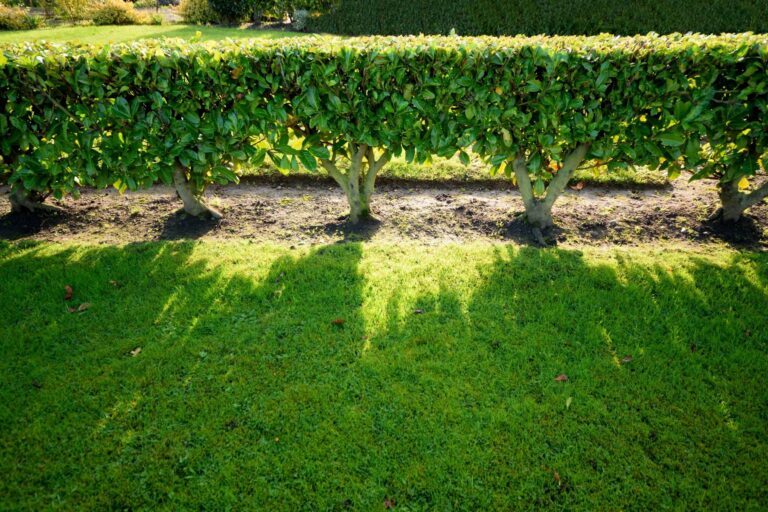
Durable for generations, living fences protect soil, contain livestock, provide wildlife habitat, and sometimes even provide wood. Learn techniques and which shrubs or tree species are best for living fences to get them off to a good start.
Fences on your farm or homestead define property boundaries and separate production zones (garden, pasture, orchard). They provide privacy and security from animal (and perhaps human) intruders. They confine livestock and protect them from predators. They guard crop areas from wild raiders (such as deer) as well as animal allies (such as sheep and goats).
Your first choice for such a multifunctional homestead necessity may be manufactured fencing: woven or electric wire, welded livestock panels, boards on pressure-treated posts, or even virgin or recycled plastic. As the energy and environmental crises deepen, however, such options are becoming less appealing and more expensive. The chemical preservatives, paints, and galvanizing agents used in fence manufacturing and maintenance may have toxic spillover effects in the environment. Furthermore, most manufactured fencing is a “one for one” solution. A woven wire fence meant to contain livestock, for example, provides that service and nothing more. The key to a more self-sufficient homestead that imitates natural systems is finding solutions that simultaneously solve more than one problem, provide more than one service and support more than one project. Enter living fences.
The Many Benefits of Living Fences
A living fence is a permanent hedge tight enough and tough enough to serve almost any of the functions of a manufactured fence, but it offers agricultural and biological services a manufactured fence cannot. For instance, it provides “edge habitat” that supports ecological diversity. As more species (insects, spiders, toads, snakes, birds and mammals) find food and refuge in this habitat, natural balances emerge, yielding, for example, a reduction of rodents and crop-damaging insect populations.
Depending on the plant or tree species you choose, living fences can provide food and medicine or fodder for your livestock. Your animals will also enjoy the shade of a dense hedge. The foliage of some hedge plants, such as elder and Chinese chestnut, contains more protein than the quintessential protein forage crop, alfalfa. Willow and honey locust also make good fodder. I’ve been experimenting with Siberian pea shrub recently, as the peas can be harvested to feed poultry.
Leguminous species included in the fence, such as black locust and pea shrub, fix nitrogen in the soil throughout the root zone, and you can harvest some of that nitrogen for garden mulches and compost in the form of leafy prunings. A living fence increases soil humus as its leaf litter and root hairs (which the plants shed to balance loss of top growth to pruning or browsing) break down.

Living fences are windbreaks, which reduce soil drying, wind erosion, and stress on livestock or crop plants, thus increasing yields. Hedges sited along contours can reduce rainfall erosion on slopes.
Living fences can last far longer than manufactured ones — for as long as the natural life span of the species used, which may be hundreds of years. Many species can be “coppiced,” meaning they will send up abundant new shoots after the main trunk has been cut. A living fence of a coppiced species readily renews itself following selective cutting for wood fuel and other uses.
Finally, a living fence, unlike a static manufactured fence, brings an ever-changing beauty to your landscape: flowers in spring, colorful fruit in summer, brilliant colors in fall and a complex, geometric structure in winter.
Living Fences in America
Though common in ornamental landscaping, living agricultural fences haven’t been used much in the United States, despite extensive use in countries that supplied Colonial America with most of its new settlers. George Washington tried to carry on the tradition at Mount Vernon because, like modern gardeners and orchardists, he was plagued by deer and other marauders. Washington, concerned by both the labor and the loss of forest involved in producing split-rail fencing, concluded that growing living fences was not only a good idea, but was a necessity.
According to Washington’s diary, the species he settled on as most suitable was “Honey locust; the seed of which not to be put more than Six Inches a part; that when they get to any size they may be so close, stubborn, and formidable, as to prevent an escalade [incursion by predators] … indeed I know of nothing that will so effectually, and at so small an expence, preserve what is within the Inclosure, as this plant.”
Osage Orange
Major living fence applications in the United States have utilized Osage orange trees (Maclura pomifera), also called hedge apple or horse apple. For an incredibly tough, enduring windbreak that’s a major player in a local ecology, probably nothing surpasses Osage orange. It was planted extensively in the central and eastern areas of the country in the 1800s (before the invention of barbed wire), especially to fence the rapidly colonized prairies. After the Dust Bowl in the 1930s, thousands of miles of Osage orange were grown as shelterbelts to prevent wind erosion.

Easily propagated from seeds, cuttings, or sprouts from the roots, Osage orange is tolerant of a wide range of soils, resistant to drought, long-lived, and affected little by insects or disease. Planted at a spacing of 1 foot, in four years it makes a fence that is “horse-high, bull-strong, and hog-tight.”
The sharp, stout thorns on Osage orange growth deter deer and livestock. A couple of heavy prunings a year can keep an Osage hedge 4 feet high by 2 feet wide. Without hard pruning, however, it will rapidly grow much taller. Because Osage orange coppices vigorously, farmers can clear-cut sections of fence on a 10- to 16- year cycle for fence posts (about 4,000 per mile) that are immune to termites and are the most resistant to decay of any North American tree species. Osage fence posts have been known to stand in the soil for more than 50 years without rotting. The hard, strong wood was previously used to make hubs and rims of wagon wheels.
Establishing Living Fences
Homesteaders typically create living fences by planting appropriate shrub or tree species — started nursery plants, stem, or root cuttings or seeds — at close spacing. As they mature, the saplings are pruned tightly to force thick, bushy growth and form an impenetrable hedge.
Another fascinating option is to join the individual plants by “inosculation.” Inosculated trees or shrubs are planted 4 to 8 inches apart. As they grow, crossing branches are tied, and they then grow together into natural grafts. The result is a closely meshed barrier that becomes stronger and more resistant each year.
Multifunctional Options
A living fence that will be exposed to deer or goats needs to offer deterrence to keep the animals in or out, whichever the case may be. Hawthorns are small trees with stout thorns that make a good defense system. They produce berries that are edible (by wild birds and people) and that can be used medicinally. The wood makes good fuel and tool handles.
Other thorny species that could be used to make living fences are pyracanthas, jujube, hollies, black locust (also fixes nitrogen), honey locust (which has high-protein seeds and pods for livestock and people), prickly ash, and rugosa rose (which has vitamin C-rich fruits, or “hips”).
Of course, your choice of species depends on your climate and the purposes for which you want to use the fence. A couple of widely adaptable species illustrate the multifunctional possibilities.

Jujube (Ziziphus jujuba), hardy in Zones 6 to 9, fruits precociously, and grows quickly even in poor soil and drought. A young tree I planted two years ago (northern Virginia, Zone 6b) is now covered with sweet, pleasant-tasting fruit. The fruits, leaves, seeds, and roots have been used in various Asian medical traditions, and the leaves make excellent livestock fodder. The dense wood makes fairly good fuel, charcoal, and agricultural implements.
Hedges of tagasaste (Chamaecytisus palmensis), which remains in leaf year-round, have been used extensively as windbreaks and shelterbelts in drier regions, and in Australia, they’ve been used as green firebreaks (used to stop the spread of fire). A deep-rooted nitrogen-fixer, tagasaste grows rapidly even in poor soil and dry conditions. It makes a hedge that recovers quickly from frequent cutting and browsing. Many livestock species, including ruminants, pigs, and poultry, relish tagasaste’s foliage, which is 20 to 27 percent protein. An early bloomer, it’s excellent forage for honeybees. It coppices readily, and its wood makes good fuel.
If you want to try an inosculated fence, a wide range of tree, shrub, and vine species are good candidates: elm, a number of the oaks, olive, dogwood, beech, hornbeam, peach, almond, hazel (filbert), a number of the willows, sycamore, grape and wisteria. Trees with pliable branches are especially suitable, with apple, hawthorn, linden, and pear among the best.

You may certainly mix different species in your living fences. You could set larger trees — fruit or nut trees, for example — at greater spacing than a tightly planted hedge, and then fill the gaps with lower growing species such as rugosa rose or berry brambles, which would produce harvestable food and thorns for deterrence.
Disadvantages
Establishing living fences can be labor-intensive — think of planting 450 seeds or cuttings per 100-yard stretch of fence. Before the fence becomes well-established, you’ll need to take care to protect it from weeds, deer and domesticated browsers. Regular pruning of the mature fence may be necessary. Of course, if you use the prunings for mulches or livestock fodder, the chore is hardly lost effort, and in some cases, the pruning can be left to grazing livestock.
The Future of Agricultural Fencing
Since the death of George Washington’s dream of farm-grown fences, Americans exploiting an incredibly rich continent and rapid technological innovation have usually preferred manufactured fences to living ones. As we enter a new age of ecological limitations and awareness, however, we will hopefully rediscover the benefits of growing our fences. We may even discover a new land ethic through utilizing a farm resource that serves as a major part of the landscape and spans generations.
How to Start an Osage Orange Living Fence
- Collect “oranges” in fall and store them in buckets exposed to freeze-thaw cycles — and even rain and snow — all winter.
- During the same fall, plow a furrow where you want the hedge. Leave it open and let the soil mellow over winter.
- The following spring, at about corn planting time, add a bit of water to the buckets and mash the fermented oranges into a thick slurry.
- Dribble the slurry along the furrow.
- Partially backfill the furrow with some soil to cover the seeds.
- If it seems prudent (i.e., the tree seedlings are consistently crowded), thin the seedlings to about 18 inches.
- In fall, lay the seedlings over in the trench, weaving them together. Backfill the trench, but don’t cover the entire stem of any tree.
- The second year, the trees will sprout a mess of lateral branches that will grow straight up.
- In the second fall, weave the new vertical stems together so you get a horizontal stem barrier about 2 feet from the ground.
- In the third year, prune the hedge’s shoots to the final height you desire (4 to 5 feet works well for most purposes). Pruning the rapidly growing verticals several times over the summer will stimulate the lower buds and branches to produce more (and more vigorous) growth.
Harvey Ussery‘s newest book, The Modern Homestead Poultry Flock (Chelsea Green), will be released in 2011.






