

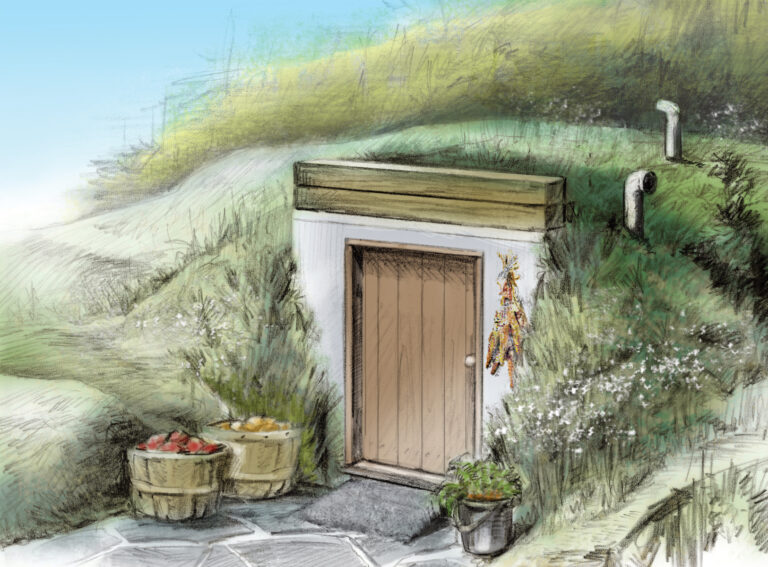
Stow your surplus with these underground root cellar plans. This modern root cellar design turns a never-used septic tank into outdoor walk-in storage.
The cool, moist and dark conditions of a root cellar make it the perfect place to keep many fruits and vegetables crisp and delicious for weeks — even months — of storage. And while there are myriad ways to store vegetables, our innovative root cellar plans show you how to build a root cellar by modifying a new, precast concrete septic tank. By following the plans, you’ll cut an entrance, install a door, add a pair of vent pipes and cover the tank with soil to bring an old-fashioned, walk-in cellar into your modern life.
Choose a Concrete Septic Tank
You’ll want to buy an unused septic tank for this root cellar design, but look for a deal to avoid paying full price. A percentage of all precast concrete septic tanks end up with small manufacturing defects that prohibit them from being used for sewage treatment. Suppliers sometimes offer discounts on these flawed tanks. As long as the tank is solid and sound, a chipped edge or a patchable hole won’t prevent it from being a root cellar. You won’t need the plastic fittings or effluent filter found inside most septic tanks, so ask the supplier to remove these before delivery.
Tank size is another detail you’ll need to consider when planning how to build a root cellar from a septic tank. The capacity of septic tanks is measured in gallons, with different models being taller or shorter. While you might be tempted to buy a 1,000- or 1,200-gallon tank because they’re common, you’ll get more food storage space and headroom with a tank that’s 1,500 gallons or larger. Standard 1,500-gallon tanks typically measure about 5-1/2 feet wide by 5-1/2 feet tall by 10 feet long, while a 2,500-gallon tank provides more than 6 feet of interior headroom. Don’t choose a low-profile tank because it will be much too short to work in. Prices for new, undamaged 1,500-gallon tanks start at about $1,100, and 2,500-gallon models can be found for as low as $1,600. Discounts for damaged tanks may be as much as 50 percent.
Most septic tanks have an internal partition that must be opened or removed to build from these root cellar plans. Try to find a tank without a partition, or ask your supplier to remove it before delivery. You can also punch through the partition yourself as part of the doorway-cutting process.
Concrete Septic Tank Root Cellar Plans

The perfect location for a root cellar is nestled into an existing soil bank in a well-drained location 10 to 20 yards from your house. Ideally, the door should face north to keep out the sun’s heat. You’d be fortunate indeed to have all of these conditions, and most people have to modify their sites. Expect to pay from $50 to $100 per hour for a backhoe and operator to excavate your site for three or four hours.
Spread a 1-foot-deep bed of three-quarter-inch-diameter crushed stone beneath the excavated tank site and the planned entryway to support foot and wheelbarrow traffic. Crushed stone is easy to move around to make a level surface for your tank. Suppliers usually offer a delivery service using a boom truck to set down the tank wherever you want. Check the tank with a 48-inch level after the boom-truck driver has set it into place. If the tank isn’t level, have the driver lift the tank so you can get a rake underneath to move the crushed stone. Keep setting, checking, adjusting and replacing the tank until it sits flat and level.
Install a Door and Vents
The tank should be in its final position before you cut the door opening, because removing concrete could weaken the tank enough to cause damage if it were moved again. Use a level and pencil to mark a rough opening on the end opposite the effluent pipe hole. Locate the bottom of the door 4 inches above the floor to keep dirt and rainwater out of the cellar.
A concrete-cutoff saw is the tool of choice for making a door opening by cutting concrete. Set up a large work platform a couple of feet lower than the tank’s top, don eye and ear protection, and recruit a second pair of hands to hold the masonry saw from above as you move along the top horizontal cut line. Make the two vertical cuts next, then tackle the horizontal cut across the bottom. Leave a small amount of concrete uncut in the upper corners to hold the slab in place until you’re ready to bust it into the tank with a sledgehammer. Repeat this process to remove the inner partition if your tank still has one.

You can make your own root cellar door out of wood, but getting it to seal well will be difficult. Consider using an insulated steel residential door pre-hung in a frame. Exterior steel doors provide exceptional seals. Choose one without a window because darkness is essential for maximizing the storage life of produce.
Good root cellar design requires two 4-inch-diameter vent pipes to control internal temperatures and allow excess moisture and gases to escape. (For advice on using root cellar vents, check out The Fundamentals of Root Cellaring.) One pipe should extend to the floor inside the cellar while the other should end near the ceiling. This difference in height encourages air circulation. All septic tanks have a hole for a 4-inch pipe at one end, which will work for a ceiling vent, but you’ll need to bore a hole somewhere else for the longer vent that extends down to floor level — just inside the door is best. While you’re at it, bore a 4-inch drain hole in the floor so you’ll be able to hose out your root cellar at the end of the season.
Finish the Roof and Backfill
The tops of concrete septic tanks have access hatches that must be sealed. Apply a generous bead of polyurethane caulking around the perimeter of the hatch openings and close the hatches for the last time. Next, use a hand-held grinder to cut off the hatches’ protruding metal handles. Now that the tank is flat on top, you’ll need to apply a watertight barrier to prevent roof leaks. Use a heavy, self-adhering water-and-ice shield designed to be used as roofing underlay. The best shields are thick and have a peel-and-stick adhesive backing — my favorite products include Blueskin self-adhesive water-and-ice barrier, and Grace water-and-ice shield. Apply two layers of shield that extend over the top in overlapping sheets and fold down the sides 4 inches lower than the joint where the tank’s top and sides meet.
Because your tank will be tucked into the earth, you’ll need a secure way to hold back the soil at the entryway. The drawings in the slideshow illustrate how to build a root cellar retaining wall using 6-by-6 timbers, with a lintel across the top to stop backfilled soil from falling down over the door. Find instructions on building a timber retaining wall anchored by T-shaped tiebacks at how to build a retaining wall with crossties. Another option is to construct a retaining wall using interlocking concrete blocks. Retaining walls ensure the best cellar performance in cold climates because they maximize the amount of soil contact on both sides of the door, and soil’s insulating factor is what stabilizes the temperature inside a root cellar and makes it suitable for storing vegetables.

If your climate doesn’t experience severe winters, an easier alternative involves banking up the soil as steeply as possible on both sides of the doorway while leaving some of the front wall exposed. Instead of building a tall retaining wall, you could install horizontal layers of geogrid (a polymer material used to reinforce soils) in the dirt as you backfill around the door, building as steep a slope as possible.
Haul in soil and spread it around the sides and top of your tank. Because backfilling by hand is hard work, you’ll probably want to hire the backhoe and operator for several more hours. Sandy, light soil is best for backfilling because it reduces soil pressure on the sides and top of the tank, drains better, and is easier to shape and contour. Aim for a layer of 1 to 2 feet of soil on the roof.
Using Your Modern Root Cellar
Plant grass on the backfilled soil, add some easy-to-build wooden storage shelves and bins inside your cellar, load ’em up with your healthy, homegrown foods — and you’re finished with these underground root cellar plans. Money can’t buy the feeling of security and satisfaction you’ll get from a winter’s worth of good eating sheltered by your own root cellar.
Wondering how this septic-tank root cellar performs? Get a report on how this underground root cellar stood up to an especially harsh New York winter.
Cutting Concrete
These root cellar plans require you to cut through the walls of concrete septic tanks. To do so, you’ll need to rent or borrow a gas-powered masonry cutoff saw spinning a 14-inch-diameter diamond wheel to make the door opening, and an electric rotary hammer with a 4-inch carbide coring bit to bore vent and drain holes. Be sure to use a saw that accepts a garden hose because water injection will tame the clouds of dust. The rotary hammer with coring bit needs no water. Septic tanks usually have reinforcing rods embedded in the concrete, so ask for a coring bit and masonry blade that can handle metal.
Steve Maxwell is an expert builder and stonemason who stores his garden produce underground in Ontario, Canada. Find his homesteading advice at Bailey Line Road. Maxwell co-authored The Complete Root Cellar Book.





