
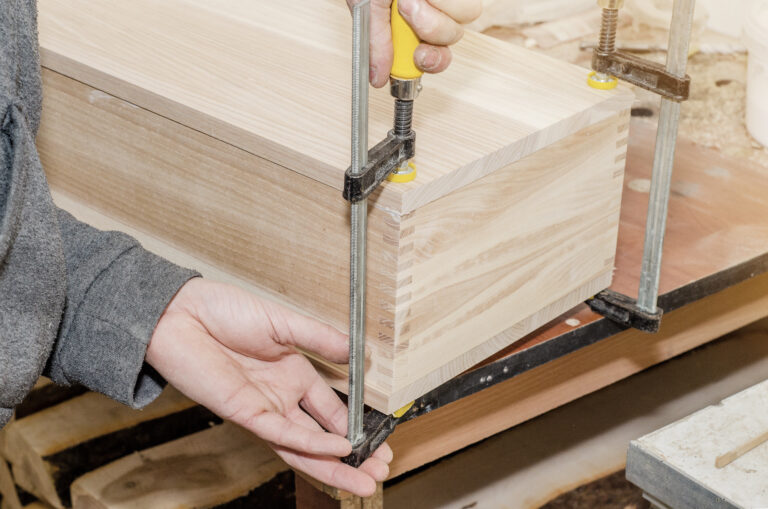
Expand your carpentry skills by learning different methods of how to build a wooden box.
Boxes form the heart of many types of furniture, cabinets and shelves, bins, storage crates, raised garden beds, and even buildings and large timber frames. After you’ve mastered the basics of how to build a wooden box, you’ll be ready to successfully tackle many DIY projects, large and small.
I’ve been making wooden boxes of one sort or another since getting serious about woodworking in the early 1980s, and the three basic approaches outlined here are the most useful I’ve found. They work well for solid timbers, boards, plywood, particleboard, medium-density fiberboard (MDF), melamine and any other sheet material.
Guaranteed Square
When you build a box, you must make perfect 90-degree corners, and a tape measure is the best tool to use. The trick to knowing you have it right has to do with geometry. When opposite sides of a box are equal in length, and measurements taken across diagonally opposite corners are equal, then the corners form 90-degree angles, and are “square.” You can bet your life on it.
I use diagonal measurements to determine square corners on everything from kitchen cabinet boxes to forms for pouring a 100-foot concrete pad. It’s an extremely useful technique that’s always reliable.
That said, the only time it’s possible to square a box is before you’ve attached the bottom or back. Without the support a bottom or back delivers, you’re still free to push and pull opposite corners to change their angle. This action is called “racking.”
The Butt-Joined Plywood Box
This is the basic design for building planter boxes, storage boxes, kitchen cabinets, benches and more. Four pieces of wood create the sides of the box, with a fifth piece forming the optional back. Despite the diverse uses of butt-joined boxes, all are constructed in the same way.
“Butt joint” is a woodworking term that describes a 90-degree connection between two pieces of wood, in which the edge of one piece is joined, or “butted,” to the face of a neighboring piece. This is the simplest of all woodworking connections, and when they involve plywood or most other kinds of sheet materials, joints completed with glue and finishing nails are more than strong enough for most situations.

Butt-joined boxes are most often made with one-half- or three-quarter-inch-thick sheet materials. Cut parts to width with your table saw or track-guided saw (see “Track-Guided Saws Make Cutting More Precise” at the end of this article). If some of the edges of the completed box will remain visible, you may want to hide the edges for appearance’s sake.
Continue by trimming opposite sides of the box to identical lengths, and then bring the corners together after spreading glue on both corner surfaces. The only exception here is melamine or other factory-finished sheet goods — glue can’t bond to these finishes, so don’t bother applying any.
You’ll find 1-1/2- to 2-inch-long hand-driven finishing nails or 18-gauge power-driven brads work best to secure glued and butt-joined corners for three-quarter-inch-thick stock used for large cabinets; 1- to 1-1/4-inch nails or brads are best for the half-inch thick materials typically used to make drawers and smaller cabinets. Either way, you’ll find it much easier and less likely to cause splitting if you drive nails by hand into pre-drilled holes that are slightly smaller than the diameter of nails you’re using. Power-driven nails move through wood so quickly that they almost never cause splitting, even without pre-drilling. (See “Three Advantages of Power-Driven Nails”.)
There are three ways to add a simple back or bottom to your box. The easiest is to cut a piece of quarter-inch- or half-inch-thick sheet material and then fasten it to your box with glue and small finishing nails. If you prefer to hide the edges of your bottom or back panel, one option is to create a two-sided notch along the inside edges of the sides that matches the thickness of your back panel. This kind of groove is called a rabbet, and a router spinning a rabbeting bit with a bearing is the easiest way to create it. A third option for installing a box bottom or back is to create a three-sided groove, called a dado, that contains the back or bottom panel. A table-mounted router or table saw are ideal tools for creating this groove.
The Shelf Box: Bookcases and More
This design has a top, bottom and two sides connected with butt joints, and additional horizontal pieces create shelves. Using glue with either nails or screws is the simplest option for anchoring these shelves, but there’s a trick to getting shelf spacing and orientation correct. By cutting your top, bottom and shelves all the same length, the sides simply straddle the ends during assembly. Cut scrap plywood spacers to fit between the shelves as you’re joining them, first to one side of the shelf, then another. The spacers automatically ensure correct placement and shelves oriented square to the sides. Have a helper hold the shelves vertically on their ends while you place the box’s side in position and drive screws.

The Timber Box
Outdoor projects often involve large timbers or logs, and though most of these structures are more like frames than boxes, the principles of box construction apply. Square timbers make a great sandbox enclosure, for instance, and round logs are perfect for building gate and dock cribs.
Beam boxes are often part of the floor frame of small buildings, and they need to come together square and true. Because timber structures are so large, even a 24-inch framing square won’t offer an accurate reference for assembling corners. In these cases, equalizing diagonals is the best way to ensure square corners. Eight-inch- and 12-inch-long galvanized spikes offer an excellent way to join parts in corners, and a 6- or 8-pound sledgehammer is perfect for driving them. Don’t try to use anything lighter, and always wear safety glasses — bits of metal often break off spike heads when they’re pounded. When joining timbers at the corners, create lap joints using a hand-held circular saw to make multiple cuts across the ends of your timbers every quarter-inch, then remove the waste with a mallet and chisel.

Locking Drawer Bottoms
A drawer is really just another kind of box. Drawer bottoms are typically made from quarter-inch-thick hardboard or veneered plywood, and the traditional method for securing them is to create dado grooves in the sides, front and back of the drawer before assembly. The only problem here is that a drawer bottom held captive within a groove isn’t necessarily going to give much support to the drawer. The drawer can still rack, unless you use this little-known trick: With your drawer upside-down on a workbench, double-check that the assembly is square, and then run a generous bead of glue along the inside corner where the bottom panel meets the drawer sides. When the glue dries, it will lock everything together and prevent the drawer bottom from rattling during use. And because the glue is on the underside of the drawer, no one will ever sees it.

Three Advantages of Power-Driven Nails
There are three big reasons to use a power nailer rather than a hammer to fasten box parts.
- A nail gun gives faster results than a hammer, and you’ll gain greater accuracy with a gun. Holding a nail and starting it with a hammer is a two-handed affair, and this makes it more challenging to hold parts together in perfect alignment just before they’re joined. A gun requires only one hand to hold and fire, freeing your second hand to hold parts together.
- Because they travel so fast, power-driven nails are also much less likely to split wood than hammer-driven nails. An 18-gauge brad nailer is an excellent option for joining most furniture-related boxes that require fasteners up to 2 inches in length.
- If you need longer fasteners or stronger nails, choose a 16-gauge or 15-gauge model. Power nailers also come in air-powered, cordless electric or fuel-fired models.
No-Glue Joinery
Sheet goods, such as melamine-coated particleboard or medium-density fiberboard (MDF), are sometimes available with factory-applied finishes, which saves lots of time and trouble because all you have to do is cut and join them. Because glue can’t bond to these slick surfaces, you’ll need to use more than finishing nails to secure butt joints.
You could use deck screws for this job, but to do so you’ll need to pre-drill holes in both sides of each joint. Create a test joint with scraps before tackling your boxes, as edges in particleboard and MDF are prone to splitting.
Two types of special screws can help, although you may have to special-order them. Lo-Root screws look like deck screws, but their unique thread design makes them much less likely to cause splitting. Another specialty screw called Confirmat is designed specifically for joining MDF or particleboard without glue, and though they also require pre-drilling, Confirmat screws make joints much stronger than ordinary screws do. Confirmat screws can also be removed, allowing joints to be taken apart easily for transport.
Covering the Edges
Drawers and cabinets with no face frames are two examples of box-based projects where edge appearance matters.
Plywood, particleboard, melamine and most types of sheet goods have ugly edges wherever laminations or core materials are visible. Even most cabinet-grade plywood with fancy veneers glued onto the face at the factory looks rough along the edges. (The only exception is an all-hardwood sheet material called Baltic birch plywood. Although laminations are visible along edges, they’re thin, gap-free, regular and quite attractive. Sand the edges smooth and you probably won’t need solid wood strips at all.) Building boxes properly often requires covering these edges, and there are two ways to do it.
The easiest way to cover edges is with iron-on edge banding. This thin, sometimes synthetic material is made either to look like wood grain or with colors that match factory-finished melamine sheets. Inexpensive, quick-to-apply and attractive, this is the stuff most often used on ready-made, economy furniture. The main drawback with iron-on edging is durability. The hot glue may let go in time, allowing the edging to move and come loose.
Gluing solid wood edging to sheet goods edges is a more craftsman-like approach, and a table saw is the tool for cutting lumber into the strips you’ll need. I make mine one-quarter-inch to three-quarter-inch thick, and one-sixteenth-inch wider than the thickness of the sheet goods.
Spread a continuous bead of wood glue on the inside face of the strips, then use clamps or masking tape to hold the strips onto the piece. There needs to be a small amount of edging overhanging the sheet goods on both faces before you set the assembly aside to dry. When the glue is hard, sand away the overhanging strip material so the edging is flush with the faces of your sheet goods. Solid, beautiful and permanent edging is what you get.
Effective skills to build a box often look more complicated than they are. A handful of basic principles are at work in many seemingly different situations. Learning to plan, cut, assemble and square box structures is a great place to build your skills. After all, boxes are everywhere.
Track-Guided Saws Make Cutting More Precise
Table saws are useful for building all kinds of things based on the box concept, but there is an up-and-coming tool that’s easier to use for cutting sheet materials. Generically called track-guided saws, these tools are made by a handful of companies.

A specially designed, hand-held circular saw glides on an aluminum track clamped to the wood. Instead of wrestling a 75-pound sheet of three-quarter-inch plywood onto and over a table saw, the wood sits still on sawhorses, while the saw slides over it. Unlike most table saws, a track-guided saw leaves perfectly smooth edges on both faces of each cut.






