You can craft your own homemade wreath from foraged materials using grapevines, honeysuckle, kudzu, sweet pea, or bittersweet vines.
The wreath dates back to ancient Greece. Being circular in shape, and thus having neither a beginning nor an end, it represented eternity and was worn by brides as a symbol of good luck and happiness. In later times, pine wreaths became popular as Christmas decorations — their scent was thought to drive evil spirits from the house. Vines are commonly used to make wreaths too. Grapevines are most typical, but you can also use honeysuckle, kudzu, sweet pea or bittersweet vines. I have used young willow branches as well. Many of these vines can also be transformed into baskets, trellises, garden furniture and fences.

Finding Vines for a Homemade Wreath from Foraged Materials
Pre-made grapevine wreaths can be purchased at most craft suppliers, but if you have access to woods or a vineyard, or you happen to know a backyard grape grower, you can collect the vines yourself. Grapevines should be collected after the grapes have been harvested and before the frost. Cut the vines into 2- to 3-foot lengths. Any longer and they’ll be difficult to detangle from surrounding ones and to transport home. A side benefit of cutting vines is that you’re actually helping to protect the trees and other plants that the vines climb on and eventually strangle as they tighten their hold. After you have your vines, remove the leaves but retain the tendrils, which will give the wreath an added decorative flair.
A Simple Grapevine Wreath

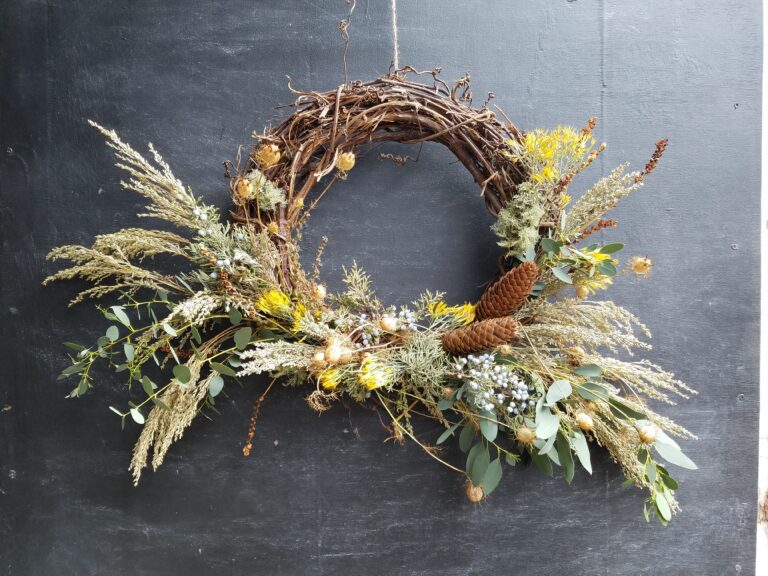
To make a wreath, use several lengths of vine to form a circle, binding the vine ends together with brown paper-covered wire (sold in craft stores). Next, weave more vines around the circle until the wreath is as thick as you want it, securing them with wire where necessary. Now prune any unattractive pieces of vine with clippers. For the finishing touch, decorate the wreath with dried flowers, berries, nuts or other woodland finds, attaching them with thin wire. If you’re planning to hang the wreath outdoors, be sure to choose weatherproof items.
Juniper Berry Wreath

Juniper berries are the most wonderful slate blue and show up nicely against a background of cedar greenery. Wired onto a grapevine wreath, juniper makes a lush, attractive decoration for the holidays. Just be sure to collect the berries early in fall before the birds eat them. I hung this juniper berry wreath outdoors over my kitchen window and eventually all the berries were devoured — but I did have a front-row seat to observe the feasting.
Potting Flowering Vines

Pre-made grapevine balls can be purchased at most craft stores and used to grow any type of climbing flowering vine, such as this passionflower vine. Begin with a planter that’s large enough to accommodate the ball. Plant a young vine in the container, and then set the ball on top. As the vine grows, train it to weave in and around the grapevine ball.
Princess Pine Wreath

Also known as ground pine or running pine moss, princess pine is an attractive vine that produces small pine cones and curly pine leaves that turn from green to soft beige if cut. Lightweight and shallow-rooted, it is easy to collect and can often be found growing under trees where grass is sparse and on compacted forest floors under leaves and pine needles.
I made this princess pine wreath by wrapping princess pine around a flat wooden form and tying it in place. I then added pine cones to complement the soft beige tone of the dried, curly pine leaves.
Materials:
- Princess pine vine
- Scissors
- Flat wooden wreath form with 6 pre-drilled holes (sold in craft stores)
- Hot glue and glue gun
- Pine cones
- Thin wire
Instructions:
- Weave the vine through the first hole in the wooden wreath form. Then wrap the vine around the wooden form until you reach the next hole, and weave the vine through it. Continue in this way until the base is covered.
- Wrap a second layer of vine around the wreath like a ribbon, hot-gluing the ends in place.
- Hot-glue a few pine cones to the wreath.
- Use wire to hang the wreath.
This excerpt is from Woodland Style: Ideas and Projects for Bringing Foraged and Found Elements Into Your Home by Marlene Hurley Marshall (Storey Publishing, 2010). Full of home decorating ideas to admire and create, Woodland Style offers more than 150 pages of unexpected adornments made from pine cones, acorns, moss, bark, leaves, tree branches, river rocks and other earthborn trimmings. This excerpt is from Chapter 2, “Twigs, Vines and Roots.”