Create your own DIY adobe house with these small adobe house plans. This step-by-step guide includes information on creating the home foundation, making adobe bricks and detailed diagrams and materials list.
What Are Adobe Homes?
Adobe homes are built from sun-dried bricks made of earth, water, and straw. Common in arid regions like the American Southwest and parts of Latin America, they are valued for their eco-friendliness and cultural significance.
Key Features
- Natural Materials: Made from clay-rich soil, water, and straw, adobe is sustainable and environmentally friendly. The clay content and clay particles in the soil provide cohesion and strength when mixed with organic materials such as straw.
- Thick Walls: Walls are typically 10-24 inches thick, offering excellent insulation by storing heat during the day and releasing it at night. These thick adobe walls not only provide energy efficiency but also reflect an architectural style favored by indigenous peoples in adobe buildings across centuries.
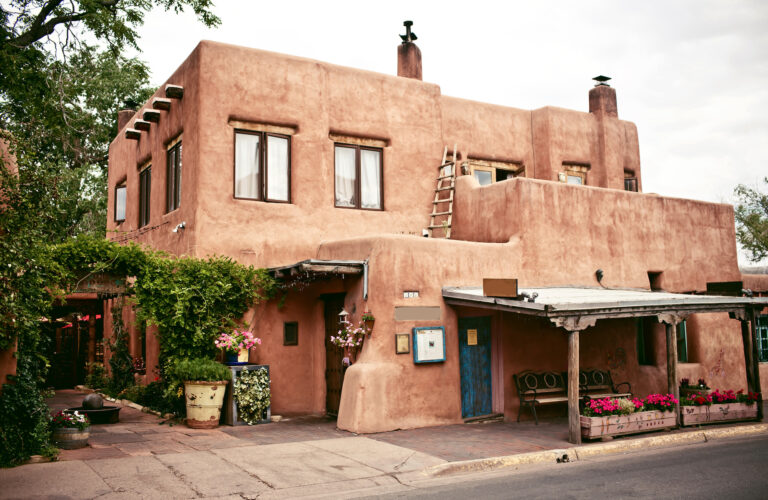
- Distinctive Look: Characterized by flat roofs, rounded corners, and exposed wooden beams (vigas), with natural earth-toned finishes. A traditional adobe roof made of mud plaster often tops the adobe-style house, complementing the earthy design.
- Maintenance Needs: Because Adobe is a dry material it is prone to water damage and requires protective coatings and ongoing care. Adobe construction will deteriorate without protective mud plaster or other water-resistant finishes, especially on the exterior walls.
History of Adobe Homes
Adobe homes date back to at least 8300 BCE, first appearing in the Middle East and later in Indigenous American architecture. Made from sun-dried earth and straw, adobe was ideal for hot, dry climates due to its insulating properties.
In the American Southwest, Ancestral Puebloans used adobe to build enduring structures like those at Chaco Canyon. Spanish settlers later formalized adobe techniques, spreading the style throughout Mexico and the U.S. Southwest. In the 17th century, adobe architecture began to merge with European influence, blending traditional earthen materials with emerging methods. Today, adobe remains valued for its sustainability and cultural heritage. It also stands as a viable alternative to modern building materials due to its lower cost and reliance on cheaper materials available locally.
Building an Adobe Brick House
Lick the material shortage by building an adobe brick house; adobe bricks are made of stabilized soil, it is as durable as concrete and much more interesting. Using adobe construction can reduce dependence on modern building materials while allowing builders to utilize abundant local resources like mud, clay and even local grasses.
Once again, we’re pleased to roll the clock back 30 years in order to reprint another in our series of articles by Hi Sibley (see “100 Concrete Blocks Per Hour” in MOTHER NO. 45 for the first in the series).
Hi, in case you’ve never heard of his work, was living a MOTHER-type life of do-it-yourself adobe houses, organic gardening, homestead bees, and like that away back at the end of World War II. And not only living it . . . but writing about it in a great number of magazines. Unfortunately for us all, more folks back there in the late 40’s were more interested in big cars, city jobs, and new homes in the suburbs . . . than were interested in Hi’s subjects.
Now that so many of us are rediscovering Mr. Sibley’s way of life, though, we think it’s only fair to honor the man who was 30 years ahead of his time by again publishing some of his down-to-earth gems one more once. This — the first of a two-part article — originally appeared in the February 1947 issue of Mechanix Illustrated (copyright 1947 by Fawcett Publications, Inc.) and is reprinted by permission.

There are few sections in the United States where the soil does not contain clay suitable for making “adobe bricks”. In view of the fact that the bulk of this material costs you nothing, and that you can make the brick yourself, it is the ideal medium for home construction.
This ease of use is why adobe blocks formed from clay mixture and straw were often used in adobe buildings by indigenous peoples, reflecting centuries of sustainable living. In modern day when mixed with an asphalt emulsion stabilizer the brick is as waterproof as concrete. It is an excellent insulator against heat, cold, and sound. It is fireproof, termite-proof, and freeze-proof.
Adobe for the old California missions was mixed with water and straw in the original excavation. The modern way is to use a mechanical mixer so as to impart a uniform quality to the brick. Formulas will be given later. In the meantime, consider the foundation. Since 12 inch wide (one story high) adobe walls weigh about 700 lbs. to the running foot, excluding the roof, a heavier footing will be required than for a frame house.


The Adobe Home Foundation
The first step is to grade the site and get the corner stakes level with a transit. Trenches for the footing are dug and flooded with water overnight. The simplest footing design is shown at A, Figure 2. This has a shallow key for mortar upon which the first course of brick is laid. In the inverted T design, B, the top is scored with a trowel to retain the mortar. This is the method used in the author’s home.

In preparing the ground, remove all organic matter and roots. The slab is poured over cinders or crushed stone, spread over the entire surface to an 8 inch depth, and well tamped. This fill serves the double purpose of insulation and waterproofing. Over it place a layer of reinforced building paper and cement the joints with hot asphalt.
A 4 inch slab of concrete is then poured over the building paper. Use a 3:2 1/4:1 mix. Maximum size of the coarse aggregate should be one inch. Do not use more than six gallons of water per sack of cement including the moisture contained in the sand and gravel. Cure the concrete by sprinkling at intervals with a fine spray of water.
At A, Figure 3, is shown a type of footing suitable for a garage. The brick begins well above the floor level and thus above reach of water when hosing down the floor. To protect the outside wall, the first four courses are plastered with stucco, with the top notched into the wall, B. Foundations for wood floors over basements are shown at C and D. In all cases the bricks are trued up on the inside as in E if the interior is not to be plastered. Otherwise, true up the outside.

At outside doorways lay a beveled 2 by 4 in the concrete to which the saddle or threshold can be screwed, Figure 4. This illustration also shows the notched brick to receive the door jamb batten, which will be described later.

The Adobe Home: Making the Brick
Molds for making the adobe brick are shown in Figure 5. A 4 inch thickness is commonly used because it cures better than a thicker one. The standard size is 12 by 18 inch having a volume of 1/2 cubic feet and a face area of 1/2 square feet, although in the house shown in the photos, bricks of 16 inch length were used. These individual bricks, when assembled together, create the structural adobe walls of the adobe-style house.
For the key bricks, adjoining door, and window openings, wooden blocks are nailed inside the molds, as shown, and for rounded corners, curved pieces are installed. A mold, making several smaller bricks for fillers, will come in handy and nave splitting the standard size brick.

Soil must contain sufficient clay to bind strongly when dried after mixing with water. The right clay content, along with sand and straw, forms a mud mixture that dries into durable bricks. Heavy soils are usually too rich in clay and require blending with sand to overcome excessive cracking during drying. To obtain the general suitability of any soil, mold a 2 inch mud ball from a sample taken below the grass roots. If the ball dries hard and is not easily crushed, it may prove suitable for stabilized bricks.
The strength is due to the natural bond of the clay and not to the stabilizer. If the soil is difficult to mix with water and the ball cracks on drying, additional sand or straw is required. Soils which contain alkalies should not be used.

The important ingredient of adobe bricks is a liquid stabilizer which not only renders them waterproof but increases their hardness until they are practically as durable as concrete. Stabilizer is sold under the trade name of Bitudobe manufactured by the American Bitumuls Company, San Francisco, California, and Bitumuls sold by the Standard Oil Co. of California.
Two series of tests should be made to determine the suitability of the soil and the amount of stabilizer required. The first series uses water and soil, for the second series add the stabilizer. If the soil is heavy clay or adobe, mix straight soil for the first brick; for No. 2, use three parts soil and one of sand; for No. 3, two and one-half parts soil, one and one-half parts sand; No. 4, two parts soil and two parts sand; No. 5, one and one-half parts soil, two and one-half parts sand; No. 6, one part soil, three parts of sand. Mold a jell size brick in each case.
Too much clay produces cracking; too much sand decreases strength and resistance to erosion. Place the mold on level ground and force the mud into the corners with the hands. Remove excess mud with a straightedge across the top and lift off the form immediately. In about two days turn on edge. After drying in the sun two weeks or more, examine for cracking and strength. This test determines whether additional blending is advisable. Small center cracks are not harmful.

Using the soil mixture that has shown satisfactory strength and the least cracking in the previous series, make up a new batch and divide into four parts, each enough for a standard size brick, 4 by 12 by 18 inch. To No. 1 add two pounds or one quart of stabilizer; two and one-half pounds to No. 2; three pounds to No. 3; three and one-half pounds to No. 4.
Thus each brick will contain approximately 4, 5, 6, and 7 percent of stabilizer respectively by weight of the 50-pound brick. Mix each portion thoroughly and mold in the brick form, saving enough from each for a pat about 1/2 by 4 inch in diameter. Allow the bricks to dry in the sun, but hasten the drying of the pats by placing in a slow oven (150 — 200 degrees Fahrenheit). When the pats are cool, immerse in cold water for 24 hours.


Adobe Home Construction – FAQ
- What are the main benefits of adobe homes?
Adobe homes are energy efficient because their thermal mass helps regulate indoor temperatures. Built using adobe construction techniques with adobe blocks and other earthen materials, they make use of natural components like earth, sand, and straw. These structures are eco-friendly, relying on cheaper materials rather than industrial alternatives. With proper care, they are highly durable and naturally resistant to fire. - How are wiring and plumbing handled in adobe walls?
Wiring and plumbing are integrated into thick adobe walls using channels–formed during construction or carved afterward–where protective conduits are installed to prevent moisture damage. This approach allows modern utilities to be added without compromising the building material. - What climates suit adobe homes best?
Adobe performs best in hot, dry climates, making adobe-style homes especially popular in arid parts of North America and South America, where adobe architecture has thrived for centuries. In wetter regions, additional weatherproofing–such as water-resistant plaster and wide roof overhangs–is required to protect the structure.
Adobe Home Materials List
Adobe Home: Walls
- 3200 adobe brick 4 by 12 by 16 inch outside walls
- 750 adobe brick 4 by 8 by 16 inch partitions
- 6 cubic yards adobe, 150 gallon stabilizer for mortar
Adobe Home: Foundation
- 30 cubic yards concrete
- 140 square yards double strength tar paper lumber for forms
Adobe Home: Windows and Doors
- 354 lineal feet 2 by 8 inch redwood, frames
- 56 lineal feet 2 by 14 inch redwood, sills
- 820 lineal feet stops
- 190 square feet 2 inch redwood for doors
- 15 pieces pine 3 by 12 by 48 inch headers, windows, outside doors
- 7 pieces pine 3 by 8 by 48 inch headers, inside doors
- 1 piece pine 9 by 12 by 14 feet headers, view window
- 1 piece pine 6 by 8 by 8 feet headers, living-dining doorway
- 9 steel sash, 37-1/2 by 51 1/2 inch, B lights
- 3 steel sash, 37-1/2 by 37 1/2 inch, b lights
Adobe Home: Bond Beam
- 3 cubic yards concrete form lumber
- 1 roll barbed wire
Adobe Home: Plate
- 178 lineal feet 2 by 12 inch pine outside walls
- 84 lineal feet 2 by 8 inch pine partitions
- 54 anchor bolts 1/2 by 7 inch
Adobe Home: Ceilings
- 5 solid redwood beams 6 by 6 inch by 18 feet
- 2 solid redwood beams 3 by 6 inch by 18 feet for ends
- 26 pine joists 2 by 6 inch by 12 feet
- 12 pine joists 2 by 6 inch by 14 feet
- 6 pine joists 2 by 6 inch by 18 feet
- 512 board feet random width 1 inch redwood, living room
- 754 board feet 1 by 12 inch knotty pine, for other ceilings
Adobe Bathroom Plastering
- 3 bags hardwall plaster
- 1 bag stucco
- 1/2 ton sand
Adobe Home: Home Roof
- 70 pieces 2 by 4 inch by 16 feet rafters
- 18 pieces 2 by 4 inch by 9 feet rafters
- 30 pieces 2 by 4 inch by 12 feet tie beams
- 1800 board feet 1 by 8 inch pine sheathing
- 100 bundles No. 1 cedar shingles
- 40 pounds No. 4 galvanized shingle nails
- 10 pounds No. 3 galvanized shingle nails
- 2 root vents, plumbing, bath and kitchen
- 1 roof jack, 3 inch for water heater
- 2 roof jacks, 6 inch for space heater
- 216 feet 2 by 4’s for ratter bracing plus flashing tin for valleys and chimney
Adobe Home: Gables
- 70 lineal feet 2 by 4’s
- 200 board feet 1 by 12 inch pine siding
- 2 louvres, 24 by 30 inch
- 1 louvre, 18 by 24 inch
Adobe Home: Cupboards and Bookshelves
- 360 board feet knotty pine
Adobe Home Fireplace
- 125 firebrick
- 40 red brick, raised hearth
- 1 damper, 36 inch
- 4 sections oval flue tile, 13 by 17 inch
- 1 angle bar, 1/4 by 6 by 44 inch
Adobe Home: Interior Cornice and Baseboard
- 276 lineal feet 1 by 6 inch redwood
- 276 lineal feet 1 by 5 inch oak
Adobe Home Plumbing
- 1 Kohler bathtub Complete
- 1 Kohler close-coupled toilet
- 1 Kohler vitreous china lavatory
- 1 20 gallon water heater
- 1 Kohler double sink
- 1 single laundry tray
- Plus fittings, pipe lines, sill cocks, etc.
Adobe Home: Linoleum
- 24 yards No. 1 grade, for bath and kitchen
Adobe Home: Paint
- 15 gallons Kemtone, ivory
- 2 gallons stain for gables
- 2 gallons linseed oil
Adobe Home: Miscellaneous
- 20 square feet tile bathroom
- 1296 square feet ceiling insulation
- Hardware, nails, etc.
This has been the first of a two-part article that was originally published in Mechanix Illustrated in February of 1947. The second half of the piece (which originally appeared in the March 1947 Mechanix Illustrated ) was printed in MOTHER NO. 47.
Read more articles about building with adobe: Adobe Mud: Building With Earth
Originally published as “Modern Home From Mud” July/August 1977 MOTHER EARTH NEWS.