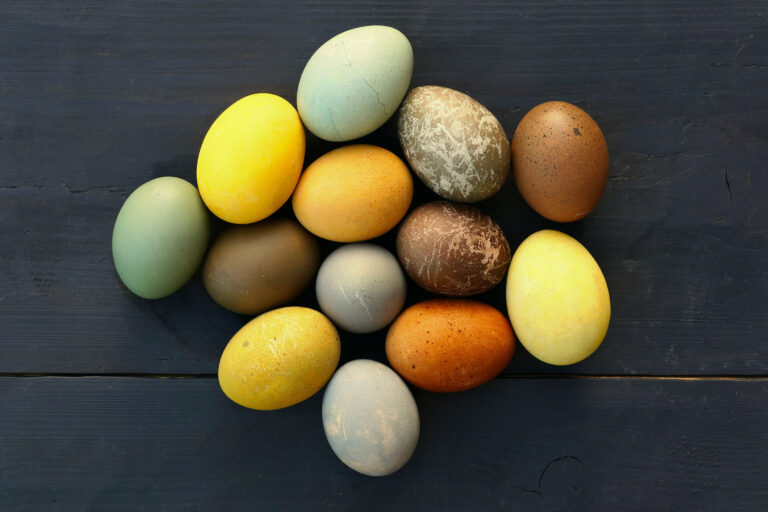
Make your own natural dyes for Easter eggs! Create beet, blueberry and onion skin Easter eggs for a lovely spring decoration.
When Alex, my 10-year-old grandson, came to stay with me during spring break, he was eager to color Easter eggs. Also, I hadn’t seen Jody Main, my friend and an Easter egg maven, for far too long — what a perfect excuse for a visit!
When we entered Jody’s farmhouse kitchen, there was a table with teacups full of dyes and a big bowl of eggs ready to go. Alex and I had great fun, and we learned a lot that afternoon about colors and which combinations produce which colors. We went home with cartons full of unique eggs.
After years of dyeing eggs using a wide range of botanical sources, Jody had streamlined the dyeing procedure. She had narrowed the necessary ingredients down to three — fresh red beets, yellow onion skins, and frozen blueberries. That’s all she needed to produce the primary colors: red, yellow and blue. By combining the resulting natural dyes in varying amounts, she can create any color of the rainbow. You can do it, too!
Dyeing and Decorating Tips
Follow the recipes below to make the dyes, using individual stainless steel, glass, or enamel saucepans for each color. Combine the ingredients and boil each color mixture separately for 15 minutes before dyeing eggs. The vinegar acts as a fixative — without it, the dyes won’t stick to the eggs.
- Before dyeing, hard boil white eggs and let them cool.
- For uniform color, strain each dye mixture through cheesecloth or a fine strainer.
- For a mottled, tie-dyed or spotty effect, leave all the ingredients in the pans.
- Use crayons to make designs — circles, geometrics, your name — on the egg; the crayoned part will not take up any dye. White crayons work especially well.
- The longer the eggs remain in the dye, the deeper the color.
- For special effects, dip half the egg in one color, the other half in another.
Coloring Easter eggs with natural dyes was a fabulous way to teach Alex about colors. When he went home, I sent along the ingredients he’d need so he could share his experience with his friends and parents. Happy Easter!
Natural Dye Recipes for Easter Eggs
RED
2 cups beets, grated
1 tbsp white vinegar
2 cups water
Substitute: strong Red Zinger tea, or chopped fresh or frozen cranberries
YELLOW TO GOLD
3 large handfuls of yellow/brown onion skins
1 tbsp white vinegar
3 cups water
Substitute: strong chamomile tea, or 2 to 3 tbsp ground turmeric
BLUE
1 pound frozen blueberries, crushed
1 tbsp white vinegar
2 cups water
Substitute: red cabbage leaves, coarsely chopped, create lavender
OTHER COLORS
Mix combinations of the primary dyes (in separate cups) to make secondary colors: red and yellow for orange, yellow and blue for green, and blue and red for violet. The proportion of one color to the other determines the shade.
Rosalind Creasy
Los Altos, California
Originally published as “How to Color Easter Eggs with Natural Dyes” in the February/March 2010 issue of MOTHER EARTH NEWS.