
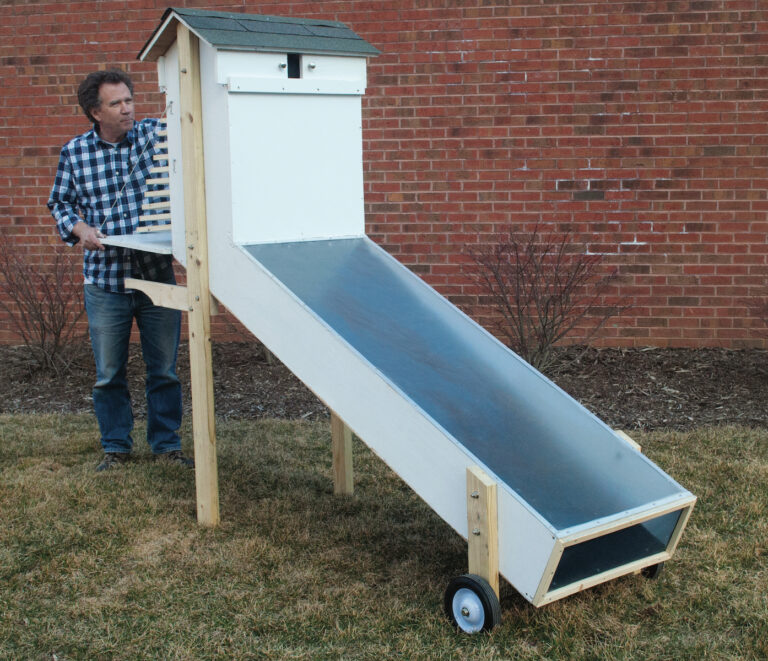
Nearly two decades of expert testing and experimentation have resulted in DIY food dehydrator plans that aren’t just efficient and off-grid — but also highly cost-effective.
For nearly 20 years, I’ve led research teams as founder and coordinator of the Appropriate Technology Program at Appalachian State University. We’ve conducted many original experiments to produce a design for the best food dehydrator you’re likely to find anywhere. Yes, this dryer is supersized — about 6 feet tall and 7 feet long — but it’s on wheels and thus moves easily, can dry large amounts of food quickly and is a must-have for off-grid living. If you have a big garden or buy bulk produce, this solar dehydrator will help you keep up with food preservation all summer and into fall. If you live in a cloudy or humid region, you can add heat from light bulbs to improve its operation. Anyone with basic woodworking skills can tackle these plans. Here you’ll find complete lists of materials and tools, plus step-by-step instructions.
How a Solar Dehydrator Works
Drying is an excellent way to preserve produce, but exposing fruits and vegetables to direct light can cause vitamin loss. This design relies on indirect solar power, meaning the drying food is not exposed to the sun but instead to solar-heated air. Our dryer takes advantage of the natural process of rising hot air to operate efficiently without any electric fans.
As you can see in the detailed drawing, the design includes a long, angled wooden box covered with clear plastic glazing and an open bottom end for air intake. Inside, the box holds diagonal layers of black metal screen. The vertical drying chamber on top has a back door to access food-drying trays inside.
The sun’s radiation passes through the plastic top of the collector box to the absorber screens, which retain heat. Air entering through the intake is warmed as it passes over the absorber screens, and then flows into the drying chamber. There, the heated air draws out the food’s moisture before exiting through vents just below the roof. The rising warm air creates negative pressure at the bottom of the collector box, which draws in more outside air to replace the air that left through the top vents. Air will continue to heat and rise, passing through the collector box and into the drying chamber, as long as the sun is shining or the dryer has access to another source of heat.
The drying chamber of this dehydrator supports 11 trays to hold up to 10 pounds of thinly sliced food — about 35 to 40 medium-sized apples, for reference. It can dry this amount of food in two sunny days, or about half this amount of food in one sunny day because of better ventilation and reduced food mass. The temperature inside the chamber can easily soar to more than 140 degrees Fahrenheit.
Why This Is the Best Solar Food Dehydrator
I’ve built many dehydrators over the years and enlisted teams of students to study all of the variables. We’ve made adjustments to improve the performance, simplify the construction, reduce the cost, and increase the durability and portability of food dehydrators. Following are several of the most effective strategies our tests have established over the years to produce the best food dehydrator you can build.
Vents and airflow. Temperature, airflow, humidity and food density will all affect a dehydrator’s performance. Ideally, you’ll want high temperatures and heavy airflow, but because changes in one factor also affect all the others, the best food dryers must achieve a balance among these variables.
You can control the temperature and humidity inside this food dryer by regulating the airflow with its adjustable vents. The vents are essential for effective operation: As cool air enters at the bottom and heats up in the collection box, the warmed air must rise into the drying chamber where it will absorb moisture from the food before exiting through the upper vents. When you close the vents, the air movement stops — and so does the fast, efficient drying of food.
Fully opened vents cause the airflow to increase and the temperature to decrease. Temperature is more significant than airflow in affecting the rate at which food dries, so we partially close the vents to increase the temperature. In general, more airflow (fully opened vents) is important during the early stages of food drying, while higher temperatures (partially closed vents) are more effective in the later stages of drying.
Dehydrator Reflectors
No official scientific standard determines the ideal drying temperature for food. The most common preferred range falls between 110 and 140 degrees. Higher temperatures also destroy harmful bacteria, enzymes, fungi, insect eggs and larvae. But temperatures that are too high can cause vitamin C loss — and food begins to cook at 180 degrees.
To bring the temperature into the ideal range, we tried adding external reflectors to cast more solar energy into the collector box. For the best performance, though, we discovered that the dryer with reflectors had to be relocated several times throughout the day, and its angle had to be adjusted as the sun moved across the sky. Based on our experiences, external reflectors usually aren’t worth the trouble.
Installing a reflector inside the collector box is an easy way to boost the temperature without the hassle of an exterior reflector. Gluing aluminum foil to the bottom interior of the collection box (underneath the absorber screen) will increase the temperature inside by more than 20 degrees. Our dryer with an interior reflector can surpass 200 degrees on sunny, 75-degree days with the vents closed. By opening the vents 1 to 2 inches, we can bring the range down to a more reasonable 120 to 155 degrees.
Dehydrator Glazing
The top of the collector box must be covered with glazing so the sun’s energy can penetrate and be soaked up by the absorber screen inside. The best material is a fiberglass-reinforced polyester (FRP) known as Sun-Lite HP. This glazing is thick, durable and translucent, and is used in many solar technologies. You can purchase it in a variety of widths and lengths from the Solar Components Corporation, and easily cut it to fit the top of your dehydrator.
We found that adding a second layer of glazing increases temperatures inside the dryer by approximately 10 degrees. But the price of the glazing material — about $2.50 per square foot — doesn’t improve performance enough to justify the added expense.
Dehydrator Absorber
This is a technical name for some simple materials installed beneath the glazing to absorb the sun’s heat and transmit it to the surrounding air. Our trials show that the best absorber is made of either charcoal-colored aluminum window screen or the type of metal lath used in plaster work. Screen is cheaper and easier to work with, but some of our tests showed that lath produces significantly higher temperatures, which justifies the added expense. At least 20 additional tests demonstrated that including six layers of steel lath, painted black and set on the diagonal, is ideal.
DIY Food Dehydrator Plans
You can construct this solar dehydrator using locally available materials — exterior-grade plywood, FRP glazing, metal screening or lath, and miscellaneous parts. New materials will cost about $300, or you could recycle supplies already on hand. Most home workshops will already stock the necessary equipment. Expect construction time to take 20 to 40 hours, depending on your woodworking expertise.
My students and I have developed a solar food dryer that works extremely well and isn’t costly to build. I encourage you to build the dehydrator to our specifications and put it to work to stock your home larder with nutritious, sun-dried food.

Materials List
- One 4-by-8-foot sheet of 3/4-inch plywood, exterior grade
- One 4-by-8-foot sheet of 1/4-inch plywood, exterior grade
- Five 1-by-6s, 8 feet long, pressure-treated
- Two 2-by-4s, 8 feet long, pressure-treated
- 2 wheels, 8-inch-diameter
- 36-inch-long, 1/2-inch-diameter steel axle
- 2 heavy-duty hinges
- Six 27-by-96-inch sheets of metal lath
- 3 square feet aluminum screen
- One 2-by-6-foot sheet of FRP (fiber-reinforced plastic)
- 30 square feet food-grade screening
- Heavy-duty aluminum foil, 25-foot roll
- 3/4-by-1/8-inch aluminum battens, 16 feet total length
- 1-1/4-inch No.8 exterior-grade Phillips flat-head screws (100 or more)
- 1-5/8-inch No. 8 exterior-grade Phillips flat-head screws (about 30)
- 1-inch No. 8 round-head screws (about 20)
- Eight 3/8-by-3-inch bolts, nuts and washers
- Four 3/8-by-4-inch bolts, nuts and washers
- 4 hook-and-eye fasteners
- 1/4-inch staples
- Exterior-grade latex paint and primer, any light color
- High-temperature spray paint, black
- Waterproof glue
- Silicone caulk
- Weatherstripping
- Shingles
Tools List
- Circular saw with rip guide
- Router with 3/4-inch straight bit and cutting guide
- Electric drill with No. 8 pilot-hole and countersinking bits
- 2 sawhorses
- Long straightedge
- Marking pencil
- Protractor
- Framing square
- Level
- Tape measure
- Staple gun
- Caulk gun
- Paintbrush
- Wrenches
- Tinsnips
- Utility knife
- Clamps
- Heavy work gloves
Step 1: Mark the Cutting Diagram

Most of the wood required for these solar food dehydrator plans can be cut from a single 4-by-8-foot sheet of three-quarters-inch-thick exterior-grade plywood. Measure and mark the plywood using the cutting diagram (above) as your guide. Note that the dryer sides are cut in a single piece so there’s no joint between the collector box and the drying chamber. You should mark the dehydrator’s sides on opposite edges of the plywood sheet to leave space in the center for the other pieces you’ll need.
The angle of the sides on this design is perfect for drying food at 36 degrees latitude in North Carolina. The unit will function well anywhere, though, offering maximal performance between March 21 and May 21, and from July 21 to September 21. If you prefer your food dryer to have the best possible angle for your latitude, refer to the suggestions in Table 1 (below). Here’s how to transfer a customized angle to the plywood sheet: Measure and mark 13 inches in from the corner on the edge of one long side, place a protractor on the mark, find the correct angle for your latitude on the protractor, and draw that angled line up from the mark to the adjacent short edge of the plywood sheet. The length of this line should be 30 inches. If you measure the line and discover it’s not 30 inches, move a straightedge to the right or left of the original line — and parallel to it — until you get a 30-inch-long line at the correct angle for your latitude, then mark the line again. Using the cutting diagram, measure and mark the remaining lines for both of the dehydrator sides, then fill in the empty space on the plywood sheet with lines for the vent covers and the front and back of the drying chamber.
Table 1: Dehydrator Angles for Different Latitudes
Latitude Degrees |
Angle in Degrees |
| 20 | 100 |
| 30 | 110 |
| 40 | 120 |
| 50 | 130 |
| 60 | 140 |
Step 2: Cut the Sides

Place the marked sheet of three-quarters-inch plywood on top of two sawhorses and cut out the pieces using a circular saw. Be sure to cut straight lines because you want the dehydrator box to be airtight. Make plunge cuts when cutting out the angles of the drying chamber and roof for the dehydrator’s sides. After cutting out the two large sides, lay one on top of the other and check to see if they’re the same size and shape. If not, mark the areas that are different and trim the larger piece with a circular saw so that both sides match. Cut the remaining components from the plywood sheet, and prime and paint the interior and exterior of all wooden pieces to reduce warping which could create an air leak.
Step 3: Cut the Braces

Before beginning assembly, you’ll need to cut some braces to support the components of the solar dehydrator on the interior. Most of these braces will serve more than one function so it’s important to use the correct one at each location. See the detailed drawing (“How it Works,” above) for proper sizing and placement of the braces.
To make the braces, cut some three-quarters-inch-thick pine boards into strips using a rip guide on a circular or table saw. You’ll need to cut the following sizes, all of them 22-1/2 inches long: six pieces measuring 3/4-inch by 3/4-inch; four pieces measuring 3/4-inch by 1-1/2 inches wide; and one piece measuring 3/4-inch by 5-1/2 inches. The 5-1/2-inch brace needs a bevel down one side so that it will line up with the angle where the drying chamber and collector box meet. You can cut this bevel with a circular saw adjusted to a 116-degree angle (your angle will be different if you’re building a dehydrator customized to your latitude) and with a rip guide installed.
To install the braces, place the two large sides upside down and side by side on sawhorses so that they’re balanced on their edges and spaced about 2 feet apart. Install the 3/4-inch-by-5-1/2-inch beveled brace between the sides where the collector box and drying chamber meet, and set a 3/4-inch by 3/4-inch brace at the air intake end of the collector box. Be sure to predrill the holes using a No. 8 countersink bit, and fasten the braces in place with 1-5/8-inch No. 8 exterior-grade Phillips screws. Now the two dehydrator sides should be held together by the two braces.
Step 4: Cut and Install the Collector Box Bottom

Remember that sheet of quarter-inch exterior grade plywood in the materials list? Cut a 24-inch-wide piece from it that’s the same length as the bottom of the collector box. In this design, the length is 6 feet and 11 inches, but the dimension will be different if you changed the angle of the collector to make a solar dehydrator specific to your latitude.
With the two joined sides still upside down on the sawhorses, place a healthy strip of waterproof wood glue down both edges of the side pieces and on the 5-1/2-inch and 3/4-inch braces you just installed. Then lay the quarter-inch plywood bottom over the dehydrator sides and secure it in place with 1-1/4-inch exterior screws every foot or so. Use 1-inch screws when securing the bottom to the braces so that the screws won’t poke through to the other side. Seal the bottom around its entire perimeter so no air can leak in and affect the operation of the collector box.
After you’re finished securing the bottom of the collector box, turn over the dehydrator and install the remaining braces as directed in the detailed drawing (“How it Works,” above) remembering to predrill holes before installing screws — two screws per 1-1/2-inch-wide brace.
Step 5: Install the Drying Chamber Front and Vent Screens
Now you’re ready to install the drying chamber’s front — it’s the painted 22-1/2-by-24-inch piece of three-quarters-inch plywood you’ve already prepared using the cutting diagram in Step 1. One of the front’s 24-inch-long sides needs to be beveled to fit tightly against the brace at the top of the drying chamber. Glue and then screw this piece, beveled edge on the top, to the front of the drying chamber. Make sure the bottom, unbeveled edge of the front fits snugly against the angle at the top of the collector box. From the inside of the drying chamber, run a bead of silicone caulk around the perimeter of the front to prevent air leaks.
After you’ve installed the front panel, you’ll notice that it ends about 5 inches below the top of the sides. The same situation will apply to the door on the back, which you’ll install later. These gaps are important for the function of the dehydrator because they serve as vents. Eventually you’ll build vent covers, but all you need to do now is to grab a staple gun and secure aluminum screening to the interior at the vents. Staple the screen to the braces at the top and bottom of the vent openings on both the front and back of the drying chamber. While you’re at it, also staple aluminum screening over the intake vent at the bottom of the collector box, again from the interior. You can frame the air intake with three-quarters-inch wooden strips on the exterior if you prefer a finished look.
Step 6: Build the Drying Shelf Supports and Roof

These solar food dehydrator plans call for 11 supports for 11 three-quarters-inch plywood shelves inside the drying chamber. You can cut the three-quarters-by-three-quarters-inch supports from a 1-by-6 pine board with a circular saw using a rip guide. Each support is 16 inches long except for the lowest support, which is 15-1/4 inches long to avoid the lowest brace inside the drying chamber. Measure and mark both sides of the inside of the drying chamber for the shelf supports, spacing them 1 inch apart. Predrill the holes before fastening the supports to the sides of the drying chamber with 1-1/4-inch exterior-grade Phillips screws. Make sure you don’t drill the screws so deep that their points project through the sides of the food dryer.

The solar dehydrator’s roof is made of two pieces of three-quarters-inch plywood, preferably scraps you have lying around in your workshop. You also can create three-quarters-inch plywood by gluing together several pieces of the one-quarter-inch plywood left over from cutting the front of the dehydrator. The roof is made up of two 12-by-30-inch pieces, with 30-degree bevels along one long edge so they can join tightly at the peak. Attach the roof pieces to the dehydrator sides and braces with 1-1/4-inch screws.
Step 7: Legs, Wheels and Handles

It’s time to get the solar dehydrator standing on its own four legs. These plans call for two front and two rear legs made from pressure-treated 2-by-4s, and attached to the dehydrator using two 3/8-inch-diameter-by-3-inch-long bolts, nuts and washers each. Install the two front legs first, cutting them 18 inches long with a 26-degree angle on the top end. Locate the front legs approximately 6 inches from the bottom front edge of the collector box, predrill the holes and secure the legs to the sides of the collector box using the nuts and washers. Approximately 2 inches from the bottom of both legs, drill a half-inch hole through the center to receive a half-inch-diameter steel axle mounted with two 8-inch-diameter wheels.
Now that the front legs are attached, you can lift up the dehydrator to measure for the two rear legs. Place a small level on the top shelf support inside the drying chamber, then recruit a helper to lift the dehydrator until the unit is level while you measure the distance from the peak of the roof to the floor. In these solar food dehydrator plans, the legs are 76-1/2 inches long. When preparing the rear legs, cut 30-degree angles from the centers of both 2-by-4s on the top ends so the legs will fit snugly to the roof of the dryer. As you’re bolting the rear legs to the drying chamber, take care that the bolts won’t interfere with the operation of the shelves.
Step 8: Vent Covers

This dehydrator design calls for vents at the top of the drying chamber on both the front and back, just below the roof. These vents are essential for effective operation of the food dryer: As cool air enters the intake at the bottom and become heated in the collection chamber, it must rise into the drying chamber where it will absorb moisture from the food before exiting through the upper vents.
You’ve already stapled aluminum screen to the inside of the vent openings. Now you need to make vent covers to help control air flow when you’re drying food. You’ll remember marking and cutting four 5-1/2-inch-wide-by-12-inch-long vent covers when you followed the cutting diagram for the sheet of three-quarters-inch plywood in Step 1. Grab a pair of these covers and prepare them for installation on the front of the dehydrator by cutting a 30-degree bevel along one of the long edges of each one. The front vent covers should be installed with the beveled edge on the top, where it will help the covers fit tightly against the slant of the roof. To hold the covers in place along the bottom edge, you’ll need to screw a 2-by-24-inch strip of wood to the interior brace at this location on the front of the drying chamber. Some adjustments may be required for the vent covers to fit well. To provide a little more sliding room, you can try adding a piece of bicycle inner tube between the wood strip and the front panel.

To install the back vent covers, you’ll first need to build up the 1-1/2-inch-wide brace at this location so it can support both the covers and the door (which you’ll install next). Attach a 3/4-by-3/4-by-24-inch strip of wood to the top half of the brace, and then screw a 1-1/2-by-3/4-by-24-inch wooden piece to the top of the strip you just placed on the brace. Drill pilot holes to avoid cracking the wood, and be sure to stagger the screws for the first and second strips.
Step 9: Drying Chamber Door

Obviously, you’ll need a door to access the shelves inside the drying chamber. The door is a 24-1/2-inch-high-by-25-1/2-inch-wide piece of painted plywood that you marked and cut using the cutting diagram in Step 1. It should open by swinging down from the top, so fasten it to the back of the drying chamber with two heavy-duty metal hinges that you’ve secured at the bottom using nuts and bolts. Instead of allowing the open door to slam against the dehydrator, you can rig it to stop parallel to the ground so that it can be used as a shelf when you’re loading or unloading the dehydrator. Make a shelf stop by securing two strands of quarter-inch braided nylon cord to the drying chamber on one end and the top corners of the door on the other end.
The door is 1-1/2 inches wider than the dehydrator, making it extend past the unit three-quarters-inch on both sides. This allows you to install four hook and eye fasteners — two on each side — to get a tight fit when you close the door. Finally, apply weatherstripping around the perimeter of the door frame to create an effective seal.
Step 10: Build the Absorber

In this step, you’ll be installing materials inside the collector box to absorb and transmit the sun’s heat to the surrounding air. The “absorber” can be made of either charcoal-colored aluminum window screen or the type of metal lath used in plaster work. Although screen is easy to work with and relatively inexpensive, our tests found that lath produces higher temperatures. Because this design is for the best food dehydrator you can build, we recommend lath for the absorber material.
Hardware stores sell lath in 8-feet-by-27-inch sheets. To make the absorber, you’ll need six 22-1/2-by-69-inch sheets that you’ve trimmed to size with tinsnips — be sure to wear heavy work gloves to protect your hands from the sharp edges of the screen. Spray-paint the lath strips black using high-temperature flat paint. While the lath is drying, prepare the interior of the collector box by covering the bottom with heavy-duty aluminum foil and gluing it in place.

The layers of lath will be positioned diagonally inside the collector box, extending from the bottom of the air intake up to the top of the collector box, just below the drying chamber. The layers of heavy metal lath need to be supported, so secure a three-quarters-inch wooden strip diagonally on the interior sides of the collector box using 1-1/4-inch wood screws, setting them at the same diagonal at which you’ll be placing the layers of lath. Set one strip of lath at a time on top of these strips, holding the layers in place by screwing a few screws into the wooden supports at the sides and bottom. At the top, you can bend the lath up over the brace and fasten it into place with screws.
Step 11: Glazing

You’ll need to cover the top of the collector box with glazing so the sun’s energy can penetrate and be soaked up by the absorber. Any plastic glazing will work, but the best option for this dehydrator design is a strong, fiberglass-reinforced polyester (FRP) material. FRP is thick, durable and translucent and used in many solar technologies. Expect to pay about $2.50 per square foot for .040-inch-thick Sun-Lite HP glazing from Solar Components Corporation. You can purchase this glazing in a variety of widths and lengths, then trim it to fit the front of your dehydrator’s collector box (24-inch-wide-by-70-inch-long in this design; your dimensions may vary) using tinsnips or a utility knife.
Before installing the glazing, prepare the strips that will hold it in place on the top of the collector box by measuring and cutting three-quarters-inch-wide by one-eighths-inch-thick aluminum bar stock to fit the top of the box. Predrill holes on all of the aluminum strips. Lay the sheet of FRP — smoothest side up — on top of the collector box. Set the top aluminum bar in place and drill through its predrilled holes, through the FRP and into the dehydrator sides.
Remove the glazing from the dehydrator and run a bead of silicone caulk across the top edge of the collector box before carefully setting the glazing back into place. Secure only the top aluminum bar to the FRP and collector box with 1-inch No. 8 stainless-steel, round-head screws. Make sure the glazing is straight on the collector box throughout this process. Gently lift up the glazing and run a bead of caulk down the edge of the collector box on one side before predrilling and screwing the edge into place. Repeat these steps with the other side and the bottom.
Step 12: Make the Drying Trays

The drying chamber will hold 11 rectangular trays for dehydrating food. You’ll want to build trays with wooden frames that will stand up to lots of use, but with screened bottoms so air can circulate around the drying food. Use four 1-by-6s
to make the frame components. Cut two of these boards into 22-1/4-inch lengths, and the other two into pieces measuring 16 inches long.
Use a router with a three-quarters-inch straight bit and a cutting guide to carve a three-eighths-inch-deep rabbet on one side of both ends of every piece. Then rip all of the boards into three-quarters-inch-wide strips using a table saw or a circular saw with a rip fence attached. You should now have 22 pieces measuring 22 1/4 inches long, and 22 more pieces at 16 inches long, all of them three-quarters-inch thick and with rabbeted ends. Your next step is to assemble the frames so they’re perfectly square. Use a framing square to set up a jig, and lay out and square up two 22-1/4-inch-long pieces and two 16-inch-long pieces into a frame. Glue the pieces at each corner and secure the rabbet joints with one 1 5/8-inch-long flat-head Phillips screw each. Repeat these steps until you’ve built the frames for all 11 trays. After the glue dries, cut food-grade screen to size and staple the screen to one side of each frame using a staple gun. The screen can be purchased from MacManiman Inc.
Step 13: Ready to Dry!
You’re nearly finished building the solar dehydrator! Just nail some shingles to the roof to shed the rain, bolt some 24-inch scrap 2-by-4 handles to the rear legs to make the unit easier to move around, and you’re ready to dry some food.
Get an early start on a warm, sunny day. Slice about 5 pounds of food — apples are great for beginners — into uniformly thin pieces about one-eighth-inch thick. Spread out the pieces on the drying trays. Open one set of the vent covers (on the leeward side if it’s a windy day) to approximately 3 inches. Don’t forget to check the food at the end of the day for dryness. Food is dry when the moisture content lower such that the food weighs between 10 and 20 percent of its original weight.
How to Use a Solar Food Dehydrator
Browse these resources for additional information on how to use food dehydrators, including instructions on drying different types of edible goodies.
- Preserving Food Using Homemade Food Dehydrators
- Making Sun-Dried Tomatoes in a Solar Food Dehydrator
- Drying Herbs in Solar Food Dehydrators
- How to Preserve Food Using Sun Drying and Natural Methods
Dennis Scanlin is a Professor of Technology and Environmental Design at Appalachian State University in Boone, N.C. For the past 30 years, he has coordinated the university’s Appropriate Technology Program where he and his students have built and tested many renewable energy systems.





