

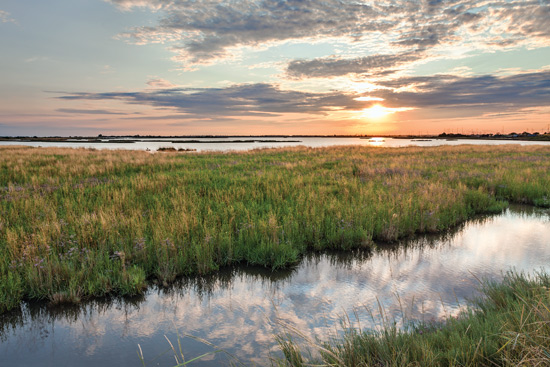
Wetlands provide food, water, protection, and livelihoods to millions of people.
As droughts become more frequent and severe in some regions of the world, water conservation and infrastructure are critical components of mitigating the worst impacts. Wetlands are one such water-rich environment that can lessen drought’s effects. According to the Ramsar Convention on Wetlands’ Global Wetland Outlook, “Wetlands provide us with water, they protect us from floods, droughts, and other disasters, they provide food and livelihoods to millions of people, they support rich biodiversity, and they store more carbon than any other ecosystem.”
Yet the very disasters wetlands protect us from are simultaneously jeopardizing their existence; according to the Environmental Protection Agency (EPA), wetlands are threatened by worsening droughts and other effects of climate change, such as sea-level rise and storm surges. The Global Wetland Outlook’s 2018 report states that natural wetlands have declined by 35 percent worldwide since 1970. Increased wildfires and reduced wildlife habitat are also effects of wetland displacement, according to the EPA, so the agency works with governments to restore and protect wetlands, and provides community-level adaptation strategies for addressing pressures.
Research has also shown that the benefits of wetlands may extend beyond the water, wildlife habitat, and carbon sequestration they offer. A study published in Proceedings of the National Academy of Sciences in July 2021 suggests that constructed wetlands, when implemented regionally at a watershed that drains into a common waterway, can help prevent agricultural runoff that degrades water quality, reducing the amount of nitrate and sediment in large streams and rivers. This runoff affects the health of wildlife and humans, and requires costly water treatment, so, within our current agricultural system, researchers say implementing and restoring optimally placed wetlands is the most cost-effective way to reduce nitrate and sediment in waterways.
Still, the Global Wetland Outlook report says wetlands made and managed by humans don’t necessarily perform the same ecosystem functions as natural wetlands do, because of “changes in water supply, removal of vegetation, or introduction of species or nutrients.” However, the report says wetland reserves are fortunately still vast, and that the Global Wetland Outlook’s mission is to help people and policymakers recognize the value of wetlands, and to provide recommendations for wetland conservation and wise use that can halt and reverse their decline.
Learn more at Global Wetland Outlook.
Edible Insects and Food Safety
Though the idea of ingesting insects might make some eaters squirm, the farming of insects to feed livestock and supplement human diets is becoming a more widespread practice. In response, the Food and Agriculture Organization of the United Nations (FAO) recently released a report on edible insects, “Looking at Edible Insects from a Food Safety Perspective.” This report covers the risks involved with producing and consuming insects as a food source, and provides tips on how to counteract those risks. The risks involved aren’t necessarily new; some of the associated hazards are applicable to all foods, not just insects, and depend on species, harvesting methods, and processing methods.

Insects can be a good source of protein, fatty acids, and more.
The increasing popularity of this practice is in part due to insects’ suitability as livestock, according to the report: Insects have a high feed conversion efficiency, rapid growth rates, and limited space requirements. Further, insect production has a smaller resource footprint than other livestock, and insects are generally a good source of protein, fatty acids, vitamins, and minerals, though an insect’s nutritional profile is reliant on species.
This publication is directed at food safety professionals, consumers, producers, researchers, and policymakers who are looking into insects’ potential to provide food stability, and who want to consider any associated food safety issues. Plus, it reviews farming regulations of various regions to help readers learn more about what’s possible where they live.
Read this report and others on eating insects at the Food and Agriculture Organization of the United Nations.
Investigation of Food Monopolies
Step into any supermarket, and you’ll be presented with a dizzying abundance of brands—a profusion that conceals the prominence of just a handful of companies, to which most of those brands can be traced back. To examine the extent of this dominance, The Guardian and nonprofit Food & Water Watch collaborated on an analysis of the market and political power of large-scale food corporations. Their report, released in July 2021, reveals that “a few powerful transnational companies dominate every link of the food supply chain: from seeds and fertilizers to slaughterhouses and supermarkets to cereals and beers.”
According to the investigation, these mega-corporations have been growing their size and influence under little-to no regulation, and they control an average of 64 percent of sales. Further, only 15 cents of every dollar spent on food makes its way back to farmers. The corporations’ economic dominance ensures they can control what gets grown and how much groceries cost—and it offers them a measure of political power that has “led to laws that put profits before food and worker safety, consumer rights, and sustainability.”
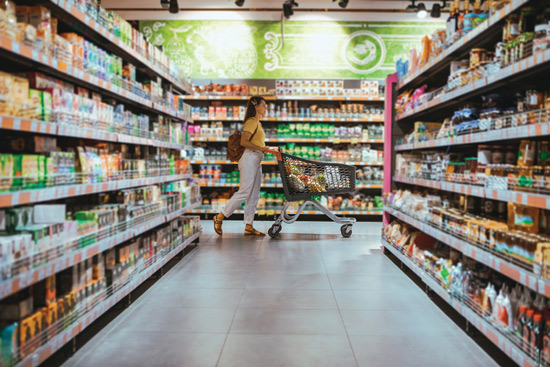
A handful of large-scale companies dominate much of the food supply chain.
The interactive report, published on The Guardian’s website, allows readers to choose a specific food category to see which companies dominate the market for items in that category. It also expounds on the hazards of food industry jobs, and the environmental impacts of monopolies. In the report, Food & Water Watch policy analyst Amanda Starbuck suggests small-scale regenerative farming, regional food hubs, and grocery co-ops as some alternatives to the current system and its consolidation.
Read the report, titled “Revealed: the true extent of America’s food monopolies, and who pays the price,” on The Guardian’s website.
Agriculture Industry Updates
Bioengineered Food Labeling
On Jan. 1, 2022, a law requiring the labeling of “bioengineered,” or genetically modified, foods will become mandatory. Passed by Congress in 2016, the law defines bioengineered food as food “that contains genetic material that has been modified through in vitro recombinant deoxyribonucleic acid (DNA) techniques; and for which the modification could not otherwise be obtained through conventional breeding or found in nature.”
The nonprofit Non-GMO Project says this labeling requirement leaves a lot to be desired, as it overlooks some products made with GMOs, including products made using emerging gene-editing techniques; products that are so heavily processed that genetic material is undetectable; products meant to feed livestock; or secondary products in multi-ingredient foods. Further, the new labels use language that might be confusing to consumers who are used to avoiding GMOs but might not know what the term “bioengineered” entails.
The Non-GMO Project has its own certification label that reads “Non-GMO Project Verified,” adorned with an orange butterfly, and it says consumers can still look for that label to know whether a food is free of GMOs, in addition to watching for the new “bioengineered” label.

Certain pesticides are facing scrutiny over their impacts.
Chlorpyrifos Ban
In late April 2021, a federal appeals court ruled that unless the Environmental Protection Agency (EPA) could prove chlorpyrifos is safe for public health, the organophosphate insecticide must be banned from all uses related to food. This decision comes after decades of the insecticide’s use for both agricultural and non-agricultural purposes, and after at least 15 years of scrutiny over its negative impacts on children’s neurological development. And after a period of reviewing the ruling, the EPA moved forward with a ban in mid-August that will take effect in early 2022.
The EPA itself has compiled evidence of this neurotoxin’s effects, and it was on track to ban the pesticide, but because its decisions are guided by the presidential administration, it backtracked on a ban in 2017. In response, a coalition of labor and health organizations represented by Earthjustice leveled a lawsuit at the EPA in 2019, leading to the recent court ruling. In the meantime, some states haven’t waited for a federal ruling and have implemented their own bans, including California, Hawaii, Oregon, and New York.
Goodbye, Glyphosate
Pharmaceutical company Bayer acquired agrochemical giant Monsanto in 2018, and Bayer has been responsible for litigation related to the herbicide Roundup ever since. The active ingredient in Roundup—and the most widely used herbicide in the world—is glyphosate, which has been linked to cancer and is the source of the claims Bayer has been attempting to address by paying out massive settlements.
In July 2021, Bayer announced that it’ll stop selling glyphosate for residential use in the United States by 2023, and will replace glyphosate with other active ingredients in Roundup. In its announcement, Bayer insists this decision to change the formulation is unrelated to safety concerns and is explicitly to limit further litigation. In the meantime, Roundup will remain available in agricultural and retail markets, though the Center for Food Safety filed a federal lawsuit against the EPA in late 2020 for its reapproval of glyphosate, citing cancer risks to farmers and farmworkers from exposure.
Calling All Millers
The Appalachian Staple Foods Collaborative (ASFC) is a network sponsored by Ohio nonprofit Rural Action. The network, which formed in 2008, comprises writers; researchers; farmers growing staple seed crops; and processors, such as millers and distillers.
In late 2020, ASFC started a Millers Peer Learning Group, open to anyone who mills grains or tree nuts from their region, whether the millers are seasoned or just getting started. This peer group has been meeting online monthly since its launch to connect millers from across the country to discuss tips, equipment, sales, regulations, and more. Each meeting begins with a virtual tour of a mill, and then facilitates a breakout for discussions. So far, more than 50 members have joined. If you’re a miller, you can join by emailing ASFC@RuralAction.org, or learn more first at Rural Action.






