Walter Jeffries and his wife Holly raise pastured pigs on Sugar Mountain Farm, their sustainable homestead in the mountains of Vermont. To improve their ability to get their pork to their customer’s fork they’re building their own on-farm USDA inspected butcher shop. Until May 15th they’re running a Kickstarting the Butcher Shop at Sugar Mountain Farm project to raise additional funds for equipment so they can open the butcher shop in summer 2012. In response to the Kickstarter project, several backers asked about the various cuts of pork, and this is Walter’s reply, which will almost surely inform you and make you a better consumer:
Several people have asked about the cuts of pork, and this article will give you an introduction to what good is a pig, nose-to-tail.
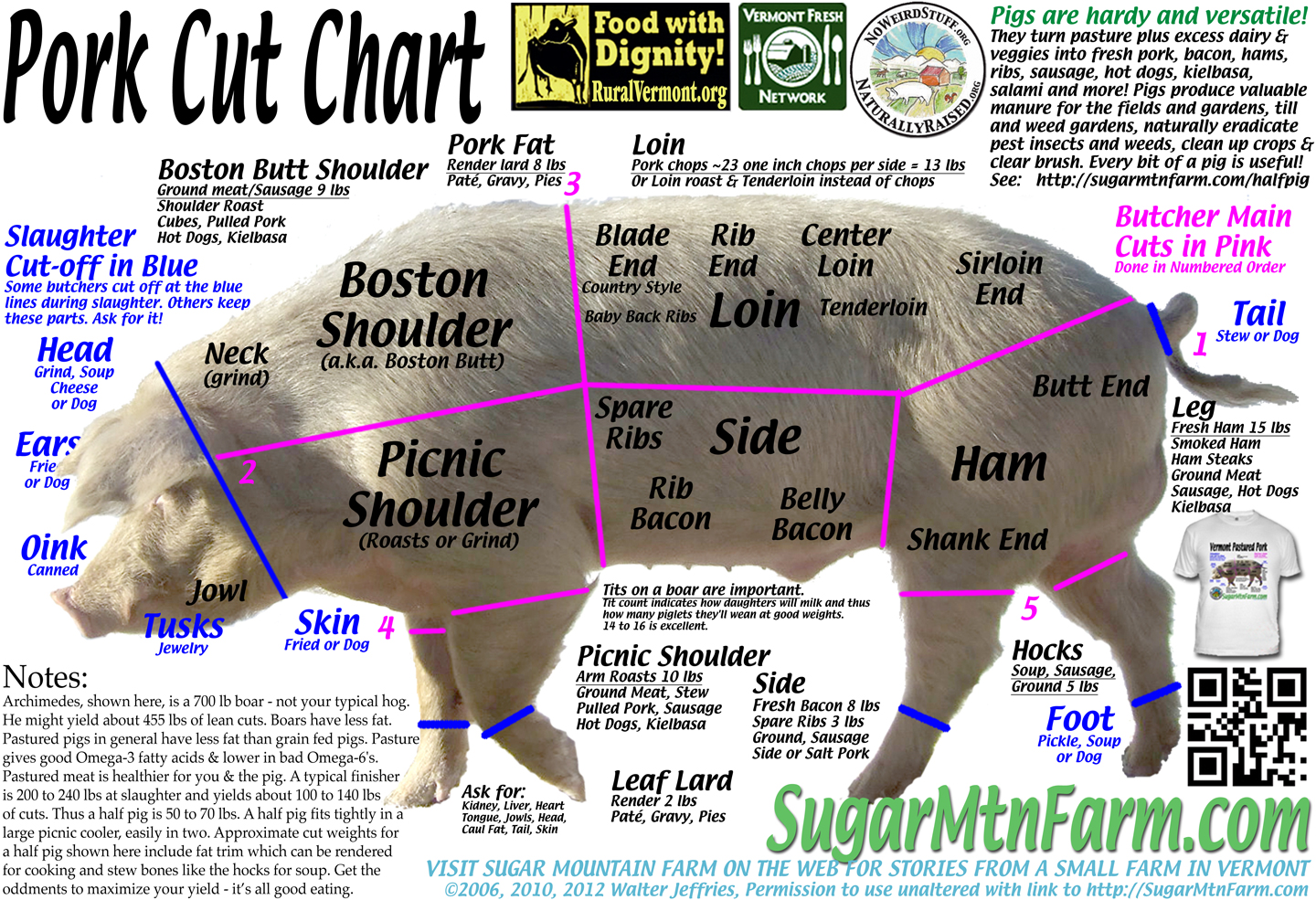
We’ll refer to the Pork Cut Chart above time-to-time. (You can zoom in on the image here to read the small print.)
Reality of Economics and Social Justice
All of the pig is good, nose-to-tail, but some of the pig sells for a lot more than other parts. This is not a social injustice. This is simply an economic reality. There are only two tenderloins on a pig and 20 people want them. There is only so much bacon to a pig and virtually everybody wants that. You can’t buy a pig and ask for it to be all cut into chops and bacon — pigs just don’t work that way although I’m trying to get there through our selective breeding program.
Supply is limited, and the rest of the pig must be eaten too, in order to avoid waste. The people who are willing to pay the higher prices for the high demand cuts make the rest of the pig available at lower prices to the rest of us. Be thankful that the 1 percent likes and pays for tenderloin. Again, this is not social injustice — just economic reality.
Additionally, not all cultures make use of all of the pig, or not in the same way. We find very little market for heart and tongue — delicious as they both are. A few customers know this secret and buy them up, but it took years to develop that market. Nobody buys the balls, at least not here — a feast for our livestock guardian dogs.
There is next to no market for lungs and pig guts. One of the advantages of our forthcoming on-farm slaughter facility is the offal, literally the parts that fall off, will be used in feeding our chickens during the winter and our compost piles to recapture the chickens’ nutrients for our farm’s soil to grow crops in the future. With on-farm slaughter, nothing goes to waste.
Selling All of the Pig
We work hard to use or sell every bit of the pig every week. It is a challenge. There is an old saying that it takes a village to eat a pig. We see this in the sales. Everyone wants the high-on-the-hog cuts. The middle-of-the-hog cuts also sell out with ease. But those low-on-the-hog portions can be a challenge some weeks. We price them accordingly. Sometimes those cuts will build up in the freezer for a few weeks before they sell. We work to sell these parts, through pricing, talking up recipes, trying recipes ourselves so we can talk about them, and getting the word about about using the lesser known cuts of the pig.
Chef A has hocks on her menu for the next four months, so those are taken care of. All winter Chef B has been making delicious stews that he thickens and flavors with trotters. Chef C takes all the tongues he can get for pickling and smoking and he’s now taking all the ears for a new recipe. Chef D took all the hearts, some tongues and a big load of ribs. Tails have been going to a researcher on fatty acids.
Through all of this, most of the pig, most weeks, gets eaten by our customers. What they don’t eat goes to the farmer’s table or the livestock guardian dogs — they work hard and have to eat too. It takes a village — and its dogs — to eat a pig.
When we’re out of one high-demand cut, some weeks we’ve had people say, “Well, just butcher another pig.” But it isn’t that simple. Without a market for enough of the pig we don’t want to take another pig every week. That would be wasteful, take up freezer space, which uses energy, and would fail to encourage people to be more adventurous eaters. Sometimes we have to tell a new chef they’ll need to wait, they’ll need to work with us on this and earn seniority for picking the high demand cuts. The price of the high-on-the-hog cuts goes up and the low-on-the-hog goes down to adjust. This is economics. The process works, each week’s batch of pigs sells and we use the pigs nose-to-tail. For the most part.
Taking it From the Top
Let’s start at the top of the pig and work our way down to way beyond the cuts of the pig — everything is useful. Along the way we’ll discuss what is literally high-on-the-hog, middlin’ low-on-the-hog, sausage, oddments and other things. Refer to the chart above, you can drag it around the screen in its enlarged form or put it into another window by control-clicking it or right-clicking it.
High-on-the-Hog
High-on-the-Hog cuts that are literally high up on the hog, along the back. These start with the sirloin, tenderloin, loin roast, loin chops and the Boston Butt. Refer to the Pork Cut Chart and you’ll see what I mean – these high priced cuts all come from the back of the pig, high on the hog. It is the sale of these cuts of pork that pay for the piglet, for feed, for raising the pig and for slaughter & butchering. It is because folks will pay that extra dollar for these higher priced cuts that pigs are farmable from the economic point of view and thus produce a lot of other good meat for everyone else at a more economical price.
Why are these cuts expensive? Simple: limits of supply and high demand.

What are the High-on-the-Hog cuts?
- Sirloin At the base of the spine between the ham and the loin. Typically sliced thin to cutlets. A lean meat.
- Tenderloin One of the leanest meats on the pig and perhaps the highest demand meat of all. Each pig has two and there are never enough. Often sliced to medallions.
- Loin Roasts and pork chops. This meat is probably the most commonly associated with pigs along with ham and bacon. These are the primary muscles of the back of the pig along the spine. Chine out for easy-cut roasts, bone out or in at your preference. Some people like the flavor added by the marrow.
- Boston Butt Also known as shoulder, not to be confused with picnic shoulder which comes from the front leg just below the Boston butt. In my opinion, this is one of best pieces of meat on a pig due to the marbling and the way the three muscles of the back come together. For roasts get it bone out so you don’t have to deal with carving around the shoulder blade. The Boston butt can be kept whole or divided into roasts. This is prime meat to be used for pulled pork, followed by picnic shoulder and ham. It can also be cut to delicious steaks, often called country ribs by some butchers.
Having Your Pork Chop and Eating Tenderloin?
Note that you can’t have your cake and eat it too. That is to say, in some cases, making a particular cut precludes making others.
For example, bone-in lower loin chops contain the tenderloin the way it is normally cut at the butcher. You could get a whole loin, preferably chine-off to make cutting easier, and then strip the tenderloin and have tenderloin as well as semi-bone in chops. But with normal pork chops the tenderloin is that little eye of meat so that makes it no longer available as a whole piece.
Likewise if you get bone-in pork chops from the loin then you miss out on baby-back ribs because they are the bone in the chops.
With meaty spare ribs you lose the chest bacon. Meaty spare ribs are wonderful, especially smoked, but if you cut your pig that way then it leaves just belly bacon.
Another example is Boston butt roast vs shoulder steaks. These are both cut from the same meat where three muscles at the top of the back come together layered with delicious fat. Some people want this for making pulled pork. Others for a roast. I love it for steaks. My absolute favorite cut of pork is the giant, flavorful, highly marbled Boston butt steaks off of an old sow or boar. A single steak may be two to four pounds. Enough to feed a family.
Middle-of-the-Hog
Middle-of-the-Hog cuts are next down in the economic tier and they literally come from the middle of the pig. Many of these are made into delicious, and very high priced, products through additional curing, brining, smoking, drying and other processing. Think bacon, hams, prosciutto, sausages, hot dogs, salami, etc.
Each of these requires some additional work to produce the final product. These steps result in loss of water and trim (shrinkage), cost time and money all of which drives the price up and concentrates the flavor. This uses portions of the pig that aren’t in high demand as cuts and turns them into delectable dining. Everyone loves bacon — vegans speak of it in fearful whispers, calling it “the gateway meat that tempts people back to the traditional, sustainable, omnivore diet.” Understandable.

What are the Middle-of-the-Hog cuts?
- Ham — Hams are typically brined and smoked to get their distinctive flavor. I’ve always been a big fan of big hams, the rear leg of the pig. I grew up with ham being a special meal and love the left overs. It’s a long slow cook. I like to glaze ours with maple sugar. Brown sugar or honey are two other common glazes. If you’re intimidated by such a huge hunk of meat consider slicing it to steaks or just cutting it in half. The ham can be done boneless, semi-boneless where the hip is removed or bone-in. The first is the easiest to carve but the bone adds flavor and can be saved for making soup. We also offer ham cubes which are great for stir fry and other dishes. Lastly, when in doubt, grind the ham to make ground for sausage, meat balls, kielbasa or hot dogs. No discussion of ham is done without mentioning the highest priced hams, the prosciutto which is salted and dry aged.
- Picnic Shoulder — Roast bone-in or bone-out or made into pulled pork. It can also be treated much like the ham, ground for a variety of uses.
- Belly — Pork bellies are most often made into bacon through a brining or dry curing process and then smoking. Smoked protein, fat, sugar and salt — What’s not to like! Pork bellies can also be made into sausage, panchetta, pork sides as is popular here in Vermont, salt pork and many other things. It is a versatile mix of meat and fat. One of the most delicious things is to leave the bacon on the spare ribs, soak them in a tomato based sauce and then smoke them for BBQ meaty ribs.
- Ribs — There are three main different types of ribs: Spare Ribs which come two racks to a side of pork and baby back ribs which are in the pork chops when bone-in. For the ultimate ribs, try smoked BBQ meaty ribs mentioned above in the bacon.
- Sausage – The sausage tends to come from the middle of the hog. Sometimes as high as the butt, rarely higher. Mostly the sausage consists of meat from the hams, picnic shoulder and belly. If the demand for hocks is low then the meat from them is available as well as jowl occasionally. We make Hot Italian, Sweet Italian, Breakfast Sage, Kielbasa and our famous all natural smoked hot dogs. In the future I would like to start making a breakfast maple sausage. Use high quality ingredients and keep the list short. We use real Vermont maple syrup from a farmer down the road for our hot dogs –delicious!
- Ground – Ground is essentially sausage before spicing and linking. It is one of the most versatile meats. You can make your own sausage, spaghetti sauce, meat balls, shepherd’s pie, lasagna, tacos, enchiladas and so many other wonderful dishes.
Low-on-the-Hog
The cuts in the high and medium areas of the pig are what are familiar to most American shoppers. But there is a lot more to the pig. Rural folk often cook some parts which urbanites may raise an eyebrow at. It is all good eating, so keep going down the pig.

What are the Low-on-the-Hog cuts?
- Hocks There is a surprising amount of meat on the hock which can go to sausage or be served roasted. They’re very good smoked. Excellent for soup and stew making.
- Jowl The cheek of the pig is much like bacon. Smoke it. Many chefs use this slightly lower cost jowl bacon for flavoring chili and stews. Jowl is also excellent in sausage both fresh and smoked.
Oddments
Where low-on-the-pig ends and oddments begins is all a matter of personal point of view. Generally the organs are considered fairly low on the hog. Feet are at the bottom so let’s start there.
What are the Oddments?
- Trotters (Pig’s Feet) Pickled, smoked, stewed or roasted. Sliced and sauced is also nice. There is a lot of great cartilage in the foot which makes an excellent thickener for soups and stews. Smoked they add flavor. Try roasting them and then slow simmering in the soup or stew pot. I’m told that eating this cartilage is good for my own joints. They put it in pills so perhaps it is better to get it direct. I eat a lot of soups and stews all winter — warms the belly and the body.
- Caul Fat Lacy fat found around the intestines. Rarely available. Use to moisten roasts.
- Leaf Fat A high quality harder fat found around the kidney used for pies and pasteries.
- Back Fat Render to lard for cooking or soap. Cut to strips for use on top of roasts. Make cracklin’s and chicharones.
- Heart Heart is the leanest of meat and very heart healthy. It is delicious stir fried with onions, peppers, mushrooms and strips of back fat.
- Liver Paté! I also like liver wrapped in bacon. Ah…
- Tongue A delicacy smoked or pickled and then thin sliced for hors d’oeuvres.
- Bones Soup and stew stock. Roast or smoke for the best flavor. Also great for carving. Try throwing knuckle bones for the original game of dice.
- Ears Fry crisp as chips or thin slice for salads
- Head Soup, stew, head cheese or roasted as a buffet center piece. Think of head cheese, also known as brawn, as solid stew that can be sliced and made into a sandwich.
- Brains There are people who eat them. Personally, I wouldn’t, as there is some question of viral, prion or other issues associated with brain tissue.
- Cartilage The connective tissue, particularly in the feet, is an excellent stock thickener. This is also recoverable from the skin.
- Skin The skin is edible and it is also made into non-food items. There are three ways of cleaning a pig of the bristles: skinning, burning, or scald and scrape. The first is faster if you’re just doing one pig and don’t have the specialized equipment. The second works but is my least favorite. Scald and scrape is the best method if you have the time, hot water and equipment. This last method preserves the skin on the pig so that it protects the meat, you keep more of the fat, the bristles are recoverable and you can then make pork rinds, chicharones, jelly or leather. Scald and scrape is rather essential if you plan to do a pig roast.
Offal
These are things that you typically can not get from a USDA inspected slaughter facility. They are in such low demand in our country that it is typically not worth the time, expense and effort for meat processors to do the necessary USDA HACCP/PR* requirements. If you want these look to custom slaughter at home.
What are the Offal?
- Blood Used in many sausage recipes as well as plant fertilizer. An excellent source of iron.
- Casings Traditionally sausages were packed in natural casings made from the cleaned intestines. Many sausage today are done with artificial casings. Look on the sausage package to find out what type of casing was used. We use natural casings.
- Chitlins Intestines of a pig.
- Stomach Traditionally used like casings or for children’s balloons.
- Bladder Used like stomachs.
- Balls Rocky Mountain Oysters
- Lungs Fried up in some parts of the world. Rarely available in the USA.
Other Parts & Pieces
Well that’s not all of the pig! There’s more to be used even if you’re not planning to eat it.
What are the uses of a pig?
- TusksDomestic pigs have four continuously growing tusks. These are found in both boars and sows but the boars have much larger and faster growing tusks. Younger pigs have thinner smaller tusks. These make excellent jewelry and are a good substitute for money. Good luck, fortune, fertility and strength are some of the special attributes of tusks in many cultures.
- Hooves The pig’s don’t actually have hooves like a horse, they’re more like nails. I’ve wondered if one might make guitar picks out of them. Someday I’ll try that. I know of no other use for them. Do you?
- Manure Pig manure is better than gold. Age it a bit in a compost pile and grow the most wonderful vegetables. Ideally have the animals spread their manure out over the pastures – saves you the labor. Our livestock have been turning our poor mountain soils into rich pastures and gardens. The manure is why I originally got livestock, I needed an organic source of nutrients for my gardens.
- Compost You can compost the manure, which means collecting it. I don’t generally do that as for the most part the animals spread it on the pastures. What I do compost is the dead bodies of livestock that die on the farm as well as the offal. This cycles the nutrients back to our land. Again, wonderful gardening.
- Bush Hogging Pigs are renowned for their bush hogging ability. So much so that a mechanical tractor implement is named for them — the bush hog. Don’t overestimate them though. Three little pigs aren’t going to bush hog a large field. It takes large numbers to do a lot of work. But if you’re patient and use managed rotational grazing techniques they’ll gradually turn poor land into good land.
- Tilling If you want to have the pigs dig up the soil then mob graze them. See Rootless in Vermont.
- Nutrient Recovery Pigs are great at using what would otherwise be waste materials. Old produce, field gleanings, waste dairy, whey are all good feeds for pigs. It is only now in modern times that the pig has become the primary consumer of cheap subsidized grains. Except, those grains are no longer cheap now that there is demand for the ethanol.
- Nutrient Retrieval Pigs and other animals are able to graze on pasture, turning what is not edible for us into high quality protein and lipids in a sustainable, environmentally friendly manner that creates habitat variety by maintaining margins of forest and field where the bio-diversity is greatest.
- Caloric Storage Livestock store calories. In the summer we graze them on pastures. They carry that energy over to the winter when we have no pastures or fresh foods available. In a northern climate this storage of summer into winter is essential to life. Herbivores die off in large numbers due to starvation during harsh winters because they lack this storage mechanism other than their own body fat. Omnivores and carnivores are able to get through the winter through hunting and ranching, by culling their herds of herbivores.
- Oink The soft grunts of a sow calling her piglets to eat can lull you to sleep at night.
Every bit the pig is useful, during its life and beyond. Pigs were traditionally known as “mortgage lifters” back before modern factory farming. In the past they were kept on dairy farms and known as mortgage lifters because the sale of the pork saved the farm in hard times. The pigs ate any excess milk as well as the whey from butter and cheese-making. These pigs would then get made into hams, bacon and cuts which helped make the dairy profitable. This was back before the head of the USDA told farmers to specialize, “to get big or get out.”
With the advent of the large-scale grain farming in the Midwestern states, the problem became how to ship the calories to the cities efficiently. The grains were fed to pigs and cattle which were then shipped alive or processed into meats including hams and bacon. Thus the “pork belly” commodities market.
Having our own on-farm butcher shop will let us more easily do unusual specialty cuts. Check out our Order Form for a list of cuts the we do standard. You’ll notice how the pricing changes as you work your way down from the High-on-the-Hog cuts to the oddments. The most cost effective way to buy pork is to buy a whole pig all at once, and even cut it yourself as shown in the By-the-Pig section at the bottom of the order form.
If you are interested in the cutting your own meat, check out master butcher Cole Ward’s DVDs about meat cutting. We apprenticed with him for 18 months to learn the art of meat cutting. He is a delight to work with. Check out the trailer on YouTube.
Fresh vs Frozen vs Cured vs Smoked
One thing that causes some confusion is the term ‘Fresh’. Consumers tend to think of the dichotomy being ‘Fresh’ vs ‘Frozen’ but in pork it is ‘Fresh’ vs ‘Cured’. Curing is the application of salts and spices to the meat, typically in preparation for smoking.
As to fresh vs frozen, realize that most restaurants buy their pork, fish and other meats in frozen or immediately freeze it. This maintains quality when done properly. The best is the special blast freezers that butchers often have which will very rapidly cool and freeze the meat so that tiny micro ice crystals are formed rather than the longer ice crystals produced during a slow freeze. The longer crystals puncture the cell walls and release cellular fluid degrading the meat. Thus for the best results, have the butcher blast freeze the meat and then keep it at the lowest temperature possible.
Speaking of freezers, colder is better, chest freezers are better than upright freezers and automatic defrost is a no-no since it periodically thaws and melts the contents of the freezer damaging the food.
When thawing meat, do it slowly. Thawing in the refrigerator the night before is ideal. Never thaw in the microwave – unless you like to eat shoe leather.
Challenge Yourself
Challenge yourself to eat a new part of the pig. Try the ultra-lean high protein heart thin sliced and fried with onions. Fry up some ears into crispy treats. Learn to make chicharones. There’s a lot more to a pig than tenderloin and pork chops. Learn to be an adventurous chef and eat like the farmer’s family.
You can see the Jeffries video and project at Kickstarter.
You may also like the article: Smoked Pork Products.
If you like smoked pork you may be interested in the topic of nitrates on NoWeirdStuff.org near the bottom.
Visit Sugar Mountain Farm’s website and blog for more great farm-and-food related posts from Walter and Holly.
*HACCP/PR is the USDA’s protocol requirements that must be in place detailing every step of the process to ensure safe food. They stand for Hazard Analysis and Critical Control Points / Pathogen Reduction. This program was put in place in the late 1990s to protect the public’s health. Some say that in the process the FDA has made it difficult to have innovative solutions and limited creative products. Is it worth it? Certainly, at some levels. The further you are away from the source the more controls you need.