
MOTHER has been compared so many times to the early farm
publications, that we’ve gone back to some 1882 AMERICAN
AGRICULTURISTs, 1892 FARM AND HOMEs and 1906 FARM AND
FIRESIDEs to make a few comparisons. Yes, sure enough.
Those old periodicals were mainly crammed full of
how-to-articles and letters from their readers just like
MOTHER — with all the ads stuck off in the back just like
MOTHER. Matter of fact, we felt so much at home rummaging
around in those “outdated” farm papers that we decided to
bring you the best of what we found. Here then, are four
pages of mostly good ideas, a few “just for fun” tips, and some great old ads from the past.
The Close of the Year
December is the first month of winter and the last of the
year. It is a most fitting time for taking an “account of
stock.” Storekeepers and businessmen know the importance of
this work. The goods are overhauled and an exact list of
all the articles, with their value, is made out; and from
this, with the expenditures, the balance for the year is
obtained. The farmer should do the same thing with his farm
property, that he may also know how much he has made or
lost during the year. The task is not a great one, as the
sheep, horses, implements, grain, etc., can be catalogued
rapidly, and when it is done there is a feeling of
satisfaction that more than pays for the trouble. It may be
somewhat difficult to estimate accurately some of the
items, as for example the amount of labor expended upon a
crop still upon the ground. A system of farm accounts kept
from week to week will aid greatly in all such cases.
Filtering Cistern Water
BY GRUNDY, CHRISTIAN CO., ILL.
While visiting a friend last year, I was surprised to find
that he was compelled to use cistern water for alt
purposes. In answer to my inquiries, he stated that no well
water was to be had in that section short of one hundred
feet, and then the quality was such that no one could use
it. Springs were unknown. Three miles distant was a creek
to which all live stock was driven, when cisterns and ponds
failed. The water in the house cistern was simply
abominable, caused by keeping the spout turned on, and
running in every drop that fell on the house. At his
earnest solicitation, I constructed a filter for his
cistern. He recently informed me
that it works like a charm and that his neighbors are all
using it. The filter is a large barrel
with one end knocked out. At the bottom is a layer of fine
charcoal. Above this is a layer of fine
gravel; over this is a layer of coarse gravel,
on the top of the barrel is a thin strainer,
held in place by a hoop which fits over the barrel. The
cloth is depressed in the center. This
strainer catches all leaves and coarse dirt, and should be
cleaned after every shower. Some use a wire strainer of
very- fine mesh, but the cloth answers the purpose very
well. The filtered water flows through a hole.
Into this hole a metal tube a foot or more long, punched
full of holes, and covered with wire netting, is inserted.
Six inches below the top is another hole; which is
fitted with a short pipe.
During a heavy shower the overflow runs out of this hole,
and into a spout provided for it. The barrel has
a small shed built overit, to protect it from the sun and
weather. This shed should open at one end, so the barrel
can be taken out at any time. The top is movable to allow
the strainer to be cleaned. The lower section of the
water-spout should be loose, so that it may be moved up or
down, and turned. The elbow rests on a block,
or bracket, and the water flows through a hole in the cover
of the shed, into the barrel. When the cistern is full, the
elbow is turned, and drops down to a block, and throws the
water into the spout to be carried away, or into a ” wash
water” cistern nearby. The above arrangement may be
modified to suit different circumstances and places. When
rain water is used exclusively for cooking and drinking, it
is best to have a cistern for it alone, and a separate one
for wash water. At the beginning of a storm, it is well to
let the rain wash the roof for an hour or two, before the
stream is allowed to enter the cistern. This is especially
necessary where pigeons and outer birds collect upon the
roots, as well as to wash off accumulated dust.
Feeding Birds in the Winter
As staple food, nothing is better and nothing is so cheap
as good Indian corn, and one meal a day may safely be of
this grain, either ground or whole. Grinding is of less
consequence for poultry than for the larger animals, as
every bird carries a complete mill for this purpose, and
puts in a new run of stones as often as it can get to the
ground. A variety of grain is always acceptable; wheat
screenings, buckwheat, oats, and rye, the last rather
sparingly. Cooked food is highly relished–potatoes or
turnips, boiled and mashed with Indian meal, scalded and
fed warm, especially on frosty mornings. Fowls are very
fond of vegetables, eaten raw, and if sugar-beets or
mangels or turnips are put within reach, they will help
themselves. For an appetizer, nothing is better than
cabbage or the tops o£ turnips. Hens never tire of
cabbage, and a good supply for winter should always be laid
in. Animal food in some shape must be furnished, if you
want plenty of eggs, Shore farmers can get fish offal from
the markets, clams from the banks, or minnows from the
ditches. Skimmed milk is always in order, and meat scraps
front fat trying establishments, sold in large cakes, and
placed where the hens have free access to them, are a cheap
and excellent food for laying poultry.
Cutting and Moving Ice Blocks
When there is good solid ice six inches thick the work of
filling the ice house should not be delayed. There are so
many risks to run in waiting for thicker ice, that it is
much better to gather the crop at the very first
opportunity. If snow comes while the ice is being formed,
it should be removed while it is fresh; this may be done
with a snow-push or a short and a heavy stable broom; and
on a large scale with a snow plow and scraper. Icemen who
harvest many thousand tons, have a complete outfit of
labor-saving tools for their work. The farmer, with only a
small house, holding 25 to 30 tons, needs a common
cross-cut saw with one handle removed. A splitting bar may
be made of a large chisel with a long handle. A pike for
handling the ice cakes while they are in the water, is very
convenient, and can be made by any blacksmith at a trifling
expense. Ice-tongs are not essential; but are so handy and
cheap, that it usually pays to be provided with them. The
ice to be cut is first lined by using a hatchet or axe
along a straight-edge board; after sawing, the strips are
cut into squares by first making a deep groove, and
afterwards using the splitting chisel. Ice is heavy and
difficult to handle, and advantage should be taken of the
ease with which it slides over smooth surfaces. Loading the
sled or wagon from the pond or river, is usually the
hardest labor of the ice harvest. This can be made
comparatively easy in many places, by drawing the ice
blocks up an inclined shute made of planks with narrow
edges of boards. A number of blocks of ice being placed in
a line at the submerged end of the shute, a spike is forced
into the rear one, and with the team attached to the spike,
the whole row is slid up into the box of the sled or
wagon.
Loading Ice Easily
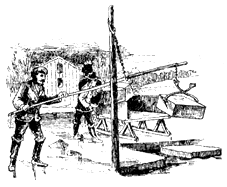
Mr. “C. G. T.,” Dutchess Co., N. Y., sends us a sketch of a
method of loading ice, here illustrated, and writes :
Whenever ice must be hauled on sleds, the following method
of loading will save a great deal of heavy lifting. A pole
of sufficient length to reach the bottom of the pond is
firmly set through a hole cut in the ice. At a suitable
height, a chain with a loop at the end is fastened; through
this loop another pole is passed, which acts as a lever. At
one end of this lever the ice-tongs are attached with a
rope or chain. A canal is cut, the ice blocks floated up to
it, when they may be hoisted from the water directly into
the sled. (Click on the “Image Gallery” to view this and other sketches.)
Winter Care of Livestock
There are a few general rules for the care of live stock in
winter, which are of universal application:
First. — They should lie dry, whether bedded
or not. A dry floor is far better than wet bedding. Spar or
slat floors, through which urine will quickly pass, and
which give the animals a level standing place, are
especially to be advised. A good degree of comfort may be
had on such floors, but a full supply of dry
litter — straw, leaves, swamp bay, etc. — certainly
makes all kinds of stock more comfortable.
Second. — Shelter saves fodder, wherever
lumber can be easily obtained, to a degree which few
practical men are aware of. The warmer the stables are, the
better, except perhaps for sheep. But with close, warm
stables, it is essential that the manure heap should be
where it will not contaminate the air, and that there
should be perfect ventilation so arranged as not to cause
drafts of air.
Third. — As to feed. This should be given
with the utmost regularity and uniformity — never more
than will be all eaten up long before the next feeding
time. Then the animals have an appetite for their food, so
that coarse fodder may be first given, to be followed with
better, and by grain in some form, if this be a part of the
daily ration. This is no doubt the most economical system,
securing the least waste and best digestion of all kinds of
fodder used in the ordinary way.
Fourth. — Grooming and care of the animals
are a most valuable means of keeping them in health as well
as of saving feed. The skin of an animal existing in a
state of nature is washed by every shower, brushed and
carded by every bush, licked by its mates, rubbed by the
ground in rolling, and in various ways kept free from
accumulations of its own exfoliations, from the stoppage of
its pores by sweat, and from its own inherent dirt. A
healthy skin means warmth, health, life, and vigor, other
things being about right, and we can secure this in horses
and cattle only by grooming. A straw brush, made by
twisting up a thick rope of straw until it becomes very
hard and is inclined to kink, than doubling it and twisting
it into a stiff mass a foot to 18 inches long perhaps, with
the ends tucked and fastened, will do a deal of rubbing
before it goes to pieces, and is for purposes of friction,
rubbing off mud, etc., better than any other brush. Clean
skins are just as important for cows as for horses, and
the use of the brush is recommended in the cattle stalls.
Fifth. — Sunshine. Fresh air and sunshine
are health-giving and invigorating principles and not one
of our living dependents should be without them. In the
thorough ventilation recommended, good air has been
provided for, nevertheless all well fed animals enjoy and
are the better for air breathed out of doors even on our
coldest days and a sun-bath of an hour or two is of the
highest value. Stables should be constructed with reference
to sunlight, and long narrow wings for stables, both for
horses and cattle, have in this particular a great
advantage over basement stables under the whole barn, as
the former may have windows for the admission of sunlight
and air throughout their entire length.
Sixth — Give all animals free access to salt.
With plenty of feed, horses and sheep will stand any degree
of dry cold incident to the climate of the United States
and Canada. Neat cattle need more protection, and it is
really cruel to expose them unprotected to winter weather.
Swine need thoroughly warm dry quarters to winter and will
hardly survive exposure such as other domestic animals will
bear perfectly well. So with poultry–while turkeys
will bear the severest storms and cold roosting in the most
exposed positions, fowls seek shelter either of thick
evergreens or houses and ducks and geese the protection of
the manure pile or the hay stack. In sheltering all animals
and poultry, which we do from motives of economy, it is
well to bear in mind their natural instincts, that those
which need it most are best protected.
When to Apply Manure
The common practice is to cart the manure from the barnyard
once a year; usually in the spring. In this way the
hauling is done, when other work is pressing, and while the
ground is soft. It is better to draw out the manure exposed
in open yards, as it accumulates, and drop it in heaps in
the fields where it is to be used. With the best facilities
for keeping the manure — that is, with a
barn-cellar — there is less loss in keeping it under
cover, and when well rotted, apply it to the ground just at
the time when it will be of the most benefit to the
crop. Manure is considered as so much capital used in
growing the crop, and bears interest only as it is used by
the plants. If beets or turnips need the most manure in
midsummer, it is economy to apply it then, provided there
is the proper facility for making, storing, and turning out
this valuable fertilizer every month in the year. Grass
lands can make use of manure at dearly all times, and upon
these it may be spread in winter with economy of labor and
excellent results.
Getting Tools Ready for Spring
A light and warm work-shop is a good investment. Men and
boys cannot be expected to do much work if their fingers
are numbed with cold, but if a suitable place and proper
facilities are provided, the stormy days of winter may be
turned to good account. Among the needed preparations for
spring is putting the implements in good order. Not merely
the mowers and other costly implements, but even the hoe
and spade will do better work if property ground. All iron
and steel tools and parts of machines can be readily
preserved from rust by the use of a mixture of lard and
rosin, melted together (an ounce of rosin to a pound of
lard), and stirred while cooling. This may be applied by
means of a rag, or better, a swab, made by winding a bit of
cloth around the end of a stick. Only a light coating is
needed, and this is more readily applied if the article be
warm. If the wood-work of machines was originally painted,
it is well to repaint when necessary, but if it was merely
oiled, use linseed oil again. For wood that has not been
painted or oiled, crude petroleum, (several applications to
saturate the wood,) is an excellent preservative. Where
there are many small tools, such as the trowels, hand
forks, etc., it is well to paint a portion of the handles
bright red. Such affairs are quite apt to be left where
last used, or dropped in going from place to place. The red
makes them very conspicuous, and will often save much
hunting. Besides repairing, various garden conveniences may
be made. Markers of various widths are useful, though it is
quite as convenient to have a marker so arranged that it
will serve for several distances. The head of the marker
should be a piece of scantling, and the teeth of hard wood.
Placing one row of teeth nine inches apart, and the teeth
of the other row a foot apart, will allow, by the use of
every mark, or every other one, rows at four different
distances to be made–9, 12, 18 and 24 inches. A good
wooden reel for the garden line is much more useful than
the poorly made iron ones so often sold. It is well to have
ready the boxes for raising plants from seeds, either in
the house or in the hot-bed . Those for the window may be a
foot wide, three inches deep, and of a length corresponding
to the width of the window frame. Those for use in the
hot-beds are most cheaply made from the boxes in which
starch, soap, and other articles are purchased. These can
be bought when empty at a low price and by cutting them in
halves two may be made from each, the cover forming the
bottom of one of them. Boxes without either top or bottom
with mosquito netting tacked on in place of the cover are
of great service in keeping insects from melon or other
vines.
A Subscription Fraud-Look out for Him
One of our subscribers at St. Thomas, Canada, writes us
that a good looking man (they are always good looking and
well dressed) with a wooden leg, is taking subscriptions
for various newspapers and giving receipts for the same,
signing the name of the firm or party publishing the paper.
He is the worst kind of a swindler, besides being a forger,
as the parties whose receipts were used by him say that
the signature is a forgery, and that they employ no
wooden-legged men or thieves in their business.
Another correspondent writes us that he sent in response to a glowing New York
City advertisement, $5 to pay for some of the goods
advertised therein. He never received the goods, and
wished us to look the parties up and, get his money for
him. He sent us an order on them for the amount, but he
might as well have sent us a Deed for “Lots in the Moon,”
as we should have about as good a prospect of finding them,
as of finding the firm he would have us look for.
Moral — Avoid all the flashy advertisements you see, as
they are only a net spread to catch the unwary.
Still another complaint comes from Glens Falls in this State, and encloses
an advertisement of a would-be Gent’s Furnishing House
situated (or supposed to be) in the immediate neighborhood
of this office. We would say to our friend that it is only
an old swindle under a new name. There is no such store as
the company advertise, and any one who sends to this man,
whose name begins with R and is spelled with four
syllables, $9 for six shirts and expects to receive them,
will die of old age before they arrive.
Corn Oysters
To six good-sized ears of corn add three well-beaten eggs,
one tablespoonful of cream and one of flour; salt and
pepper to taste, fry in butter and serve hot.
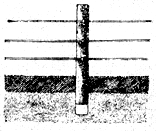
Posts Lifted by Frost
The curious expansion of water freezing, and of soils
filled with water, has a telling effect upon fence posts
standing in damp ground. The top soil around a fence post,
if dry, or only slightly moist, does not affect the post
during winter. But if the particles of soil are saturated
with water, on freezing the whole expands an eighth; so
that, when frozen eight inches deep, the post is lifted an
inch out of the lower unfrozen soil. If the frost
penetrates sixteen inches, the post rises two inches. When
the frost leaves, and the surface soil sinks back, the post
remains two inches out of the ground. A few freezings of
the surface will thus inevitably throw the post out so far
as to render it useless, unless it is driven down every
spring before the open space left at its bottom is filled
by soil washed in. For this reason it is advisable to make
the extreme lower ends of fence and other posts a little
tapering, or at least to clip off the bottom corners so
that they can be driven down more easily when lifted. We
will say now in advance, that all fence and other posts
should be examined early every spring, and those at all
lifted be driven back with a beetle or sledge hammer. A
stitch in time will save nine, here. On naturally dry, or
drained land, the above trouble will not be experienced,
except at places where water flows through them from a
higher to a lower level, thus keeping them wet, or very
damp.
Frost Destroying Stone Fence Walls
When these stand on water-saturated soil, the expansion by
cold, if uniform on both sides, does not affect them. But
almost invariably, especially if running in any direction
but north and south, and often then the soil under them
will be more frozen or sooner thawed on one side than on
the other, and thus they will be thrown out of
perpendicular, and more or less disturbed. Only four inches
of frozen wet ground under one side of a stone wall, and
none under the other, will lift the frozen side half an
inch, or enough to tilt five inches to one side the top of
a wall five feet high and two feet thick at the
bottom–enough to greatly disturb it, and ultimately
throw it down. A wall set down two or three feet deep in
the ground will be similarly affected, if water stands
around its base. There are two remedies. One is to run a
drain under or near the wall, deep enough to carry off all
standing water about it, below the freezing point. The
other is, to raise the earth into a ridge before the wall
is built, high enough to have it always dry. This is
readily done by successive plowings, turning the furrows to
the center of where the wall is to stand. The saving of
foundation stone will far more than cover the cost of
raising the ridge; and the fence will not need to be so
high if standing on such a ridge, as animals will not jump
it so well when they must spring from ground rising in
front of them.
Dust Baths for Hens
Lay in a supply of leaves and dry dirt before the cold
season opens and the ground is frozen. The fowls will have
to remain during a large portion of their time in the
poultry-house in the winter, and will require materials
for the dust bath. For this purpose there is nothing
superior to coal-ashes, but they must be sifted twice,
first to remove this coarse materials, and next through a
fine sieve, in order that only the finer portions may be
used. A dust bath should be composed of dust (not coarse
dirt), in order that the hens may throw it well into their
feathers. Dry dirt is always plentiful, and should be
placed under shelter, especially if there is an insufficient supply of ashes. Wood-ashes should not be used
for the dust bath, as they contain potash and irritate the
skin. Leaves are the best of all materials for the floor,
as they not only induce the hens to scratch, but to a
certain extent prevent draughts of air on the floor.
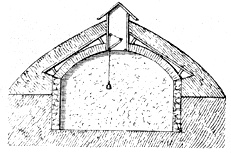
A Frost Proof Cellar
A good cellar for storing roofs, etc,, that is frost proof
in winter, and cool in summer, maybe constructed as
follows: The ground should be excavated for four feet, and
walls of stone built, with an arching of brick to cover the
whole. An air space is left between the bricks and the
earth above them. This is made by laying scantling
lengthwise of the roof, and covering them with boards or
plank well battened. This secures a non-conducting air
space, which prevents the passage of moisture from the
outside. A ventilator in each gable end of the cellar,
provides for a circulation of air, and the escape of any
moisture that might otherwise collect on the surface of the
boards. There should be a sash or trap door in the
ventilator shaft, that may be opened or closed by means of
a cord and weight, which hang down in the cellar. In hot,
summer weather it may be necessary to provide some shade
over the ventilators. A cross section of such a cellar is
shown in the engraving.
Controlling Broody Hens
If it is desirable to prevent broody hens from incubating
at this season, it can be done with but little difficulty.
Simply provide a coop, raised a few inches from the floor,
the coop to have a bottom made of slats, so as to allow of
free circulation of air under the hen. A broody hen’s
efforts are directed to warming her eggs. She does not
relish cold draughts underneath her body, and soon leaves
the coop in disgust. This method is humane and efficacious.
In other words the hen must feel the accumulating warmth of
the nest or coop in order to remain at her work.
Getting Rid of Rats
Everybody has a method of getting rid of rats, and all are
good at times. To the farmer and poultry keeper these
rodents are a terrible nuisance and means of loss. They
will capture a half-grown chicken before your eyes and
escape with him before you can do anything. It is very
hard to trap them because they won’t go near the traps
after one or two have been caught. Many do not know that
spreading a square yard of thin cloth over the trap will
deceive them. Place the bait on the pan of the trap, but on
top of the cloth. It rats cannot be driven out of the
building, poison in some form will kill many. Rough on Rats
is sure death,but is dangerous and must be kept away from
poultry and all other stock.
Precipitated carbonate of
baryta, which is a poisonous, heavy, white powder, devoid
of taste and smell, has been tried and proved very
effective. Mix with four times its weight of barley meal,
make a stiff paste with water, and introduce small pellets
of it into the rat holes. The smallest quantity proves
fatal, and it seems to immediately paralyze the hind
quarters, so the rat will not get away and die where he
could be eaten by domestic animals and prove fatal to them.
It has been proved that neither pigeons nor fowls will
touch the paste. Rats may be also killed by feeding them
regularly in one place and then a few days substitute dry
plaster of paris and a little meal for the regular food.
Have a pail of water where they can drink and the plaster
of paris will harden inside and kill them.
Whether or not a
method is cruel is hardly to be considered in this
connection, and we give this for what it is worth: Catch
several rats without injuring them and put them in a tight
cage. Do not feed them anything and they will eat each
other, until all but one are eaten, and he may then be let
loose. He has now such a love for a cannibal diet that he
will soon eat every rat on the place. Rats may also be
scared away by catching one or two, covering them with tar
and feathers, and letting them go, or by putting a leather
collar and small bell on the neck, or painting them with
phosphorus. They will run after the others, and all leave
the building for good. Cover the floor near their holes
with caustic potassa; they will get sore feet, and licking
their feet will get sore mouths. A spry cat or dog will
generally see that these rodents keep out of the way.
How To Prepare an Asparagus Bed
The preparation of an asparagus bed should be made with
more care than for most vegetables as it is to be a
permanent crop. The ground should be thoroughly drained,
naturally or artificially, and preferably of a rather light
sandy loam. This should be trenched and a heavy coat of
well-rotted manure applied. Either one or two-year-old
plants are set, which may be raised from seed or bought of
nurserymen. Set in rows not less than 4 ft apart, 6 is
better, and 3 ft in the row. Set the roots from 4 to 6 in
below the surface so as to cultivate over the crowns. The
beds will last longer and stand drouth better when set
deep. The plants may be set in either spring or fall. If in
the spring, as soon as the ground is dry enough to work;
and if in the fall as soon as plants can be obtained, which
is usually early in October. Fall setting where possible
is preferable for the roots have the chance to form and
start earlier the next spring.
Wintering Celery
To winter celery successfully out of doors
it should be banked to the very tips, the earth being kept
away from the upper part of the celery by boards. Over the
top a trough or boards may be nailed to keep off the rain.
This roof should be heavily covered with coarse strawy
manure. This will keep it safely until Christmas and during
the severe weather later; if litter be placed above this it
will probably keep till spring. Frequent inspection will
dictate whether still greater protection will be required.
With a very large quantity of celery for market, a trench 1
ft wide and 18 in to 2 ft deep may be dug. Tile may be
placed in the bottom and the celery packed closely together
in the trench. It should then be walled up as previously
described and covered with an inverted trough of hoards.
A celery house is in use in many places. It is little more
than a roof on the ground, the object being to have the
roofers near the top of the celery as possible. The celery
is packed in rows; with paths between through which the
attendant may occasionally crawl to inspect it. The
greatest danger will be from keeping it too warm and
inducing rotting. There will be no danger of too much
ventilation in the mildest weather. Whatever the roof is
composted of it should be tight, as water dripping through
upon the crop will surely rot it. It is not necessary to
put up the celery until late in the season. — Hollister
Sage, Fairfield CO., Ct.
How to Peel Tomatoes
Nearly all cook books say, “pour boiling water over ripe
tomatoes and then skin them,” and at least 99 In every 100
persons attempt to peel them in this manner, and
consequently do it with much difficulty and very
imperfectly. This is the proper way to peel tomatoes: Cover
them with boiling water half a minute, then lay them in
cold water till these are perfectly cold, when the skin can
be slipped off without difficulty leaving the tomatoes
unbroken and as firm as before they were scolded.