

Reprinted with permission from Popular Science.
So you got the dome up this summer and it shot your entire budget. You’ve already moved in, but winter’s comin’ on and you have no idea how you’re gonna keep warm. Wouldn’t it be nice if you could find some way to heat the thing free . . . And wouldn’t it be even nicer to get paid for keeping warm?
Yes, indeed. And you can do it too. Bill Cheney does. Although bill heats a shop and not a home with the rig described in this article, there’s no reason why it can’t see you through that first homesteading winter . . . Or more.
Naturally, MOTHER EARTH NEWS advises that you follow construction drawings exactly and observe proper precautions when using your heater.
The fuel I burn to heat my shop doesn’t cost me a penny. In
fact, I’m paid a buck for every 100 gallons I haul
away. It’s old crankcase oil, and gas stations are happy to
have me pump it out of their waste tanks.
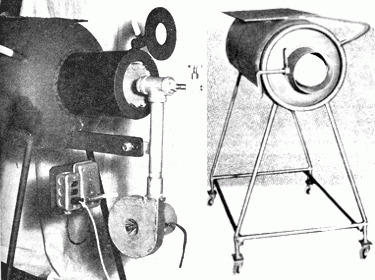
I built my own stove from a condemned bottled-gas cylinder.
You can pick one up for peanuts because legally they can’t
be used again, and it’s too costly to cut them up for
scrap. If you can’t get one, a 30, 50, or 100 gallon steel
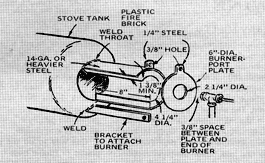
drum can be substituted. My stove cylinder is 14 inch by 40 inch,
but these dimensions aren’t critical. The ones for the
throat and firing port are, since they guarantee
the hot throat that’s required to burn any fuel. I
circulate the heat with a small electric fan, and there’s
plenty to spread around: With clean oil, the heater can
produce up to 500,000 BTUs per hour.
It’s clean heat, too, although some smoke is generated when
the burner is first started. To carry this (and all carbon
monoxide fumes) outside, a stack is required. Where
erecting one is impractical, you can burn natural or
bottled gas, instead. You just insert a different jet
nozzle. When burning gas fuels, I exhaust right into the
shop; there’s some water vapor, but not enough to cause
troublesome condensation. Better check local regulations,
though. If they specify a stack for gas, too, you might as
well enjoy the economy of crankcase oil.
Start with the stove. If you’ve been able to pick up an old
bottled-gas cylinder, you must prepare it in a special
way. Set the tank upright on its base and fill it with
water. Lay out an 8 inch circle at the crown of the domed top.
Using a cutting torch, pierce the tank with a short arc cut
out on this circle. (As the cut will be below water line,
water will flow out until level with it.) Complete the
circle and drain the tank.
With the tank up-ended, cut a 6 inch diameter hole in the
center of the base for the exhaust. It’s in the center so
heated air will build up in the top of the stove, improving
combustion as well as retaining heat. I formed my exhaust
pipe by bending a sheet of 1/8 inch steel plate, but lighter
material can be used.
Weld the throat at the other end, and complete the stove
by placing it on its side in a sturdy stand. Mine is a pipe
frame welded to the cylinder and equipped with casters so
the stove can be rolled around the shop or used outside.
You need lots of air to burn the fuel properly. I bought a
used vacuum cleaner blower and brazed a 1inch pipe coupling
into its outlet for attaching the burner pipe. Since
throttling the air output causes the blower to speed up, an
airflow valve could damage the motor. Instead, I installed
a rheostat, salvaged from a sewing machine, to regulate the
motor speed.
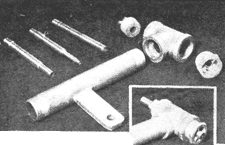
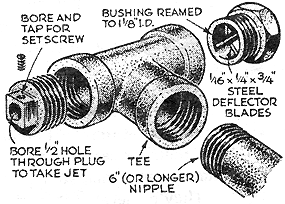
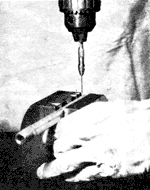
The heart of the heater is the burner itself. It’s made of
four black-iron 1 inch pipe fittings. The deflector imparts a
swirling motion to the blower air that helps mix it with
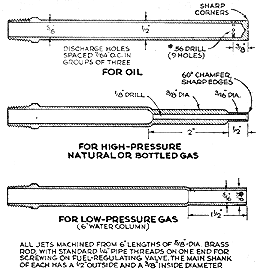
the fuel from the jet. The jet is secured with a setscrew
so it can be adjusted–or replaced with another type
if the fuel is changed. The position of the jet, in or out,
depends on the choice of fuel, and–if it is
gas–the fuel pressure.
When oil is used, the bottom of the supply tank should be
about a foot above the burner.
To start the burner, if oil is the fuel, open the port
plate and thrust a crumpled newspaper or oil-soaked rag
well into the throat. Light this, close the port turn on a
little air, and slowly open the fuel valve until oil
ignites in the throat. Gradually increase the air supply;
then give more oil. Once the throat becomes hot, increase
the flow of both air and oil, experimenting for the best
mixture and proper jet position When properly set, there
should be no smoke or soot. To shut the stove off turn off
the oil first, letting the blower run until the fire is
completely out. If this isn’t done, oil may drip onto the
hot throat and flame will puff out of the burner port.
When firing with gas, start the blower at low speed and
hold a piece of burning paper just below the closed port
while slowly turning on the gas.
Whatever your fuel, never look directly into the port;
always inspect it at an angle, or use a small mirror. While
the fuel can’t explode, the great heat might singe your
whiskers.





