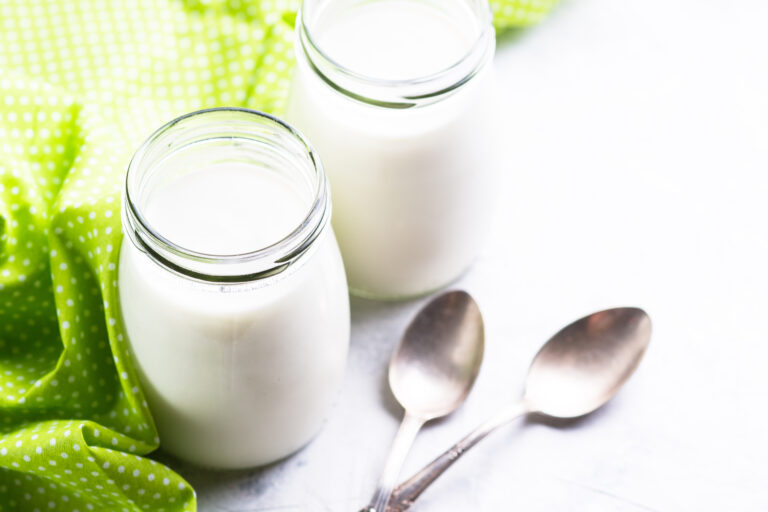
Learn how to make homemade yogurt recipe that is better than what you’ll find in grocery stores, usually less expensive than store-bought and free of the preservatives, stabilizers, fillers and sweeteners found in most grocery store yogurts.
No doubt you’ve heard about the health benefits of yogurt, the most widely consumed fermented milk product in the world. Delicious yogurt is nutrient-dense, packing a one-two protein-calcium punch, among other valuable nutrients. Those with moderate lactose intolerance may find yogurt easy to digest. Most famously, yogurt’s live bacteria (usually a combination of Lactobacillus bulgaricus and Streptococcus thermophilus) may keep undesirable bacteria in our digestive systems at bay.
In fact, some have speculated that the prominence of yogurt in the diet of Bulgarian peasants is responsible for their unusually long life spans. In other parts of the world, yogurt is a staple as important as bread or water, and it comes in many incarnations, from carbonated yogurt “sodas” to tangy cheeses to delectable sauces. The culinary traditions surrounding this fermented milk product run so deeply that writer Anne Mendelson, author of the book Milk: The Surprising Story of Milk Through the Ages, has dubbed the yogurt-loving part of our globe from eastern Hungary to western China “Yogurtistan.”
Homemade yogurt is much better than what you’ll find in grocery stores. It is usually less expensive than store-bought, and will also be devoid of the preservatives, stabilizers, fillers and sweeteners found in most grocery store yogurts. You can make your homemade yogurt with the highest-quality milk (cow, goat, sheep or even buffalo), ideally locally produced, free of hormones and tastier than national brands. Ideally, milk for yogurt-making comes from healthy, grass-fed animals — they make the most nutritious milk you can get — and will not be ultra-pasteurized, which denatures some of the milk components. Homemade yogurt can outshine commercial yogurt in flavor and texture. Plus, it’s pretty easy to make.
Any milk can be used to make yogurt, including skim, low-fat or whole. If your aim is to end up with a thick, creamy yogurt ideal for broad culinary uses, you’ll be most pleased with whole cow’s milk. Yogurt made with goat’s milk, which has a different composition than cow’s or sheep’s milk, is good, but you probably won’t be able to stand a spoon up in it unless you strain it or add powdered milk.
The Best Homemade Yogurt
Slowly heating the milk is also important to achieving the thick texture many yogurt lovers seek. The faster you heat the milk, the grainier the yogurt will be. Heating kills bacteria that could compete with starter bacteria, and slow heating denatures lactoglobulin, allowing the proteins in milk to link in a “fine matrix of chains that is much better at retaining liquid in its small interstices,” says Harold McGee in On Food and Cooking: The Science and Lore of the Kitchen.
You’ll need a good starter culture. Find yogurt starters through cheesemaking suppliers and in well-stocked grocery stores. Some heirloom cultures have been kept for many years. (Try Cultures For Health and New England Cheesemaking Supply.) Or inoculate your milk with store-bought plain yogurt that contains live cultures. Find one with flavor you enjoy and, after your first batch, keep your own starter going by using a portion of each batch to inoculate the next one.
Our recipe calls for less starter yogurt than you may see in many other recipes. This is a tip gleaned from The Joy of Cooking, by Irma S. Rombauer. “You may wonder why so little starter is used and think that a little more will produce a better result,” says the 75th anniversary edition. “It won’t. The bacillus, if crowded, gives a sour, watery product.”
Deciding how to incubate the yogurt is the next important decision you’ll make in this simple process. Any contraption that maintains a set temperature of 110 to 115 degrees Fahrenheit will do just fine. A small cooler or thermos will also work well. If the cooler won’t be full, fill it with jars of heated water or bath towels to maintain the ideal temperature. You may also be able to fit your yogurt container into a food dehydrator set to the correct temperature. Another option is your oven, turned off but heated with the pilot light, light bulb or a large container of hot water — some experimentation may be required if you choose this method. Many inexpensive, easy-to-use electric yogurt-makers also accomplish this.
If a batch of yogurt did not set up properly, all is not lost. Reheat it to 110 degrees, mix in another tablespoon of starter, and try again.
Many people add powdered milk to yogurt to thicken the final product and boost the calcium content. Skip this if you think yogurt is best in its pure form, as Mendelson does. Most yogurt-making traditions thicken the final product by subtraction rather than addition, she says. In other words, strain out the whey.
Add flavor after plain yogurt is finished. Some people put fruit or sweeteners in the container during fermentation, but adding them before you eat the yogurt is just as easy.

How to Make Homemade Greek Yogurt Recipe
Today, many commercial makers thicken yogurt with gelatin or carrageenan, which comes from seaweed. However, straining is historically the way to thicken yogurt and concentrate the flavor to make it suitable for uses in sauces and other dishes. For thicker homemade yogurt, pour it into a cheesecloth bag or tip it into a colander lined with cheesecloth or a clean kitchen towel to strain for a few hours. Greek yogurt traditionally is made by straining; it’s made with the same cultures as regular yogurt. Let the yogurt drain for up to a day and you’ll end up with yogurt cheese, or labneh. Keep the yogurt refrigerated while it drains.
For ideas on using yogurt in new and interesting ways, we highly recommend Milk: The Surprising Story of Milk Through the Ages by Anne Mendelson and The Art of Fermentation by Sandor Ellix Katz.
How to Make Homemade Yogurt Recipe
Ingredients:
- 1 quart milk, preferably unhomogenized, not ultra-pasteurized
- 1 tbsp starter yogurt
Instructions:
- Heat the Milk. In a heavy-bottom saucepan, slowly bring the milk to 180 degrees Fahrenheit over low heat (use a thermometer). Stir frequently to avoid sticking caused when the milk sugars burn.
- Remove From Heat. Pour the milk into a separate bowl to cool it to 110 to 115 degrees. Set the bowl into larger bowl filled with ice and stir regularly to speed cooling if you like. Be sure to monitor the temperature carefully.
- Mix in the Starter. In a separate small bowl, mix about half a cup of the milk with your starter, then pour the mixture into the rest of the milk. Stir to combine.
- Incubate. Pour the inoculated milk into your incubator, and keep the container at approximately 110 degrees for several hours. Avoid jostling the container while the yogurt sets.
- Check Consistency. Most yogurt will set to a custard-like texture in 3 to 4 hours, but you might like the results better after 6 or 8 hours. The longer yogurt incubates, the tangier and grainier it will get. At the same time, the longer it ferments, the more lactose will be removed. After a few hours, check the yogurt by gently removing a small spoonful without jiggling the rest of the yogurt. Check every half hour or so. Refrigerate the yogurt when it has reached desired consistency.
How Long Does Homemade Yogurt Last?
Your homemade yogurt will probably never taste better than the moment you’ve decided it’s done, but some people enjoy the changing flavor as the yogurt sours over time. It keeps well for a week or two, but may decline in effectiveness as a starter for the next batch after 5 to 7 days.
Tabitha Alterman considers cooking with high-quality, artisanal and homegrown foods to be one of life’s greatest joys, and it’s a joy she relishes sharing with others. She believes sustainability and self-sufficiency are the keys to better-tasting food, not to mention a richer life. Her kitchen is usually full of interesting foodie science experiments. She does her best to grow delicious, healthy veggies and herbs via tiny bits of space here and there, including a little patch in Kansas and her fire escape and windowsills.
Frequently Asked Questions
How long does homemade yogurt last?
Your homemade yogurt will probably never taste better than the moment you’ve decided it’s done, but some people enjoy the changing flavor as the yogurt sours over time. It keeps well for a week or two, but may decline in effectiveness as a starter for the next batch after 5 to 7 days.