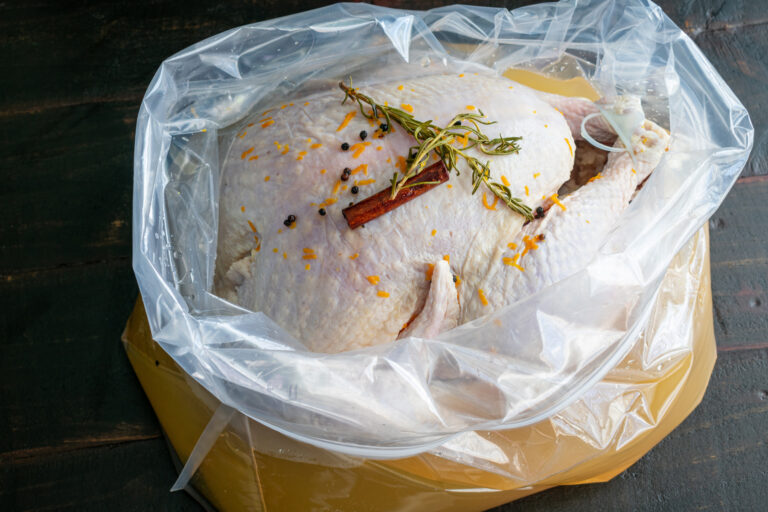
Ingredients
- 1 gallon/4 liters water
- 1 cup/225 grams kosher salt
- 1/2 cup/125 grams sugar
- 1 bunch fresh tarragon (about 1 ounce/25 grams)
- 1 bunch fresh parsley (about 1 ounce/25 grams)
- 2 bay leaves
- 1 head garlic, halved horizontally
- 1 onion, sliced
- 3 tablespoons/30 grams black peppercorns, lightly crushed with the bottom of a sauté pan
- 2 lemons, halved
- One 3- to 5-pound/1.5- to 2.25-kilogram chicken or turkey breast
Directions
- Combine all the brine ingredients in a pot large enough to hold the chicken or turkey; give the lemon halves a good squeeze as you add them. Place over high heat and bring to a simmer, stirring to dissolve the salt and sugar. Remove from the heat and let cool to room temperature, then refrigerate the brine until it’s chilled.
- Add the chicken or turkey to the brine. Weight it down with a plate or other object to keep it completely submerged and place in the refrigerator for the appropriate time.
- Remove the chicken or turkey from the brine, rinse well, and pat dry. Let rest uncovered in the refrigerator for 3 to 24 hours.
- Preheat the oven to 450 degrees F/230 degrees C.
- Roast the chicken or turkey until it reaches an internal temperature of 160 degrees F/71 degrees C (the cavity juices will be clear when it’s done). Remove from the oven and let rest for at least 15 minutes before serving.
What does brining do? How long does it take to brine different meats? Perfect your wet brine technique with this recipe for brining whole chicken or turkey.
What Does Brining Do?
A brine is simply salty liquid (a dry cure with water). Doesn’t sound like much, but in fact, when salt combines with water, its power is magnified. Salt in solution penetrates meat faster, it is the most effective marinade possible because it can flavor the meat down to its center via osmosis, and it results in a juicer finished dish. And it can also be used to preserve meat.
Brines, more so than dry cures, are an excellent way to impart seasoning and aromatic flavors. A brine penetrates a chicken or a pork loin rapidly and completely, bringing with it any flavors you might have added to the salty solution (garlic, onion, tarragon, pepper). Chefs often use brines for pork, chicken, and turkey–the three types of meat that benefit the most from brining–because they result in a uniformly juicy loin or bird that’s perfectly seasoned every time.

There’s a pleasing contradiction in the brine. Salt, as we know, dehydrates–it draws moisture out of the cells of the meat. Yet while a brine’s main effect on meat is to dehydrate it, a brine nevertheless results in a moister, juicier cut, and one that stays juicy even on reheating. The reason for this seeming contradiction, explains Russ Parsons, who has written about the subject both in the Los Angeles Times and in his book, How to Read a French Fry, is that salt changes the shape of the protein in the meat or bird so that it can actually hold more juice than unbrined meat. Salt allows the protein molecules to expand, to connect more loosely, and thus contain more water within each cell. Salt makes each cell, in essence, plump up.
Because of this effect, roasting a brined chicken or turkey and hitting it at just the right point of doneness is easier than with an unbrined chicken. You can actually overcook it, in fact, and it can still be juicier than a perfectly cooked bird that wasn’t brined. The brine seems to allow the breast to withstand the high temperature while the slowpoke legs and thighs continue to cook. At Five Lakes Grill, Brian always brines the pork chops so that no matter who’s working the line that day, the end result will be exactly the same, a chop with just the right amount of seasoning and always very, very juicy.
And there’s an added benefit that usually goes unmentioned, but is not insignificant. Brined meat has been shown to harbor lower populations of harmful bacteria than unbrined meat, the result of salt’s time-tested effect of curing. It dehydrates those living things, either killing them or preventing them from multiplying.
Turkeys, because of their very large, very lean breasts, benefit most from brining. Do you always want to brine a chicken before you roast it? Probably not, because it requires some additional work–and forethought. Also, the texture of the skin is altered by brining, cooking up dark brown and shiny because the brine has taken all the water out of it. It’s a lot easier simply to salt the chicken and pop it into a hot oven. But if you like to cook, you will certainly want to have the brining technique (and a basic brine ratio) in your repertoire. (If you’re thinking ahead but aren’t going to brine the bird, salt your bird a day before cooking it, and it will be even better, the salt having had a chance to penetrate the flesh deeply, as with a brine. Really the only culinary difference between a brine–salt with water–and a dry cure–salt without water–is the ability to introduce a variety of seasonings and flavors in a way that they, and the salt, uniformly surround and penetrate the meat.)

A brine should also include a third component: sugar. Sugar helps to balance out some of the harsher effects of salt and enhances flavor. Finally, because sugar browns so nicely, it helps to give a deep rich color to the surface or skin of roasted meats.
Sugar can usually be used in any of its various forms–white or brown sugar, honey, molasses, dextrose, maple sugar or syrup. Depends what you’re making. Dextrose is a refined corn sugar, sometimes called baker’s sugar; it is very fine and therefore dissolves easily. For ham or fresh pork, brown sugar or honey has an excellent effect.
A fourth optional but often desirable component is an additional flavoring ingredient–herbs, spices, or aromatic vegetables. As the brine itself penetrates the meat, it brings with it the additional flavors. You might add tarragon, parsley, and thyme to your salted water for an herb-brined turkey or turkey breast. Brian’s Five Lakes brine for pork chops includes sage, garlic, and juniper berries. Corned beef uses pickling spices in its brine. If you use aromatic components (which in chefs’ vernacular are called aromats), it’s important to heat your brine first so that the flavors fully infuse the liquid. This also helps to ensure that the salt and sugar completely dissolve and disperse evenly throughout the brine. It’s then critical to chill your brine before adding the meat, or you’ll be making bad soup–cooking your meat rather than brining it. Adding other aromats in addition to the herbs and spices, such as onion and carrot, to a flavored brine (essentially combining the brining technique with a court-bouillon, or quick stock, technique) is rarely a bad idea if you have the time. In the end, though, it’s the salt in the water that works the magic.

- Because brines are such powerful tools, you need to use them with care. It’s all too easy to infuse meat with too much salt. The saltiness of the meat is determined by two factors: how salty the brine is and how long the meat stays in the brine. If you leave a 3-pound chicken in our brine for longer than 24 hours, the meat will eventually become too salty. A fat turkey breast, though, needs 24 hours for good brine penetration. As in all seasoning, it’s better to undersalt, because you can always add salt if something is underseasoned. If, however, you leave your meat in the brine too long, or suspect it’s become too salty, there are ways to fix the problem. To check, cut off a piece, rinse and dry it, and then cook it; it should taste a little too salty, having come from the surface (where the salt concentration is highest immediately after brining), but not unpleasantly so. If your meat does taste too salty, then you need only rethink how you’ll handle it. You can immerse it in unsalted water for half the time it was in the brine, and this will reduce its salt content, salt always seeking equilibrium. Or you could braise your meat rather than roast it, cooking it in water or stock with vegetables, and the salt will season the other components.
- We recommend a 5-percent brine: 50 grams of salt per liter of water, or 5 ounces salt per 100 ounces of water. (This ratio, incidentally, also happens to be perfect for blanching green vegetables.) If you’re concerned about salt intake, you can reduce the salt and sugar in your brine, but remember that only a small percentage of the salt enters the meat.
- When you remove the meat from the brine, always discard the brine. Never reuse it–it’s not only diluted from the meat juices, it’s also infused with impurities from the meat.
- Pay attention to the recommended brine time.
- Allow the meat to rest in the refrigerator after it’s been brined, a couple hours for small items and up to a day for larger cuts. Resting allows the salt within the meat to disperse more evenly. Immediately after it’s taken out of the brine, the meat closer to the surface will have a higher salt concentration than the interior will. When a turkey, say, is allowed to rest, the salt seeks equilibrium and continues to migrate until the salt concentration in the cells is uniform throughout, which will result in a uniformly seasoned bird. Resting also allows the exterior to dry, which results in crisper skin.
- Always chill the brine thoroughly before adding the meat to it. Chilling a brine can take time. To reduce the time needed for cooling, heat all the other brine ingredients in half the required amount of water. Once the salt and sugar are dissolved, add the remaining water, either cold or as ice water.
- Choose a container that’s taller than it is wide when brining larger items, such as a whole chicken or turkey or a fresh ham, because that will require less liquid to submerge the food.
- Always brine meat in the refrigerator.
Brine Times
The time you leave a piece of meat in the brine is critical. If you leave it in too long, it can become unpleasantly salty; it’s always better to err on the not-long-enough side. Smaller items need only a matter of hours, big items sometimes require a matter of days. Again, brine the item well ahead of cooking it so that it can rest to allow the salt remaining in the flesh to distribute itself evenly, from 2 hours to a day.
- Boneless chicken breasts (8 ounces/225 grams): 2 hours
- Pork chops, 1-1⁄2 inches/3.5 centimeters thick: 2 hours
- A 2-pound/1-kilogram chicken: 4 to 6 hours
- A 3- to 4-pound/1.5- to 2-kilogram chicken: 8 to 12 hours
- A boneless turkey breast, 4 inches/10 centimeters thick: 12 to 18 hours
- A 4-pound/2-kilogram pork loin: 12 hours
- A 10 to 15-pound/4- to 7-kilogram turkey: 24 hours
- A turkey over 15 pounds/7 kilograms: 24 to 36 hours
- Fish: 1 hour for thin fillets, 6 to 8 hours for fillets or steaks 1 inch/2.5 centimeters thick or more
Recommended Finished Temperatures for Meats
Remember that meat will continue to cook after it’s out of the oven (this is called carry-over cooking), and its internal temperature will rise five to ten degrees. All meats should be allowed to rest. Roast chicken should rest for at least 15 minutes before serving, and turkey for 20 to 30 minutes.
- Pork: We prefer pork medium-rare to medium, 130 degrees F/54 degrees C, for a finished temperature of 135 to 140 degrees F/57 to 60 degrees C. (In 2011, the USDA reduced the recommended temperature from 165 degrees F/74 degrees C to 145 degrees F/63 degrees C.)
- Poultry: Poultry should be cooked until the thigh registers 160 degrees F/70 degrees C, for a final temperature of 170 degrees F/76 degrees C. A good way to check if a chicken is done is to tilt it to allow the juices in the cavity to run out. If they are clear, and free of blood, the chicken is done.
Brining Whole Chicken or Turkey

Brining whole chicken or a turkey is a foolproof way to ensure juicy white meat and completely cooked dark meat. That’s especially valuable with a turkey, but it also gives you a little leeway when cooking a chicken. The following recipe will work for a chicken, a boneless turkey breast, or a whole turkey. You may need to double all amounts for the brine ingredients if you’re cooking a large turkey, 18 pounds/8 kilograms or more, depending on your brining container. You need a container large enough to hold the turkey completely submerged (check beforehand), but if your vessel is too big, you may need to make more brine to submerge the turkey.
For the brine, it’s fine to include the herb stems and the papery garlic and onion skins, if they’re free of dirt. When planning this meal, be sure to allow enough time to let the chicken or turkey rest after brining, optimally for a day, but at least for a couple of hours.
The skin of brined birds can become so dehydrated that, with the sugar in the brine, it sometimes crisps quickly as the bird cooks and can become too dark; if you see this happening, place a sheet of aluminum foil loosely over the bird to deflect the direct heat.
More from Charcuterie:

• Natural Pickles and Sweet Pickling Spice Recipe
Reprinted from Charcuterie: The Craft of Salting, Smoking & Curing, Revised and Updated by Michael Ruhlman and Brian Polcyn. Copyright © 2013, 2005 by Michael Ruhlman and Brian Polcyn. With permission of the publisher, W.W. Norton & Company, Inc.