Select the three sisters crops from a list of bean, corn, and squash seed varieties to add to your three sisters Native American garden.
The following bean, corn and squash varieties have been traced to different Native American tribes. Learn about varieties, sources (see the key to sources below,) growth habits, appearance, known history, culinary uses, and flavor notes.
Corn Varieties
‘Cherokee’ (long-and small-eared) Corn (6)
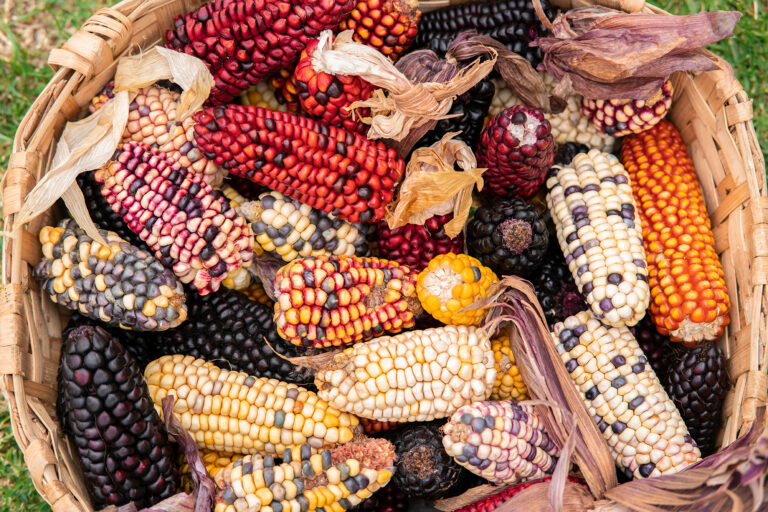
- Two types of multicolored popcorn (must be ordered separately); 100 days to maturity; grown by the Cherokee
- Small kernels of popcorn with big corn flavor; good in pies, cookies and stuffings
‘Dakota Black’ popcorn Corn(6)
- Maroon-black kernels on 4-1/2-inch ears; 1 ear per stalk; 6-foot-tall plants; 90 days to maturity
- Yields larger puffs of popped corn than the ‘Cherokee’ variety does, but has a similar nutty flavor
‘Hopi Sweet’ or ‘Tawaktchi’ Corn (4)
- Small ears with white kernels; 100 days to maturity
- Sweet corn that’s commonly dry-roasted at the milk stage and then stored for later use (a food-preparation technique of the Pennsylvania Dutch that was acquired from Native Americans); can be eaten like typical sweet corn, but is so tender you can eat it raw; also used as a dry corn in savory pies or stuffings, or stewed with poultry
‘Mountain Pima’ Corn (4)
- Small ears with yellow and, on occasion, red kernels; 100 days to maturity
- A Southwestern sweet corn that can be used like ‘Hopi Sweet’; good for creamed corn and corn soup
‘Puhwem’ Corn (3)
- White kernels on extremely long ears; a towering variety that reaches 16 to 18 feet with raccoon-proof ears high up on the stalks; not well-adapted to the Three Sisters planting scheme; known as “mother corn”; from the Delaware Nation
- Used as a dry corn and is one of the best Native American corns for making corn flour; exceptionally flavorful; great for dumplings, Johnny cakes and cornmeal pound cakes; can be used in cake and bread recipes (consider blending with wheat flour); a rich nuttiness comes through even in grits made from this corn; starchy, so grits cook quickly and thicken up with a soft, porridge-like consistency
‘Shawnee Flour Corn’ (1)
- Eight- to 10-inch ears with white kernels; plants reach about 10 feet in height; grown by the Shawnee
- Somewhat grittier than ‘Puhwem’ flour corn, but the flavor is about the same; good for hominy
‘Tutelo Strawberry’ Corn (3)

- Five to 6 feet in height with one or two cobs low on the stalks; ideal for Three Sisters if planted with short pole or semi-pole beans; when planted in hills, it will sucker and send out side shoots, some of which will produce additional ears; 115 to 130 days to maturity; originated in Virginia and western Maryland; a variety that was preserved by the Cornplanter Senecas of Northwestern Pennsylvania
- Used for grits, mush and hominy; the unique, deep rose color of this corn is preserved in the meal and grits, and turns out a wonderfully pink polenta; has a slightly sweet taste similar to that of maple syrup, so it works well as a “dessert” corn
‘Virginia White Gourdseed’ Corn (6)

- White, flat kernels; known among the Iroquois as “tooth corn” because of the kernel shape; 125 days to maturity; one of several truly ancient Native American corns surviving from the Eastern Woodlands
- Whole kernels look like large, flat seeds, and this appearance can be used to advantage in stews, stuffings and baked dishes; makes excellent hominy and grits; hint of almond or walnut flavor
Bean Varieties
‘Arikara Dry Yellow’ Beans (7)
- Bushy, drought-resistant; small, yellow beans; a primary food crop for the Mandan and the Arikara tribes of the Missouri Valley
- A bean at its best dry; has a light color and smooth consistency if puréed, so is ideal for soups and stews; subtle flavor goes well with poultry
‘Cherokee Trail of Tears’ Beans (1, 2)

- Drought-resistant; heavy producer; black beans grow in pods that ripen red to violet; taken to Oklahoma by the Cherokee during their forced migration in the 1830s
- Used as a dry bean; works well for refried beans or paired with cornbread; has a heavy bean flavor that can be controlled with a little bit of red wine vinegar
‘Genuine Cornfield’ or ‘Scotia’ Beans (1)
- A true corn hill bean; grown by the Iroquois
- Can be used like any Mexican pinto bean; turns creamy as a baked bean, which makes it excellent for cassoulet-type dishes; good with duck
‘Indian Hannah’ Beans (1)
- Tan seed with brown markings; ideal to grow with a short corn; a Delaware/Lenape variety of “wampum bean” preserved by Hannah Freeman, the last of her tribe in Chester County, Pa.
- Young, tender pods make good snap beans, while the large green seeds make good shelly beans; can replace pinto beans as a dry bean; mild flavor; makes excellent bean flour for adding to breads or grits
‘Mayflower’ or ‘Amish Nuttle’ Beans (2)

- A semi-pole variety; small, speckled beans; grown among the Iroquois
- Used as a dry bean; a small-seeded variety that’s good combined with other vegetables, especially in soups and stews; excellent mixed with wild rice; flavor is similar to that of cowpeas
‘Ohio Pole Bean’ Beans (1)

- Prolific variety; robust vines about 8 feet in length; 8-inch pods; best adapted to grow on tall corn varieties or, better yet, sunflowers; beans have purple speckles on one end
- This large, fat dry bean is good for baking; has a meaty flavor that goes well with game or red meats
‘True Red Cranberry’ Beans (1)

- Unique, round red beans; a New England variety
- A classic for baked beans; keeps its shape well when baked; used either as a shelling bean or as a dry bean; texture is dense and meaty; works well with smoked meats
‘Wild Pigeon’ Beans (1)
- A semi-pole, cut-short variety; best grown on short corn; produces tiny beans; grown by the Iroquois
- Good for soups, stews or stuffings; nutty flavor reminiscent of hickory nuts; can be ground for flour and added to grits or mush to impart an interesting background flavor; goes well with morels and other wild mushrooms
Squash Varieties
‘Arikara’ Squash (Cucurbita maxima) (5)
- Oblong in shape; off-white with faint, flesh-colored stripes or speckles; a North Dakota squash.
- Good for winter storage; generally used for soup, as it makes a nice, thick purée; also valued for its squash blossoms, which can be used in cookery fresh or dried
‘Mandan’ Squash (Cucurbita pepo) (5)
- Early, insect-tolerant variety that is more generally available than most Native American squash; small, round, flattish squash that’s cream-colored with green stripes; developed by the Mandan peoples in North Dakota; one of the first Native American squash acquired by noted seedsman Oscar Will
- A summer squash best if eaten young and soft, at which point it has a slight nutty flavor; can also be stored for fall and winter use; stored squash can be cut to create a “lid,” emptied of seeds, and then splashed inside with a bit of sunflower oil, a few pieces of dried fruit, and, best of all, a few spoonfulls of fresh pawpaw, which will caramelize the interior (if you cook the squash this way, close lid and place in bowl with a bit of water; cover and bake)
‘Menominee’ Squash (Cucurbita pepo)
- Small, top-shaped squash that ripens dark green with lighter green stripes; the name of this squash (which is also the name of a Native American nation in Wisconsin) means “Wild Rice People”
- Can be eaten young, at which point it resembles zucchini; if fully ripe and hard, it can be stored for winter as a source of seeds; try cooking the seeds with wild rice or baking the young squash with a wild rice stuffing
Key to Three Sisters Native American Seed Sources
- Appalachian Heirloom Plant Farm Winchester, Ohio.
- Baker Creek Heirloom Seeds Mansfield, Mo.
- Mill Hollow Farm To order seed corn, send check or money order payable to Mill Hollow Farm; P.O. Box 501; Edgemont, PA 19028; $14 per packet (includes postage).
- Native Seeds/SEARCH Tucson, Ariz.
- Sand Hill Preservation Center Calamus, Iowa
- Southern Exposure Seed Exchange Mineral, Va.
- Vermont Bean Seed Company Randolph, Wis.
- Seed Savers Exchange Decorah, Iowa
Read more: Connect to an ancient heritage by growing rare vegetable varieties in Three Sisters Native American Gardening and Preserving Native American Seed Heritage. Also, check out the joys and benefits of two carefully preserved varieties in The History of ‘Carl’s Glass Gems’ Native American Rainbow Corn and Try Puhwem ‘Mother Corn,’ a Revered Native American Variety.