

We Americans can and must design a lifestyle that consumes less resources. On the surface, it’s not difficult to imagine that we could create a satisfying, culturally rich lifestyle while consuming less fossil fuels and other nonrenewable resources. For example, most of Western Europe consumes far less than we do.
Yet there are significant roadblocks to sustainability and simple living as a national ethic. One is a socially transmitted anxiety that changes will require sacrifice. While the idea of simple living is appealing to many, others dismiss it as “doing without” or “having less.” To me, the key question is, less of what? To give just a few examples, who would object to having less stress, illness or insecurity?
It’s Not About Money — or Stuff
When we think about having more or less in life, we tend to focus on money. But money itself is neither a good nor a bad thing; its real value depends on how it is earned and spent. A person’s skills, talents and good energies often result in monetary as well as other types of rewards. That’s great! But the real value lies beneath the money, in the essential assets that are often in short supply, such as the respect of other people, fresh ideas, time, health and citizenship.
If money becomes the central focus in a person’s life, the resulting imbalance may well create poverty in other areas, reducing his or her odds of being truly happy. For example, people may be poor in available time, or else have lots of time but not know what to do with it. We may lack meaningful connections with people, be culturally clueless, or lack vitality and playfulness. Natural systems may be less abundant as a result of our business decisions and excessive purchases, or the community we live in may lose the benefit of our creative, civic energy — all because we are off-balance, as many Americans now are.
Simplicity can be thought of as a tuneup of priorities, habits, skills and values. So many of us are too exhausted from a lifetime of physical and psychological detours to get what we need. Rather than just being consumers, we are being consumed! Personally, I’ve found that far too often, things that are not alive intervene in my life, competing for my attention. The house needs a paint job. The car needs a lube job. The microwave shorts out. But maybe this kind of stuff isn’t worth so much of my energy. When I stop to think about it, I find that I’d rather focus on living things, such as the trees, shrubs and crops in my garden.
Doing and Not Doing
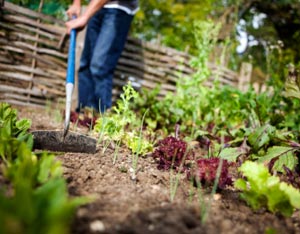
As I worked in the garden this morning, I made a mental note of the similarities between organic gardening and lifestyles based on simplicity. Both are enriched with experience and creativity, and in each case, what we “give up” is less important than what we get. Organic gardening is commonly thought of as “doing without” pesticides and fossil fuel-based fertilizers — not really much of a deprivation. In return, we get healthier crops. Because the soil in a typical organic garden is a fertile, living system, its produce delivers more nutrition per forkful. Similarly, although a simple lifestyle often has fewer material things in it, it’s rich in emotional and experiential nutrients.
But even more interesting is how this style of gardening affects the gardener. In organic gardening, information and skill replace resources, resulting in a more pleasant experience for the grower, who now feels a sense of challenge and engagement. For example, a plum tree in my backyard developed a leaf-spot disease for several years in a row, and I wasn’t having much luck with natural controls, such as baking soda. However, further research revealed that fungal organisms in the soil catapult spores onto the leaves to spread the disease. This year I prevented the fungus from spending its summer vacation on my tree by packing a thick barrier of leaf mulch around the base of the tree — a simple but effective solution.
Similarly, by understanding why their health is out of balance, people in the simplicity movement can meet many of their own health needs for far less money, using preventive approaches such as eating healthy food, getting plenty of exercise, and practicing meditation or yoga. These practices may require some effort, but that effort and knowledge are precisely what make us feel that we are participants in life rather than just spectators.
How to Be Happy
Psychologist Mihaly Csikszentmihalyi (try saying that name three times fast!) calls it “flow.” A person is happiest and most secure when he or she is completely involved in an activity for its own sake. The ego falls away, time zips past, and a person doesn’t question the “rightness” of his or her actions.
Csikszentmihalyi started researching optimal experience at the University of Chicago in the 1970s, compiling data from people from all walks of life. His research catches people in the middle of their daily activities and asks them to record what they are doing and how much they enjoy it. His findings prove that to be genuinely happy, we need to actively create our experiences and our lives, rather than passively letting media and marketers create it for us. The pathway to greatest happiness goes beyond mindless consuming to the heightened, enlightened realm of mindful challenge — a realm where we are engaged, connected and alive.
At the core, some of the most basic human needs are a sense of belonging, healthy food, clean air and water, and stronger connections with people and nature. We want to have satisfying sex and restful sleep. We want to feel relaxed, yet engaged, and we want our lives to have a sense of purpose. Basic needs such as these are common across all cultures and historical eras — what changes is how we meet those needs.
Humanity has amazing potential. We have a maturing understanding of biology and its limits. We are hard-wired for cooperation. We are blessed with the ingenuity to create devices and policies that get more value from each unit of energy and each unit of material. We have the ability to transform our societies. We just have to learn to perceive “value” in a different way, and muster the courage to change.
Dave Wann is author of Simple Prosperity: Finding Real Wealth in a Sustainable Lifestyle and co-author of the bestselling book Affluenza: The All-Consuming Epidemic. His most recent book is The New Normal: An Agenda for Responsible Living. Learn more at www.davewann.com.






