

The following is an excerpt from Keeping Bees and Making Honey by Alison Benjamin and Brian McCallum (F&W Media, 2008). This spectacular book offers an in-depth profile of nature’s most effective pollinator and covers all aspects of modern beekeeping, including where and when to get your bees, different types of hives, how to harvest and sell honey and beeswax, and even sensational recipes for Honey Cake, Mustard and Honey Salad Dressing, Spicy Chicken Wing Marinade, and more. This excerpt is from Chapter 7, “Gardening for Bees.”
You may want to give your bees a helping hand when it comes to collecting pollen and nectar by planting bee-friendly flowers and shrubs in your garden or outside space. Even in a larger garden, you’ll unlikely have enough flowers to produce sufficient nectar to sustain a hive, so your bees will probably go farther afield — up to 3 miles — to find richer and denser sources of food. But the right flowers, fruit and vegetables in your garden will attract some of your own bees, as well as welcoming other visitors such as the bumblebee and solitary bee species. Above all, a garden or patch devoted to plants that are attractive to bees can be a source of great pleasure to any beekeeper, as much for the riot of color as for the activity of the bees.
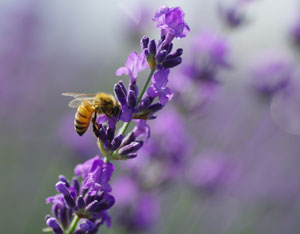
Two other important factors contribute to a successful bee garden: The flowers should be in full sunlight and should be planted in groups. Flowers grown singularly or in twos and threes may fail to attract bees. A decent-sized clump of a suitable plant, such as lavender, is much more valuable. Likewise, bees often overlook flowers grown in shade even though they may produce nectar and pollen.
Don’t place the plants too close to the hive thinking you are helping the bees by reducing the distance they have to travel to find food. Flowers very near a hive are in the firing line when the bees go on their toilet trips, so they sensibly avoid them as a food source.
Unfortunately, some of the most spectacular-looking garden flowers are of no use whatsoever to the honeybee. Double-headed roses, chrysanthemums and dahlias, for example, provide no nectar and hardly any pollen. In contrast, many flowers that are often discounted as weeds, such as dandelions and forget-me-nots, provide a rich source of food. That is why one of the best and easiest things you can do to make your garden more bee-friendly is to throw away the weedkillers that maintain those immaculate-looking lawns and instead let your lawn and flower beds go wild.
If you are not quite ready to hand over your well-tended garden to the vagaries of nature, the next best thing is to leave just a patch to run wild. One way to get your wild garden started is to sow wildflower seed mixtures. The flowers will be a useful source of nectar and pollen, but your wild garden will not just attract bees — the tall grass will also provide a welcome habitat for a number of other creatures, and the berries, fruits and seeds produced by some of the plants will be food for birds and other animals. Soon this part of your garden will be teeming with life!
In addition to wildflowers, the most useful plants you can grow are those that provide nectar or pollen very early in the year (when it is in short supply in the hive and elsewhere) and those that flower late in autumn, providing food for winter. Bees thrive if there is a continuous supply of nectar and pollen throughout the brood-rearing season.
Global warming is thought to be causing a change in flowering times, with plants flowering earlier and some flowering more frequently throughout the winter months in temperate climates. The potential impact on beekeeping is that the bees’ natural rhythm of seasonal population decline will be confused because of the availability of nectar at the time of year when the queen doesn’t normally lay eggs. This availability of nectar will encourage her to lay, but there won’t be enough workers to look after the brood, which will lead to weakened and stressed colonies. It will take generations of bees to evolve to fit in with the new climatic conditions. Another worrisome impact of hotter and drier summers is a likely change in garden styles. People swapping their poppies for palm trees or their sweet peas for succulents could have a significant effect on the availability and timing of bee forage, not to mention the increasing trend toward easy-maintenance decking and paving replacing labor-intensive and water-hungry lawns and flower beds.
Year-Round Food
Snowdrops, the buttercup-like winter aconite, crocuses, daffodils and hyacinths all supply much-needed fresh pollen and nectar after the long winter months. These can be planted under trees or shrubs to produce a carpet of flowers in early spring, when large parts of the garden are still bare. The white deadnettle, which flowers from early spring well into winter and increasingly year-round, is a bee’s best friend, as are other year-round plants such as ivy and heathers.
Purple- and white-colored buddleia, Michaelmas daisies and sedum, which turns red come autumn, are all late-flowering plants which, as well as supplying the bees’ final sustenance before winter, will add a late flourish of color to your garden.
Flowers to consider from late spring through summer include tulips, forget-me-nots and dandelions, which are out just before the fruit blossoms appear. A bed containing the purple spikes of Salvia x superba and edged with the long-flowering common catmint is sure to be full of bees in midsummer. Other perennials you could usefully plant include fuchsia, cornflowers, yarrow, goldenrod, geranium, the bell-like campanula and the fast-growing lavatera with its pink, trumpet-shaped flowers.
If space allows, hazels, shrubby willows and honeysuckles are useful sources of nectar and pollen in early spring. In early summer, a wall or fence covered in red-berried cotoneaster will be a favorite. Among taller plants, hollyhocks, sunflowers, foxgloves and the daisy-like rudbeckia all attract bees.
In a wilder setting, clovers, rosebay willowherb and brambles are among the midsummer pollen producers. For autumn pollen, try heathers, thistles, ivy, balsam and autumn-flowering crocuses.
Many culinary herbs are a good source of nectar, so in addition to creating an herb garden for your kitchen, you can simultaneously create a bee garden. The mint family, which includes sage, thyme, marjoram and basil, is a must, along with rosemary and lavender. Herbs grow well in pots, so if you have just a backyard, a roof terrace with no space for flower beds or even just a windowsill, you can still attract bees with a collection of pots planted with a variety of herbs. You could also add a miniature fruit bush — these too are now available in pots. Raspberry, blackberry and gooseberry bushes will provide not only juicy, soft fruits for you to eat but also delicious nectar for bees. In the case of raspberries, bees are known to collect the sweet juice from the ripe and overripe fruit because, unlike other fruits, bees can puncture raspberries’ delicate skin. Apples, for example, are of no interest to a bee because the skin is too tough, but the delicate white blossom on the apple trees in spring is a welcome source of food early in the season.
Other plants that can be grown easily in a small, outside space or in pots and that provide nourishment to both beekeeper and bees include beans, marrows and tomatoes. If you grow sweet peas intertwined with the beans in true cottage-garden style, the bees will have two flowers to feast on when they visit.
You will often hear beekeepers talking about a “nectar gap.” This refers to the short period in summer when supplies of nectar from fruit trees (such as apples) and oilseed rape have dwindled and other sources are not yet available. Bear this in mind when you are planning what to plant in your bee garden.
Trees
If you have diligently planted a variety of bee-friendly flowers, shrubs and fruit bushes, you can take great delight in frequent visits from honeybees and bumblebees throughout the year. But if you live in a town or suburb, chances are much of your honey will actually come from nectar collected from surrounding trees. In the countryside, where there are fields of crops and pastures of wildflowers, trees are less important for bees, but in towns and cities they will probably provide their main source of food. Look around at the trees that shade your garden, the trees in your streets and those that fill nearby parks. Even in inner cities you’ll be surprised just how many of them dot the landscape.
Hazels, alders and poplars supply pollen at the beginning of the year. Acers, including the ubiquitous sycamores, follow with both pollen and nectar, and at the same time there is blossom from the horse chestnut and sweet chestnut trees. For many town dwellers, however, it is the lime tree that flowers in midsummer that is the source of much honey.
Suggested Flowers for a Bee Garden
Annuals
- baby blue-eyes (Nemophila spp.)
- blanket flower (Gaillardia spp.)
- blue-eyed Mary (Collinsia violacea)
- California poppy (Eschscholzia californica)
- candytuft (Iberis amara)
- China aster (Callistephus chinensis)
- clarkia (Clarkia elegans)
- common baby’s breath (Gypsophila paniculata)
- cornflower (Centaurea cyanus)
- flax (Linum spp.)
- gilia (Gilia spp.)
- godetia (Clarkia amoena)
- lavatera (Lavatera spp.)
- love in the mist (Nigella spp.)
- mallow (Malva spp.)
- malope (Malope trifida)
- meadowfoam or poached egg plant (Limnanthes spp.)
- Mexican aster (Cosmos bipinnatus)
- mignonette (Reseda spp.)
- Nasturtium (Tropaeolum spp.)
- phacelia (Phacelia spp.)
- pheasant’s eye (Adonis spp.)
- sweet alyssum (Lobularia maritime)
- tickseed (Coreopsis spp.)
Perennials
- Alpine rock-cress (Arabis alpina)
- alyssum (Alyssum spp.)
- aubrieta (Aubrieta spp.)
- Canterbury bells (Campanula medium)
- Carpathian harebell (Campanula carpatica)
- catmint (Nepeta spp.)
- checkerbloom (Sidalcea spp.)
- coneflower (Rudbeckia spp.)
- cranesbill (Geranium pratense)
- fernleaf yarrow (Achillea filipendulina)
- fleabane (Erigeron spp.)
- forget-me-nots (Myosotis spp.)
- French honeysuckle (Hedysarum coronarium)
- fuchsia (Fuchsia spp.)
- goldenrod (Solidago spp.)
- herb hyssop (Hyssopus officinalis)
- hollyhock (Alcea rosea)
- horehound (Marrubium vulgare)
- hound’s tongue (Cynoglossum spp.)
- knapweed (Centaurea spp.)
- large blue alkanet (Anchusa azurea)
- lavatera (Lavatera spp.)
- lavenders (Lavandula spp.)
- loosestrife (Lythrum spp.)
- marjoram (Origanum majorana)
- sage (Salvia spp., especially S. x superba)
- scabious (Scabiosa spp.)
- sneezeweed (Helenium spp.)
- thoroughwort (Eupatorium spp.)
- thrift (Armeria maritima)
- thyme (Thymus spp.)
- veronica (Veronica spp.)
- willowherb (Epilobium spp.)
- woundwort (Stachys spp.)
Bulbs
- autumn crocus (Colchicum autumnale)
- common hyacinth (Hyacinthus orientalis)
- crown imperial (Fritillaria imperialis)
- quamash (Camassia spp.)
- snowdrop (Galanthus nivalis)
- snowflake (Leucojum spp.)
- tulip (Tulipa spp.)
- winter aconite (Eranthis hyemalis)
Reprinted with permission from Keeping Bees and Making Honey, published by F&W Media, 2008.





