Discover the ideal seasoned firewood moisture content and keep these tips in mind while seasoning firewood to heat your home.
Wood is essentially a mass of tiny long tubes, or cell cavities, that run the length of the tree. Moisture exists both as “free water” in these cavities and as molecular water that is locked in the cell walls. When a tree is felled, the slow process of drying begins, and the free water is the first to evaporate. Once the free water evaporates, the moisture content of the wood is around 30 percent. This is called the “fiber saturation point.” After this, water begins to leave the cell walls, and the wood starts to shrink and crack.
For optimal burning, firewood should be dried, or “seasoned,” until its moisture content is less than 20 percent. Firewood with a moisture content higher than that may eventually burn, but it is devilishly hard to light and just as hard to keep burning. Also, your new high-efficiency wood-burning stove or furnace is guaranteed to perform sluggishly as it struggles to burn freshly split, or “green,” firewood–much of the heat and energy content produced are wasted in drying the wood’s excess moisture. Just as important, the stove does not burn the tars and creosote in the smoke produced by the fire, and they end up lining the inside of your flue pipes and chimney. They also blacken the glass windows of your wood-burning appliances and produce a lot of blue-gray smoke, fouling your house and annoying your neighbors.
Seasoning wood has another important but less obvious benefit–when wood is properly cut and stacked right away, mold has less opportunity to establish itself. Throwing unseasoned firewood into a pile allows mold to spread throughout the logs, mold that you unwittingly release into your home’s environment when you bring the firewood inside throughout the heating season.
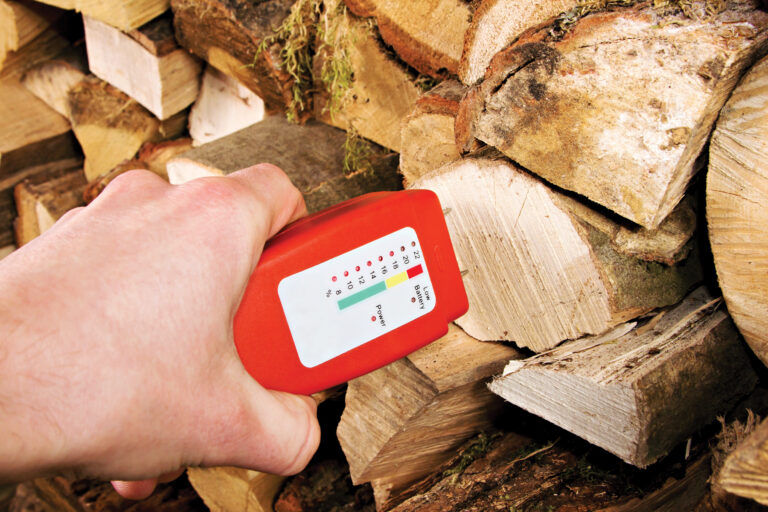
You can buy already seasoned firewood or buy it green and season it yourself. How can you tell whether wood is properly seasoned? It’s possible to test the wood with a moisture meter, which measures resistance to a small current and converts it into a moisture-content reading, yet this reading can vary widely from one area of the log to another. With a little practice, however, you can use the following tips to judge accurately for yourself whether your wood is dry. Use as many as you can for the best results.
- Radial checking. Look for cracks and checks in the end grains that radiate out from the heartwood to the sapwood. These appear before the wood is totally seasoned, so your testing should not stop here.
- Color. Wood fades and darkens as it seasons, changing from white or cream to yellow or gray. Different species have different colors and shades, but it’s safe to say a stack of bright, freshly colored wood is far from seasoned.
- Smell. Split a piece and sniff; if the exposed, fresh-cut surface has a pleasant, sappy aroma (or if it feels damp and cool), it’s too wet to burn.
- Loose bark. As wood dries, the bark slowly begins to separate from the wood and eventually falls away. If the bark is still attached to the wood, peel it back with a sharp knife and check the cambium. If the cambium is green, so is the wood. A cord of seasoned wood should have more wood without bark than bark-covered wood.
- Listen. Bang two pieces of wood together. Dry wood sounds hollow; wet wood sounds dull.
- Lift. Seasoned wood weighs much less than green wood of the same species.
- Trial by fire. If in doubt, burn some! Dry firewood ignites and burns easily; wet wood is tough to light and hisses in the fire.
There are advantages to buying firewood green, provided you have the room to store and season it for a year. For one, you’ll be absolutely sure the wood is seasoned, and it will cost a lot less, anywhere from $15 to $50 less per cord than seasoned wood. Also, seasoned wood may be in short supply in some areas, so you may not have a choice.
Firewood can take a very long time to properly season. Exactly how long is a matter of ongoing debate in wood-burning circles. The traditional rule of thumb is to season firewood for at least six months before the heating season; some hardwoods require at least one to two full years. The truth lies somewhere in the middle and depends on piece size, tree species and local climate.
The protective bark on a log helps prevent the interior moisture from evaporating, so firewood begins to dry significantly only after it is cut and split. By splitting the wood into smaller pieces, you create a greater surface area, and the greater the total surface area, the lower the overall density, which means the wood dries and seasons at a faster rate. Trees with a dense wood structure, such as oak and elm, season much more slowly than do ash and birch. “Diffuse porous” species, such as maple, birch and poplar, season more quickly than do “ring porous” species, such as oak and ash. Conifers have an entirely different cell structure than deciduous trees and take longer to dry, so they are best split into small pieces. Trees felled in spring when the sap is “up” also have a higher moisture content. Finally, if you live in a damp maritime climate, seasoning times may be longer.
As with a really good meal, seasoning makes all the difference in a quality fire. In the end, with the exception of truly dense hardwoods, such as oak, and large-split softwoods, most household firewood bought in the spring can be seasoned enough for burning by winter. It’s not the type of tree but, rather, the seasoning that makes or breaks your fuel supply.
If you plan to season firewood yourself, here are five simple guidelines to follow:
- Cut to length. Cut firewood to the right length for your stove, fireplace or furnace. This is usually about 3 inches (7.5 cm) shorter than the width or length of your firebox, depending on how you load the wood. Shorter is always better than longer.
- Split to the right size. Wood should be split to the proper dimension for your wood-burning appliance. For most efficient woodstoves, that is no more than 6 inches (15 cm) across. A range of dimensions from 3 to 6 inches (7.5-15 cm) for woodstoves and slightly larger for furnaces is best.
- Stack and expose. To season firewood properly, stack it in a place where the sun can warm it and the wind can blow through it. A single row exposed to the sun and prevailing winds is best–as the sun heats and evaporates the water from the wood, the wind whisks it away.
- Season for a season. The key to seasoning lies in the word itself: Most firewood properly split and stacked takes at least a season to dry properly. For many of us, that is about six months. If you stack your wood in early spring, it should be ready to be put away for winter use by October. Hardwood may take longer depending on the species, the local climate and how green it is when you buy it.
- Don’t cover it up. Covering your drying woodpile may keep the moisture off your firewood if you live in a rainy climate, but it can also hinder the sun’s drying and lead to additional chores, like chasing tarps or plastic sheets blown away by the wind.
Want to learn more about heating your home with firewood? Read about the Sustainability of Heating With Wood.

This excerpt has been reprinted with permission from Wood Heat, by Andrew Jones and published by Firefly Books, 2014.