
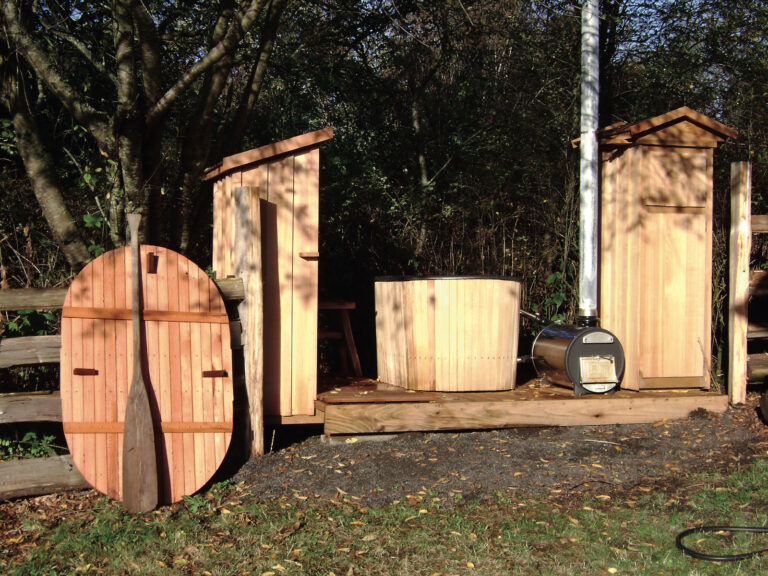
Looking to self build a hot tub? Create a relaxing oasis in your backyard for about $1,500 with this stock tank DIY hot tub.
I have lived in the Pacific Northwest with its cool, damp winters for more than 20 years, and I always wanted to build a hot tub. I wasn’t interested in one of the popular jetted tubs because their cost is prohibitive, the pump noise and vibration are bothersome, and the chemicals used to keep the water free of bacteria are a turnoff.
The idea of using a stock-watering tank for a DIY hot tub project has been around for a long time, but all of the ones I’d seen were pretty unattractive. I wanted a setup that was nice-looking, easy to use, and economical. My hot tub dreams came together when I discovered a wood-fired spa stove made in Japan by a company called Chofu and imported by Island Hot Tub Co. Depending on how the soaking area is customized, the setup I’ve designed can cost about $1,500.
Soaking in a Wood-Fired Hot Tub
Unlike a commercially available tub that only requires you to plug it in and set a timer, you’ll be more involved in the operation of your wood-fired soaking tub. The water is not continually kept hot, so each soak needs to be planned a few hours in advance. I find the involvement is part of the attraction. It creates anticipation that starts with building the fire and culminates with climbing into the steamy, relaxing tub.
The Japanese have long recognized the benefits of soaking in hot water to relieve aches and pains and deal with the daily stresses of life. They typically bathe before soaking to avoid dirtying the water and to maximize the number of times the water can be used before it requires changing. Before each soak, I wash up using hot water dipped directly out of my tub. This keeps the water clean and also acclimates me to the water temperature. Traditionally, the Japanese tend to like their water exceptionally hot, but the Consumer Product Safety Commission recommends the water temperature in a hot tub never exceed 104 degrees Fahrenheit. I keep a hose handy to add cold water if necessary.

Heating and Maintaining the Water
The tub I chose holds 100 gallons if filled to the brim. That much water costs about a buck in our town. Fill the tub 3 to 4 inches from the brim, otherwise the water displaced by your body will be lost when you get in. This setup uses considerably less water than commercially available tubs, thus making it more practical to drain the water frequently, keeping it free of bacteria without using toxic chemicals.
With daily use for two people, we replace the water every four days. When the water needs to be changed, you can simply drain it into a garden area. If you want to keep the water longer or are worried about bacteria growth, add about a quarter cup of 35 percent hydrogen peroxide per 100 gallons (wear gloves and safety goggles during handling). Hydrogen peroxide at this strength is sold as a water clarifier in spa stores. It separates into hydrogen and oxygen in the water, and the oxygen is the active ingredient that kills bacteria.
Now’s the time to make a decision about how to heat the water. Chofu offers gas and wood-fired heaters. Both types of stoves use convection to move the water, so no pumps are required, and they both can heat 100 gallons of water in about an hour and a half.
I chose the wood-fired heater because it’s cheaper to operate, uses no fossil fuels, and is one more way of being less dependent on public utilities. Plus, I like the sound and smell of a wood fire.
The wood-fired Chofu heater costs about $998, and you don’t need an electrical connection to operate it. This heater has no automatic thermostat for the water temperature, so there is a bit of a learning curve to achieving the desired temperature. The water is usually ready after you’ve burned two loads of wood in the stove.
Homemade Hot Tub Design Considerations
Stock tanks are available in either metal or polyethylene plastic. The metal tanks have vertical walls, making them somewhat less comfortable. I chose a plastic tank made by Rubbermaid — it has a sloped side so it’s comfortable to use. It’s roomy for one person and cozy for two — ideal for you and your sweetie. The tank is nearly indestructible, and has a rolled-over top edge, which is both attractive and comfortable to rest your arms on. There is also a threaded 1-inch drain port at the bottom of the tank. Most farm stores carry stock tanks of this size, with prices starting at about $111.

Don’t forget to consider privacy. Decide how much you need and design your bath area accordingly, considering options such as a fence or a movable screen. The more comfortable and convenient the tub is to use, the more enjoyment you will get out of it.
When choosing the location, also factor in whether the tub will be visible from your house or yard, and whether the setup will be attractive and blend into the landscaping. There should be a place for firewood and kindling next to the stove, and a place to hang your robe or clothing. If you plan to drain the water onto your garden, the tub needs to be at or above the elevation of your garden and needs a valve on the drain.
If you choose a woodstove to heat your tub, keep in mind prevailing winds and, if possible, locate the stove so the smoke path avoids your house. Smoke-filled air may ruin your relaxation time. In my case, where I wanted to locate the stove in my yard put the smoke path directly in the way of the house. Taking a chance, I put it there anyway, and it works fine. Smoke drifts into our patio and outside living area on occasion, but only for a short time immediately after the fire has been started or fresh wood has been added.
If you live in an area prone to freezing, you’ll need to protect your hot tub system. In most climates, the water in the tub itself can handle an extended period of cold weather before it freezes, but take care to ensure the water in the stove and water lines doesn’t freeze. You can easily drain the stove via a drain plug in the back. I insert a rubber cork into the bottom port to the stove. This allows the water to drain from the stove, yet saves the majority of the water in the tub. Insulate the bottom waterline to the stove, as well as any drain hoses. If your area has extended periods of freezing weather, the safest approach is to drain the entire system after each use.
I am thoroughly delighted with my homemade hot tub. My only regret is that I did not build one a long time ago. Enjoy!
DIY Hot Tub & Stock Tank Hot Tubs
- Construct the wooden attachment collar. You will need to create a 2-inch-thick wooden collar around the outside of the tub to which you will eventually attach the vertical siding. Use a rot-resistant wood for the collar, such as cedar or redwood.
Start by measuring the inside width of the tub at the approximate height from the bottom of the tub where the collar will be located (about 8 inches from the bottom), and divide it in half to determine the radius of the curved end.
- Next, using the radius, draw a half circle on a piece of plywood, followed by another radius (using the same centerline) 2 inches larger than the first. These two half circles form the inside and outside faces of the wooden collar. Bisect these lines around the curve to form four equal-length pieces.
Now cut 22-1/2-degree angles on each end of four 2-by-4s, making them 12 inches long between the long points of the angle. Place the pieces on top of the drawn curves, butting their ends together and making sure they cover the drawn radius lines. Now redraw the two radius lines onto the 2-by-4s and cut them out using a saber saw or band saw. Glue the straight pieces of collar to the tub in the same manner. - Attach the collar and insulate the tub. Glue the wooden collar pieces to the tub using a product called Great Stuff. This foam insulation is normally used to fill gaps around windows and doors, but in this plan it acts as an incredibly effective glue. It’s waterproof, sticks to anything, and is extremely difficult to keep off of yourself, so wear old clothing and protective gloves when using it (it will not come out of clothing). Great Stuff takes a while to set up, so the individual collar pieces will have to be supported in place until it dries (see vertical sections of 2-by-4 in photo, above). When using the adhesive, remember that less is more, because it will expand considerably as it sets up and could easily push the piece being attached out of alignment.
It’s not practical to insulate all surfaces of the tub, but get as many as possible. The best product to use to insulate the tub is solid Styrofoam “blue board” insulation. It comes 1 and 2 inches thick, and you can glue it to the tub using the Great Stuff. - Cut and attach the cedar siding. After you’ve glued on as much insulation as you can, apply the cedar siding. I found half-inch-thick cedar fence boards worked wonderfully. They are reasonably priced and usually clear and free of knots. Cut the boards to length and rip them to 1-3/4-inch widths (the exact width isn’t too important, as long as it’s less than 2 inches). Leave about one-sixteenth inch between the individual boards to allow for expansion. The boards will go up easily on the straight sides, but the curved ends are a bit more work. The combination of the curve and the tilted sides requires the individual boards going around the curved ends to be an eighth-inch wider at the top than the bottom. This will keep them relatively plumb. Adjust this step accordingly if you’re using a different- sized stock tank or a metal tank with straight sides.
- Attach the boards by first applying some glue to the top of the tub. After pushing the board up as far as it will go behind the lip, screw it to the wooden collar with a stainless steel screw. Do not use too much adhesive, as it will come out of the cracks between the boards as it cures. In the areas where the hot water lines and the drain are located, leave the boards off until you finish the plumbing installation. The plumbing is minimal, requiring only a valve and a few elbows.

- Install the stove and make a cover. Hooking up your stove will be one of the last steps, and the directions that come with the stove are great. The only issue that may come up is not having the correct size saw to drill the holes in the tub, but overall, it’s a snap. The chimney installation is straightforward, although the chimney needs to be tied to something for wind support. I located my wood storage structure close to the stove so it could support the chimney.
You can make a cover for your hot tub out of the same wooden material that surrounds the tub. Make the boards on the cover close enough to keep leaves and debris out of the tub. Our cats love the cover, and they sit up there in the steam whenever the water is warm.


Originally published as “How to Build a Hot Tub” in the June/July 2010 issue of MOTHER EARTH NEWS.





