


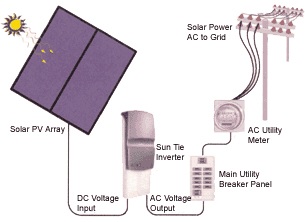
Most residential photovoltaic (PV) systems consist of PV
modules, a battery bank to store the electricity, a charge
controller to regulate the charging of the batteries, and
an inverter to change the solar-generated direct current
electricity into the more commonly used alternating
current. People living in remote areas of the U.S., off the
grid, have been relying on these types of PV systems for
years. However, more and more people who are already
connected to the grid are turning to renewable energy for
part or all of their electricity needs. These grid-tied PV
systems send solar-generated electricity back into the
already existing utility grid.
With a grid-tied system there is no battery bank – the
utility company acts as the battery. (Many people choose to
keep batteries, however, as a backup in case of grid
failure.) When a system produces more electricity than is
needed, the excess is sold to the utility company. When the
homeowner needs more electricity than is being produced,
electricity is bought from the utility company. Under
federal law, the Public Utility Regulatory Policy Act
(PURPA, Section 210), utility companies are required to buy
electricity from renewable energy producers.
The other difference in grid-tied systems is the type of
inverter used. Line-tied inverters are designed to sense
the presence of grid power and shut off when the grid does.
This keeps the PV-generated electricity off the grid in
case there are utility people working on it.
The majority of grid-tied PV systems use PV modules mounted
on a roof or a pole near the house. However, some systems
use PV cells that actually become an integrated part of the
building (a common example are PV roof tiles). While these
systems may reduce the cost of PV systems, they are still
about 50% more expensive than standard PV modules. And
standard PV modules don’t come cheap.
At What Price?
At 25 to 40 cents per kilowatt hour, PV-generated
electricity is still more costly than electricity purchased
from our country’s extensive electric grid. Still, many
people are turning to this clean-energy option for reasons
of ecology rather than economy. Most of our electricity
comes from coal, oil or large hydroelectric dams, all of
which have devastating environmental impacts. The use of
solar power can reduce dependence on these environmentally
damaging sources. In fact, a one-kilowatt PV system can
prevent 150 pounds of coal from being mined and 300 pounds
of carbon dioxide from entering the atmosphere each month.
These facts convinced Randy Udall, director of the
Community Office of Resource Efficiency (CORE) in Aspen,
Colorado that PV is cost-effective. “Conventional energy
economics assumes that the future is worthless and the
environment doesn’t matter,” Randy says. “If you value the
future or the environment, PV is cost-effective.”
To encourage more homeowners to invest in PV systems, CORE
started a fi nancing program. Through CORE’s program,
customers make a small down payment and receive a
zero-interest loan to pay for the rest of their system over
four to six years. CORE pays the interest on the loan.
Spinning Backwards
One thing that makes grid-tied PV attractive to homeowners
is net metering. Under PURPA, utility customers can sell
excess electricity to the utility company. However, the
utility only needs to purchase that electricity at the
wholesale price — much lower than the retail price. The
excess energy is metered using an additional meter that
must be installed at the customer’s expense. But if the
utility offers net metering, the customer can use the
excess electricity to offset electricity used during the
billing period. Currently, 30 states require at least some
utilities to offer net metering.





