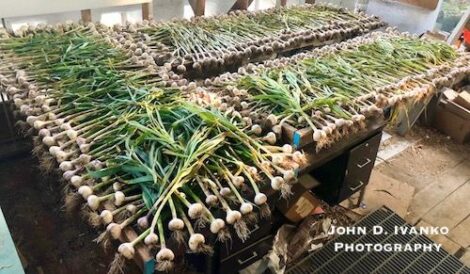
Organic garlic curing at Inn Serendipity straw bale greenhouse
As Lisa Kivirist and I write about in our Farmstead Chef cookbook, growing garlic is nature’s ponzi scheme. That’s what happens when you plant a head of garlic which usually consists of about 6 to 12 cloves. We harvest our garlic in July, curing them in our straw bale greenhouse.
When it comes time to plant garlic late in the fall, we break apart the bulb and separate out each of the cloves: our seeds. By the second season, that original bulb or head of garlic has produced new six heads. By Year 3, as many as 36 bulbs (6 heads x 6 cloves each). In Year 4, there’s 214. You see where this is going. By Year 10, more than 10,000 garlic bulbs. So, we can sell some of the garlic for profit, while retaining the largest heads to plant for next year’s crop.
Unless we suffer a catastrophic crop failure, pretty uncommon for garlic crops, it’s practically impossible to go bust. Nature is hardwired to cover itself, reproductively speaking. For proof, try counting the blossoms on an apple or cherry tree in the spring. Some blossoms become apples or cherries, others don’t (blame it on the bees, a late frost or some other weather calamity). The point here is that nature, more often than not, goes overboard on abundance. And if you tend your own orchard or garden, it doesn’t take long to realize that the bushels of apples don’t cost a penny. Just your time and some labor.
Our ‘German Red’ hardneck garlic is a cash crop at Inn Serendipity Farm and Bed & Breakfast, generating more than a thousand dollars a year. So, we sell a lot of garlic locally, and ship it, too, taking orders online. Now that we’ve been selecting only the largest and best cloves on our particular Wisconsin site to plant the following year, our German Red garlic is ideally suited for our soil, climate and seasonal weather conditions. This means it becomes easier to grow every year and the crop increasingly reliable, since we’re planting the best plants for the following year.
We do get a lot of questions from first time garlic growers, asking for tips and organic practices that have served us well over the past twenty-three years. Here are a few the most common questions.
How many seed garlic heads to I need when planting?
Pounds wise, there about six to seven heads of our German Red garlic per pound for seed, based on the size of the garlic. The diameter for our German Red seed garlic is roughly 7.25-inches to 8-inches and weighs from 2-and-3/8 an ounce (66 grams) to 3 ounces (86 grams). For reference, we sell our culinary garlic for eating and cooking, too; there are nine to twelve garlic heads per pound for eating. Our culinary garlic will last for eating until March, 2020, if properly stored in a cool and dry place out of the sun.
Each of our German Red garlic heads used for seed will have about eight to eleven cloves. But you only want to plant the biggest cloves and the ones that have a good wrapper around them for planting. When planting, however, I only select the largest and best-looking cloves, so about four to seven cloves are planted for each head. The bigger the clove, the better, all other things being equal. The other smaller or “compromised” cloves we used in cooking or turning them into pickled garlic for sale under our state’s high-acid cottage food law. We keep the seed garlic dry and in a cool spot until it’s time for planting.
When do I plant seed garlic?
For our southern Wisconsin location, given the increased variability and unpredictability of weather caused by climate change, we usually plant our garlic in prepared beds at end of October or early November, depending on the temperature and when the ground starts freezing. We manage our growing fields organically, so we rotate our crops in different rows every year to help minimize disease and other issues. We never plant garlic in the same row, year after year. In terms of farming workflow, we like to plant potatoes (in early spring) next to garlic, since both can often be harvested around the same time.
How do I plant garlic?
We mulch very heavy with straw after planting the garlic cloves about an inch or so in the prepared soil. We cover the planted garlic cloves as much as five to six inches with straw and sometimes leaves. If we have a snow-free, but bitterly cold, winter, it’s peace of mind to have the cloves covered under the blanket of mulch. Come spring, we can always pull back the mulch to allow the young garlic stems to emerge from the mulch. After that, the mulch provides a weed barrier and helps preserve moisture.
What we’ve shared is what has worked well for us. We’ve never used woodchips and don’t water our garlic after planted. We suggest getting a “planting with garlic” book or read other articles from Mother Earth News on the subject, since there are lots of strategies and approaches to try in your location.
John D. Ivanko, with his wife Lisa Kivirist, have co-authored Rural Renaissance, Homemade for Sale, the award-winning ECOpreneuring and Farmstead Chef cookbook along with operating Inn Serendipity B&B and Farm, completely powered by renewable energy. Both are speakers at the Mother Earth News Fairs. As a writer and photographer, Ivanko contributes to Mother Earth News, most recently, Living with Renewable Energy Systems: Wind and Solar and 9 Strategies for Self-Sufficient Living. They live on a farm in southwestern Wisconsin with their son Liam, a 10.8-kW solar power station and millions of ladybugs. Read all of John’s MOTHER EARTH NEWS posts.
All MOTHER EARTH NEWS community bloggers have agreed to follow our Blogging Guidelines, and they are responsible for the accuracy of their posts.