Photos by Kathy Shaw
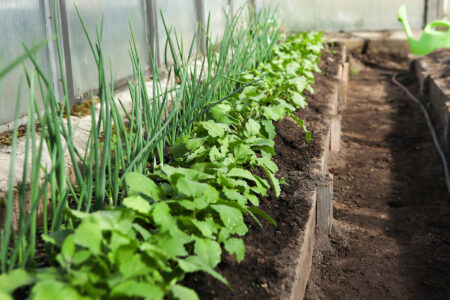
Tomato Cages aren’t just for use in the summer any longer. We find uses them just about year-round. In the spring they serve as low tunnel frames with plastic to warm up soil and get a jump start on the growing season for lettuce and other greens as well as support for tall pea vines.
Summer has them supporting indeterminate tomato plants and as well as vining cucumbers, melons, beans and squash. They also work as a low tunnel support with insect barrier fabric over broccoli and other cole crops.
Fall brings them back to the ground as low tunnels with plastic to extend the season, while others just lay on the ground to the west (prevailing wind) side of the pond to stop blowing leaves from entering it.
Then in winter, they do double-duty as protection around shrubs to keep the deer from nibbling or rubbing and also on top of our frozen pond so the deer don’t fall in where the aerators keep the water either open or with thinner ice, dependent on the actual weather. The first year we had the pond we learned this the hard way since we saw a deer go into the water and couldn’t get back out again in the approximate four foot zone. Pat, my husband, and I had to wade through over two feet of snow to get to the pond, then Pat lassoed the deer and hauled her out to safety. Come spring we found that a second deer had fallen in one of the other six aerators and wasn’t so lucky, as it stayed unnoticed under the ice until it thawed.
Cage Instructions
We use 5-foot-tall concrete reinforcement wire for our tomato cages and four-foot T poles to keep them upright. Pat counts out 13 of the 6-inch squares of the wire or about 12 feet and cuts it off the roll, then cuts off all of the last square except for two wires, the second from the top and second from the bottom. This gives us about a 2-foot circle with the two wires to fold back along the other edge and keep the frame circular. Having the other wires cut flush with the squares helps the harvester to not get scratched when reaching in to grab tomatoes or cucumbers.
Opened tomato cage as low tunnels
Low Tunnels
Using a cage opened up, plastic or fabric can be binder-clipped or clothes-pinned onto the frame. We put a couple of bricks on one long edge of the frame itself to act as hinges, lay down a couple more bricks on the other side of the bed, stretch the other cage edge over them and to hold the tunnel in place. Additional bricks on the material at the hoop ends keep the tunnel closed.
If using plastic in spring or fall, be sure to peel it back from the ends during warm days so you don’t burn your plants. By the way, the plastic underlayment left over from installing laminate floors is the perfect width for these tunnels.
Tomatoes in cages
Tomatoes
We can fit three of the cages into our 4-by-8-foot beds for the sprawling tomato plants we grow. After the tomatoes are planted and caged, the only maintenance is to gently pull the growing tips back into the cage weekly, a very pleasant and easy task to do. Some of the tomato varieties we grow will make it all the way to the top of the cage and back down to the ground in our Wisconsin summer — a whopping 10 feet of growth!
Peas, Cucumbers, and Melons
These plants need some encouragement to get them climbing as they tend to sprawl or reach for other supports, but again, a once a week regiment of moving them to the desired location will keep them growing up the cages. Note that once the melons start to size up, they will need a sling to support them; the cage is heavy enough to tie the slings to. No need to sling cucumbers, they will stay hanging down ready to pick and it’s much, much easier than searching through the picky vines then when they are prostrate.
Pole beans on arch
Beans, Squash, and Pumpkins and Arch Instructions
The varieties we grow have longer vines than five feet so we typically grow these on arches using the same wire with six foot T poles to create 7 foot arches that are four feet wide on the north side of the garden beds. Counting out about 32 squares or 16 feet, Pat cuts the fencing in two the long way to make two 16-foot lengths and cuts the tails off flush with the vertical wires, making two separate arches. The poles are hammered into place and the wires are woven over them in about the middle of the two foot spread.
These arches will last a very long time are sturdy enough for 10 pound pumpkins and add more dimension to the garden. We have six of them, three to grow squash and pumpkins and three to grow beans. We rotate or flip the crops annually.
Two notes. One: make the arch lower if you can’t reach 7 feet or you won’t be able to pick the beans at the top of the arch. Two: squash and pumpkins will need to be trained gently, don’t break the vines. There is no need to sling the pumpkins though and they look so cool hanging in the late summer garden.
Pumpkins on arch
Uses for Pre-Fab Tomato Cages
Even though we do make our own tomato cages, we still use quite a few of the cages that can be purchased at a garden center. These are great for eggplant and pepper plants which have a tendency to fall over when weighted with fruit. They are also great to prop up taller, floppy flowers such as peonies, hollyhocks, roses, verbascum and the like. We have one small flower garden in the middle of the yard with these types of plants along a couple of bird feeders.
The cages stay in that garden all year. When the plants are cut back in the fall, we cull 3- to 4-foot white pine trees from our woods and just prop them up in the cages to give the birds some perches and extra protection from wind and predators all winter. They make for a nice view for us too.
Kathy Shawhas gardened for more than 30 years, including as a test gardener forOrganic Gardening magazine. She and her husband, Pat, are Master Gardeners and owners of Kathy’s Island Botanicals, where they make and sell natural bath products. They live in an earth-sheltered home on 35 acres in central Wisconsin. Read all of Kathy’s MOTHER EARTH NEWSposts here.
All MOTHER EARTH NEWS community bloggers have agreed to follow our Blogging Guidelines, and they are responsible for the accuracy of their posts.