

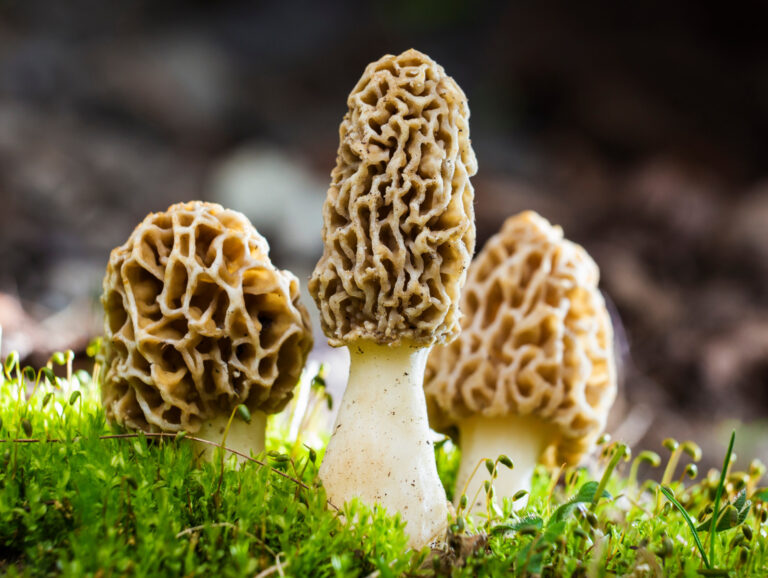
Is growing morel mushrooms possible? While not the easiest thing to cultivate, it can be done. Learn how to grow morel mushrooms at home and what to avoid.
Every weekend at the farmers market, I have a few people approach me with a hungry twinkle in their eye (It’s a very thinking-about-morels-specific twinkle) and ask wistfully if it’s possible to grow morel mushrooms at home. It is entirely possible, although many will tell you that growing morel mushrooms is a fool’s errand — the thing is that it usually takes between 3 to 5 years for any morel mushrooms to grow, and you won’t know until they pop up whether or not it worked. Morel mushrooms are quite interesting in that they have several very particular needs in order to grow, one of the most critical being that they have to experience a cold snap in order to trigger growing.
We’re fortunate to be in Michigan, where we’re guaranteed a good cold snap, at least for a while in the winter, and the spring morel season is big here. They say a winter with big snowstorms will yield the best morel seasons. If you live in a warmer climate that doesn’t get cold winters, growing morel mushrooms isn’t likely to work, but if you’re in a place where snow and frost aren’t strangers, you’ll likely have some luck if you’re patient enough to wait a few years for your mushrooms to grow.
People frequently ask how to grow morel mushrooms indoors — there have been a few recent successes in commercial indoor morel cultivation. Still, it’s a fidgety process that requires a great deal of control over temperature through different phases of the growth process and can be costly to maintain with no guarantee of success. Many morel lovers claim that morel mushrooms grown indoors lack some of the beloved flavor that morels are so treasured for, although I do think that some of that flavor comes from the timeless delight of gathering them in the wild. Whatever the case may be, here’s the classic outdoor approach to growing morel mushrooms at home.
And don’t miss the recipe for Morel Chili below!
Where to Begin Growing Morel Mushrooms?
Supplies:
- A 5 gallon bucket
- A morel mushroom (or a few! The more the merrier! More scientifically, the more morels you use, the more spores you’ll have in your slurry, and therefore, the better chance you’ll have at successfully growing them!)
- A tablespoon of molasses
- A few cups of ashes (I use what’s left when we clean out the fireplace; any wood ashes should do fine as long as you haven’t burned anything plastic/chemical/things that shouldn’t be burned in them.)
You can start your morel patch with either an actual morel mushroom (dried has a chance of working, but fresh is ideal), or you can get a liquid culture. Several sellers online advertise “morel seeds” – don’t fall for it. Mushrooms don’t grow from seeds, and I have yet to hear of one of those particular kits working. You could get a morel culture and work from that. You’d use the same approach here to make a slurry, using culture instead of an actual mushroom, but today we’ll focus on doing this the old-fashioned way from a mushroom as it’s the least-fidgety, most-likely-to-succeed approach to growing morel mushrooms.

Safety & Success for Growing Morel Mushrooms
If you want to try growing morel mushrooms at home, make sure you have an actual morel mushroom to start with. Luckily, they have a fairly distinct appearance, but they have a few lookalikes, including a very toxic variety called Gyromitra esculenta, which can be fatal when consumed. A few similar ones range from benign to causing an extraordinarily upset stomach, and together, these assorted doppelgangers are collectively referred to as false morels.
A true morel will be hollow on the inside; most of the copycats are not. However, as with any wild-foraged mushroom, it’s absolutely critical that you have a seasoned mushroom forager with a trained eye to correctly identify your morels so you know that you’ve got the right thing from the get-go. Even true morel mushrooms have to be cooked in order to safely eat them, so don’t ever eat them raw, even once you have a positive ID.
Preparing Your Slurry
To start, take a morel mushroom — even better, a few morel mushrooms (don’t rinse them off) — and stick it in the blender with about a tablespoon of molasses and then fill it up the rest of the way with water. Give it a whirl until the mushroom is chopped into little bits in the water. Let it sit overnight.
The next day, take a 5-gallon bucket, fill it most of the way up with water, and add a few scoops of ashes (5 cups is my go-to, but it’s not exact. Use what you have. Morels are often found in areas recently charred by forest fires. We believe that something about ash encourages them to grow.)
Pour the molasses-mushroom mixture from your blender into the bucket and add a TINY bit of salt (like 1/16th of a teaspoon at the most – it helps keep contamination at bay, but salt will also inhibit good fungal growth, so you really only want the smallest amount possible.) Stir it all together, set the lid on loosely, and let it sit another night.
Spreading the Morel Slurry
The next day, you’ll take your bucket out to your chosen spot. It should be a shady spot with dead or decaying wood (bark will do) and some leafy, mulchy debris on the ground doesn’t hurt either. The ground beneath shouldn’t be too hard packed — nice loamy dirt is good. Think undisturbed forest floor. This is what we’re aiming for. Stir your bucket one last time and then pour it over about a 4×4′ patch of ground. And then forget about it for a few years.
You’ll probably be tempted to check the spot every spring (I always am), and that’s totally fine — just don’t let the wait discourage you. Often, people will start them and become discouraged after a year or two and think that they didn’t take, and giving up at that point, never realizing that they were, in fact, successful at growing morel mushrooms; it just takes a few years. (Although I’ve met two people who did have success within a year, so definitely keep an eye out!)
After about three years, you can start looking in earnest to see if your morel growing endeavor has worked.
Harvesting Morel Mushrooms
Morel hunters’ wisdom dictates that you never pick all of them – always leave a few in the ground to keep building up the spores in that area over time.
The best way to harvest your morels is to slice them off close to the ground (many swear by pinching and twisting instead of cutting them; it’s a personal preference but I’d prefer to cut them to leave as much of their mycelial network as undisturbed as possible) Many mushroom hunters like to carry their morel harvests in an onion bag (or similar mesh bag, you could even crochet one if you’re handy) this allows any extra spores from what you’ve picked to drift around while you’re mushroom hunting, thus giving you a pinch of extra luck for future harvests.

Cooking with a Morel Mushroom Harvest
There are few things in life more satisfying than cooking up mushrooms that you’ve played a role in growing and delighting in the incredible flavor and mood they bring to the table. Many people will tell you that the very best thing to do with your morels is fry them in butter and devour them, which frankly, I can’t argue with (and you should always try at least a small amount of your edible mushrooms this way so that you get a good feel for their flavor profile, it will give you a million more ideas about what else you could cook with them!)
Follow this link to find my favorite morel mushroom chili recipe!
Erin Hamilton is the founder of The Mushroom Conservatory, nestled in the rural heart of Howell, Michigan, where she resides with her husband and creative copilot, Elijah, and their lively brood of children.






