




Companion planting is based on the observation that some
plant seem to have synergistic relationships with certain
other plants One or both of them grow better, yield more,
and sometimes even taste better when they grow near one
another. I have found, however, that there’s a lot more to
companion planting than simply pairing up plants that
benefit from one another’s company. My wife Sylvia and I
have spent years trying different combinations, and our
garden now looks quite a bit different from the garden we
had in our first companion planting years. In fact, every
year’s garden is an experiment. I can’t take you on the
whole companion journey, because we’re still en route
ourselves. But I can show you how we started while sharing
some of things we learned along the way.
Eliminate the Negative
Companion planting begins with the liberating notion that
we can sow different plants in the same garden space. It’s
important to remember, however, that while certain plants
will help others thrive, some plants inhibit their
neighbor’s growth. The first step, then, in planning a
companion garden is to eliminate the combinations that
don’t work. This is especially important if you
plant in beds rather than in rows.
In a traditional garden, the root systems of plants in
adjacent rows are kept apart by a wide band of compacted
soil that roots cannot penetrate. In beds, on the other
hand, plants may be only inches apart, so roots can spread
and intermingle. Thus, it is particularly important to
avoid antagonistic relationships — those in which the
growth of either or both plants is inhibited. Antagonists
should have at least six feet between them in a bed. Better
yet, put them in separate beds.
You can avoid many problems by keeping a few entire plant
families away from each other. For example,
members of the cabbage and onion families don’t get along
with members of the tomato and pea families.
Sometimes, plants within families don’t grow well
together. They may be afflicted by the same pests or
compete for the same nutrients. Close cousins carrots and
parsnips don’t get along; neither do potatoes and tomatoes.
A cabbage planted among broccoli will attract cabbage moths
as though it was among other cabbages.
Poor Bedfellows
Some insect pests have a taste for several different kinds
of plants. Pairing them up offers predatory insects a
one-stop smorgasbord. Take care to avoid the following
combinations:
Corn and tomatoes Call it a corn earworm,
call it a tomato fruitworm — it’s the same beast in either
case and likes both crops equally. Keep some distance
between the corn and tomato patches.
Potatoes, tomatoes, peppers and eggplant
The striped Colorado Potato Beetle is a nightshade
nightmare and will feed on any plant related to potatoes,
such as tomatoes, peppers or eggplant.
Cucumbers, squash and melons Pickleworms
prefer cucumbers, but will happily munch their way through
a nice squash or melon.
Accentuate the Positive
Once I have a list of plant combinations that are likely to
fail, I look for the opposite: plants that thrive side by
side. Plants work in synergy for a number of reasons. Some
plants provide a better physical environment for one
another in terms of nutrient-, sun- and shade-sharing; some
plants act as natural insect repellents while others
attract friendly insects; and some beneficial combinations
are simply inexplicable mysteries.
The Summer Sandwich Sometimes we plant things together just
because they’re likely to be harvested together, such as
basil and tomatoes-complementary ingredients for a salad or
sandwich. There are other reasons, however, why this might
be a good pairing. Tomatoes are big, heavy-feeding plants
with deep root systems; basil plants are relatively small,
light feeders with fairly shallow roots. Both plants,
however, are very sensitive to cool temperatures at either
end of the growing season and need similar protective
coverings, such as plastic tents or row covers.
The pest-repellent nature of certain plants has a
counterpoint: Some plants attract insects that are
beneficial to the garden
Opposites Attract
Deep-rooted plants thrive near shallow-rooted neighbors
because they draw nutrients from different places. Thus,
car rots make suitable companions for leaf lettuce,
arugula, garden cress and onions.
This pairing works the same way aboveground: Plants of
similar heights may compete for sunlight, while those of
different heights can share. Corn and potatoes can grow
peacefully in adjacent beds, but corn and indeterminate
tomatoes will shade one another.
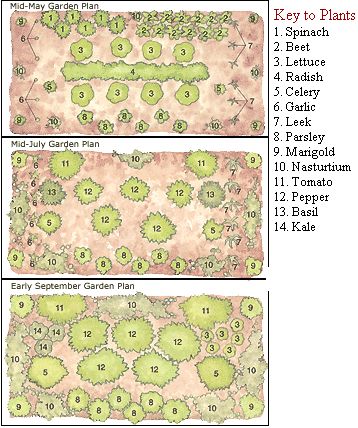
Plants that require most or all of the growing season to
mature can have short-season companions. We sow a bit of
spinach between the rows of garlic soon after the garlic
shoots emerge in the spring. While it’s there, the spinach
provides a living mulch for the garlic, discouraging weeds
and conserving moisture in the soil. By the time the garlic
needs all the space in the bed, the spinach is long gone.
Likewise, a small sowing of radishes, which will detract
some pests from more fragile plants, can go almost anywhere
in the garden and be up and gone long before it competes
with slower-maturing companions.
Sow Confusion with Interplanting
Plant-eating bugs and some plant diseases love gardens laid
out in rows. Carrots here, tomatoes there, and all the
onions together somewhere else offers pests a minimall of
end-to-end munching.
Mixing things up makes it harder for diseases or pests to
gain a toehold. An onion disease harbored by some of the
onions grown from a set will not infect plants grown from
seedlings if the seedlings are in a separate bed some
distance away. Cabbage butterflies that have to flit all
over the garden in search of cole crops will get more
predatory attention than butterflies that can settle in one
bed. The greater the distance any bug has to cross from one
feast to the next, the more likely it will itself become
prey.
Better Home in Garden
One of our favorite companion planting combinations didn’t
come from a list, but from figuring out through observation
how two plants might meet one another’s needs.
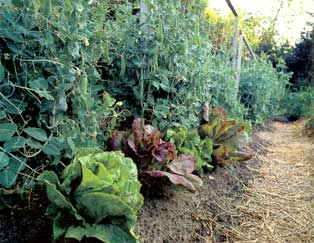
When we started growing peas in wide beds instead of narrow
rows, we created a situation that begged for a companion
planting experiment: The peas did not need the space a 30-
or 36-inch-wide bed had to offer. At about the same time
the peas began to climb their trellis netting, a batch of
lettuce seedlings we started in the greenhouse were ready
to move to the garden. We paired them up in the bed and
found the combination quite beneficial to both. The peas
and lettuce didn’t compete for sunlight — a bit of shading
from the peas actually helped the lettuce stay cool later
in the season so it didn’t go to seed as quickly. The
lettuce acted as a living mulch for the peas, keeping the
soil moist and cool for the pea roots. Peas grown this way
were at least as productive as those grown alone, and they
produced over a longer season. The lettuce matured quickly,
producing very large heads that were both tender and tasty.
We have refined the combination over the years. At first,
we planted the peas down the center of the bed with lettuce
on both sides. The lettuce on the shady side grew more
slowly, but it ended up getting about as big and looking
almost as nice as the lettuce grown on the sunny side. But
it didn’t taste as good. The shady-side lettuce heads were
older (and hence a bit tougher) and not as sweet. Now we
plant the peas closer to the northern edge of the bed — and
the lettuce all goes on the southern side.
Poisonous Plants
Adding flowers to the vegetable and herb mix in a garden
does have one possible negative effect: Some flowering
plants might contain poisonous elements, which you don’t
want to harvest along with the food plant. None of the
flowers we use or recommend are poisonous, but you’re
probably going to want to try your own combinations. If you
want to experiment with combinations not on this or another
list, check to make sure the plants you try aren’t
dangerous. Some examples you’re likely to encounter are
lily of the valley, pasque flower and monkseed.
Companion Planting for Pest Control
Certain bugs favor specific plants and seek them out to
feed upon. Those same bugs find other plants distasteful
and avoid them. If we mix the plants bugs deem tasty with
ones they don’t care for, the bugs will become confused and
avoid the plants they like along with the ones they don’t.
All plant-eating bugs avoid members of the onion
family — probably because they stink. We don’t know if the
odor repels pests, or if the onion-family aromas mask other
plant smells and prevent pests from finding them. In any
case, most garden plants will be less bothered by insects
if they live among onions or their relatives. Onions,
chives and garlic repel ants, aphids and flea beetles.
Garlic offends Japanese beetles, vegetable weevils and
spider mites.
Celery deters the white moth that begets the green
caterpillar that eats cabbage, broccoli and other cabbage
family crops. All heavy feeders with shallow root systems,
they’ll need extra compost.
In adjacent beds, beans and potatoes make mutually
beneficial neighbors. The beans repel Colorado Potato
Beetles, and the potatoes reciprocate by driving away
Mexican Bean Beetles.
Radishes should go anyplace flea beetles are a
problem, since flea beetles would sooner eat radish leaves
— especially young and tender ones — than they would any
other leaves. Although radishes may suffer from
defoliation, they can withstand greater damage than most.
They can also deter striped cucumber beetles from
cucumbers.
When an Ounce of Prevention Yields A Mess
Mint discourages cabbage moths and ants, and horseradish
repels bean beetles, but both mint and horseradish are
hardy perennials that, left uncontrolled, will quickly take
over your garden and become pests themselves. You can still
use mint and horseradish as insect repellent companions in
the garden, but make sure they are securely contained.
Plant them in large clay pots and set the pots in the
appropriate beds of vegetable plants.
Say it with Flowers
Many plants give off volatile chemicals that are attractive
to the pests that feed on them. If you grow
stronger-scented plants among your vegetables, you may be
able to disguise or hide the crops’ scents and keep the
pests from finding them. Some of the possible
strong-smelling companions are other vegetables, but a lot
of them are herbs and many more are flowers. We began to
make our biggest breakthroughs in companion planting when
we started combining our vegetable, herb and flower
gardens.
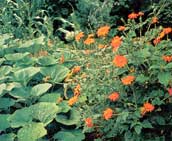
Marigolds are useful against aphids, Colorado Potato
Beetles and whiteflies.
Rosemary deters carrot flies and cabbage moths; sage
repels both.
Hyssop, wormwood, thyme and sage all repel the
cabbage moth.
Rue and white-flowered geraniums are offensive to
Japanese beetles.
Tomato hornworms don’t like borage or basil.
Marigolds repel whiteflies, tomato hornworms, bean
beetles, cucumber beetles and asparagus beetles.
Neither squash bugs nor whiteflies can abide
nasturtium.
Luring the Helpful Insects
The pest-repellent nature of certain plants has a
counterpoint: Some plants attract insects that are
beneficial to the garden.
Flowers of all sorts and some herbs attract
pollinating insects, and the more pollinators there are in
your garden, the more likely that fruiting vegetables will
be pollinated in a timely fashion. Borage and cleome lure
bees; dill, fennel, cosmos and marigold attract
butterflies.
Some pest-eating predators, like lady beetles, are
helpful to the garden both as larvae and as adults. Others,
like hover flies and lacewings, as larvae, feed on insects,
but as adults subsist on nectar or pollen.
Lady beetles like morning glory vines, angelica,
coreopsis, cosmos, sweet alyssum and tansy.
Hover flies — the larvae of which eat aphids,
various beetles and caterpillars, leafhoppers, mealybugs
and thrips-like chamomile, asters, cornflower, black-eyed
Susans and marigolds.
Many of the flowers that attract or provide shelter and
food for helpful insects are perennials — a fact you can
use to your advantage by locating your perennial garden
near your vegetable garden.
Soft Science
Very little is known about why some of these plant
relationships are antagonistic or beneficial. It is clear,
for instance, why carrots benefit from proximity to onions,
leeks, rosemary, wormwood or sage: Carrot flies, whose
larvae attack young carrot roots, are repelled by the
aromas those plants give off. But why do carrots paired
with tomatoes or lettuce grow to mutual benefit? Why do
celery, parsnips and dill inhibit carrots? Nobody knows for
certain.
I have a few general rules I use to evaluate plant
combinations, then I check my results against the lists.
Consider all the advice, including the suggestions here, as
a starting point, rather than gospel. Keep track of the
results and compile your own list of garden companions.
Knowing the companion lists are mostly somebody’s guesses,
I’m inclined to use my own best guesses as a basis for
garden experiments.
The Best Reason of All
Shortly after sunrise, dew still shimmering on the
asparagus ferns, I head for the garden, coffee cup in hand,
to see if there’s a morning glory blooming in the corn.
There is. So long as I’m there, I may as well pull a few
weeds, check for Colorado Potato Beetles, and maybe thin
the carrots.
Companion planting, particularly with flowers, has made our
garden a more pleasant place to be and enticed us to spend
more time there, which has had a beneficial effect on all
that grows there …and on us.
Ed Smith gardens with his wife, Sylvia, and their children
in northern Vermont. When he’s not gardening or writing
about the subject, Ed makes cabinets and furniture and
teaches in Goddard College’s Sustainable Living Program. Ed
wrote The Vegetable Gardener’s Bible
(Storey Books, 2000).





