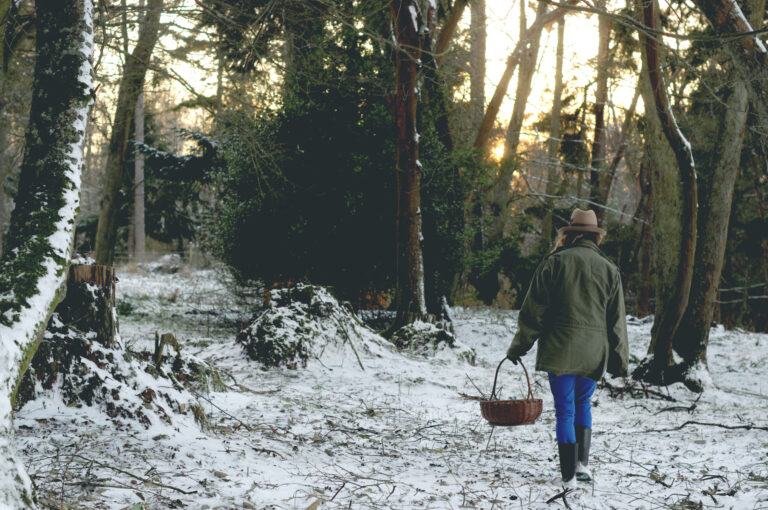
Wondering what to forage for in winter? Learn all about it with this winter foraging adventure, finding foods like cranberry, cattails and watercress.
In my opinion, the mark of a real wild food foraging is the ability to rustle up a square meal from nature’s larder in the dead of winter . That’s why, one cold day up here in northern Wisconsin-with the temperature hovering around 9 degrees F — I decided to put myself and a neighbor’s son (a young fellow who had never searched for edible wild plants before) to a test: Come dinnertime, we would either sit down to a hearty foraged feast . . . or go hungry.
Actually, I had another motive for my idea, too. I wanted to teach Muskrat (a nickname given my companion by his father, in reference to the lad’s inborn affinity for water) the value of our region’s wetlands as a source of food. I knew that streams and marshes are prime foraging territory year round . . . and I wanted to illustrate that important point to the youngster.
So Muskrat and I sat down to plot our strategy and decided that–with any luck–our menu that night would be a chowder of cattail shoots, watercress, and freshwater clams (actually a type of mussel found in this part of the country) . . . biscuits made from cattail-root flour . . . roast rabbit . . . and highbush cranberry for dessert. I figured that we could find all those goodies within walking distance. I suspect that Muskrat, on the other hand, probably wasn’t quite so sure. Nevertheless, he grabbed his .22 rifle while I rustled up a plastic bag and a couple of pairs of insulated rubber “trapper’s gloves”. Then we headed off (dressed in appropriately warm garb, including watertight boots) for a nearby ice-free stream.
Clams And Cattails
Even in these parts, where freshwater mussels abound, finding the succulent wild-lings can be difficult if you don’t know where to look. In the summer, I frequently search along the banks of streams until I come across shells left by marauding raccoons. Usually, two or three such remnants in the same place mean a clam bed is nearby. But during the winter, of course, snow covers the ground and hides the evidence.
So, Muskrat and I simply waded into the creek and headed upstream (that way, any silt we kicked up would be carried away behind us), peering intently into the water and feeling around on the bottom with our gloved hands for clam-shaped objects. Sometimes the little rascals are almost entirely buried in mud–with just the edges of their shells protruding–and sometimes they’re lying flat, hidden among a seemingly infinite number of rocks of a similar form. But persistence generally pays off . . . particularly if you search (as Muskrat and I did) around the downstream sides of boulders or other large obstructions–or at the upstream end of a deep pool–where the diminished current drops floating food to the bottom and into the open mouths of waiting shellfish. Within a few minutes my young apprentice and I had extricated four good-sized freshwater clams . . . enough for our chowder.
[EDITOR’S NOTE: All bivalves are filter feeders and thus readily accumulate pollutants and pathogens in their bodies. It’s important, therefore, that you forage shellfish only from pure waters. Also, you should keep in mind that of the approximately 300 species of freshwater mussels in this country (nearly all of which are edible), 16 are included on the federal government’s endangered species list . . . and others are protected on the lists of individual states. Because these varieties are rare, your chances of coming across one on an occasional foraging outing are very slim . . . nevertheless, you should check with your state’s wildlife or natural resources authorities before you go mussel hunting, just to see what the situation is in your locale. Some specific areas may be closed to the practice.]
With the quartet of shells safely ensconced in our collecting bag (along with enough water to keep the bivalves submerged and fresh), we waded ashore and walked along the bank in search of cattails. We’d hiked only a few hundred feet when we came to a good stand of the plant, with its characteristically spiky, cornlike leaves poking out of the snow. When we cleared the white stuff away from a small patch and chopped through the ice below, we could see water about a foot deep.
Muskrat stuck a gloved hand into the marsh, felt around in the mud until he got a good hold on the ropelike roots of one plant, and with a mighty heave pulled the whole mass–roots, stems, and leaves–out onto the ice. He repeated the procedure twice. I chopped the roots from the stems and washed the mud from the skins and from the tender white shoots that tapered out of the brown rhizomes.
As we worked, I pointed out to Muskrat that chopping a hole in an ice-covered marsh is like opening the door to a winter pantry: Besides cattail roots and shoots, you can find crayfish, bullheads, frogs, turtles, arrowhead tubers, pond-lily roots, and a wide variety of other delicious wild edibles. Then I stuffed our cattail harvest into the bag, and we set out in search of the final ingredient for our chowder: watercress.
Now most fair-weather foragers are familiar with this pungent green, but not very many folks know that a well-established patch of watercress–which requires clean, cold water and fertile bottom soil in which to grow–will do quite well even in the middle of winter. I knew that we were close to a cress bed that–in the summer–covers nearly half an acre . . . and sure enough, when we arrived there, several good-sized bunches were waving in the incoming current of a little feeder spring.
Since watercress looks tough and well-rooted, Muskrat made a common mistake: Before I could stop him, he grabbed hold of several plant tops and tugged hard . . . and they pulled completely out of the soil, roots and all. I explained to him that since the roots are unpalatable, it’s a much better idea to pinch or cut the plant off just below the leaves, leaving the roots intact to produce another generation of salad greens. Anyway, with that lesson learned, we proceeded to harvest enough for our stew.
Wild Food Surprise
By the time we’d gathered our clams, cattails, and cress, we were ready for a break . . . so Muskrat and I sat down next to a big evergreen to soak up the afternoon sun.
Suddenly, a meadow mouse flashed out of its hiding place beneath a low-hanging snow-covered limb, and Muskrat–quick as a cat–reached out and caught the little animal in his gloved hand. The boy studied the vole (and vice versa!) for a minute or so, blowing gently on its fur to observe its thick winter coat. My guess is that this action probably deposited a strong human scent on the critter . . . at least, that’s the only reasonable explanation I can think of for what happened next.
When the youngster put the mouse back down on the snow, the timid rodent ran straight into a nearby rabbit burrow to escape . . . and almost immediately we heard a terrific thumping and squealing down in the hole. A split second later, a cottontail squirted out of the opening, going so fast that it was literally airborne! Before we could fully grasp the situation , another rabbit flew out and joined its partner under a brush pile a short distance away.
Well, since rabbit was on our menu, we could hardly ignore this loud knock of opportunity. We loaded the .22, chased the rabbits out into the open, and quickly dispatched one while the other ran free.
Loaded down with our “groceries”, we headed back home . . . stopping only long enough to pluck a supply of frozen cranberries from a bush studded with the tenaciously clinging bright red fruit.
Preparing the Feast
Foraging for food on a cold winter’s day is not only an interesting and enjoyable outdoor activity . . . it’s downright hungrifying . By the time we got back to the old homestead and warmed ourselves by the woodstove, we were ready to eat, so we hurried to prepare our feast.
While Muskrat commenced skinning and cleaning our rabbit, I proceeded to whip up the chowder. First, I washed the cattail roots and snapped of the shoots, setting the brown ropy pieces aside to be converted into flour. Then I peeled the shoots and sliced them wafer-thin, and washed and chopped several sprigs of watercress. That done, I scrubbed the clam shells very thoroughly, and placed them, along with about 1/2 cup of water, in a pan on the stove. When the mussels had begun to open from the heat, I removed them and let them cool . . . pried the shells apart (I stuck a knife in past the lips and cut the muscle) . . . and excised the meat, holding the shells over the broth pan to catch any juices that ran out. In the summer, freshwater clams’ stomachs are usually full of a black material that must be cut away and discarded, and the pot liquor and juices must be drained through a fine cloth to filter out impurities . . . but these wintertime specimens didn’t seem to need such processing.
Next, I put the clam meat through a crank-type food grinder, again making sure to reserve the juice and add it to the broth. Then I put the “clamburger” into the pan with the pot liquor . . . added the sliced shoots and chopped watercress, along with a little salt and pepper . . . and placed the soup on the back of the stove to simmer.
By the time I’d finished the chowder, Muskrat had cleaned and cut the rabbit into six or seven pieces and was shaking the washed, drained chunks of meat in a bag containing whole wheat flour and a bit of salt. He then browned the flour-coated pieces in a skillet with just a little butter, put the meat in a deep baking dish, and placed the dish in the oven (which we’d preheated to about 300 °F) to bake for 1-1/2 hours.
The next job on the list was to make cattail-root flour for our biscuits: I cut the washed roots into six-inch lengths, put the chunks through the food grinder (after cleaning out the clam meat, of course), and spooned the fibrous mash into a pan filled with cold water. In a few minutes the root fibers and skin floated to the top, while the heavier starch–the “good stuff’–remained on the bottom. I simply skimmed the debris off with my hand, carefully poured the water away, and there was my biscuit flour. Some folks might want to repeat the grinding/ floating process–to refine the product a bit more–and many foragers prefer to dry the moist starch before using it. But since all dough recipes call for the addition of liquid anyway, I just go ahead and use the damp, “fresh” starch, mixed half and half with toasted whole wheat flour.
At this point, I must admit, the enticing aroma of the simmering soup and the roasting rabbit had set our stomachs to growling like a pair of hungry puppies, so I wasted no time at all in putting together a batch of biscuits. Here’s the recipe I used: Mix together I/2 cup of cattail-root flour, 1/2 cup of toasted whole wheat flour, 1 teaspoon of baking powder, a dash of salt, and–if necessary–some water, to make a sticky dough. Then form the batter into half-inch-thick palm-sized patties and fry them in just a bit of corn oil in a skillet until they’re golden brown.
Of course, we still had dessert to prepare too, so I put the hot biscuits in the warming oven while Muskrat washed and stemmed our foraged cranberries. I then poured the fruit and enough water to cover it in a pan and simmered the berries until they burst open and released their juices. Next, I added enough honey to sweeten them . . . stirred in some powdered gelatin (2 teaspoons of gelatin for every pint of liquid) . . . and put the sauce into the refrigerator to cool. I knew that by the time we’d eaten our dinner and given our stomachs an hour or so afterward to rest, the delicacy would be firm and ready to serve with whipped cream. Yum!
A Meaningful Meal
I don’t think I have to tell you we didn’t go hungry that night. Even more satisfying than the hearty meal, though, was the feeling of accomplishment: Not only had we successfully foraged a nourishing meal from the “barren” winter landscape, but–in the process–we’d also learned a little more about, and grown closer to, the natural world that supports us.