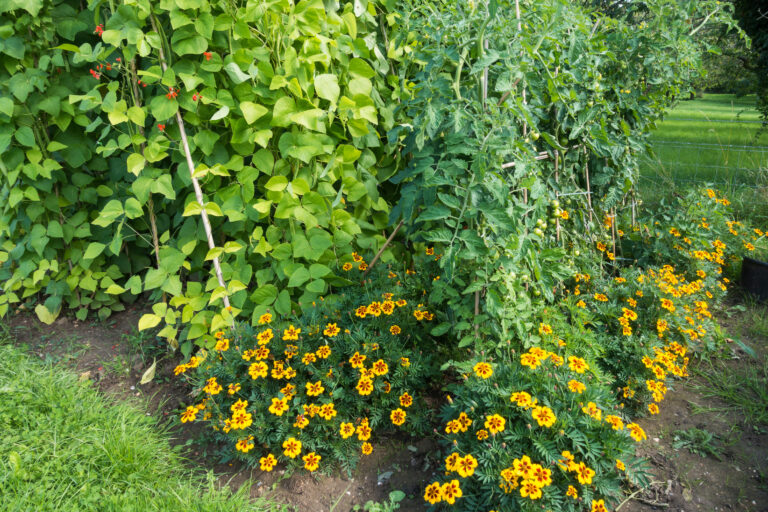
Carrots love tomatoes and vice versa because carrots repel enemy pests of tomatoes, and tomatoes repel pests that endanger carrots. By following a vegetable garden companion planting guide, you can save time and money trying to defend your crop against pests and disease.
The magic and mystery of companion planting has intrigued and fascinated man for centuries. Plants that assist each other in growing well, repel insects, or even repel other plants are all of great practical use. However, we’re just beginning to find out why, for example, carrots love tomatoes and radishes love lettuce. In the coming years, I hope scientists, gardeners, and farmers everywhere will work together to make discoveries that will significantly augment the world’s food supply. Already, companion planting has produced insect- and disease-resistant fruits, grains, and vegetables, and experiments are being conducted on weed-resistant varieties.
A primary enemy of the carrot is the carrot fly, whereas the leek suffers from the leek moth and the onion fly. Yet when the leek and the carrot live in companionship, the partner plant’s strong and strangely different smell repels the insects so well that they do not even attempt to lay their eggs on the neighbor plant. This is why mixed plantings give better insect control than a monoculture, where many plants of the same type are planted together in row after row.
It’s the same with kohlrabi and radishes in their community life with lettuce. Earth flies often afflict both, but when the flies get the odor of lettuce, they take off. Even when diseases affect plants, one can usually alleviate the situation with a mixed plant culture.
This article includes both “what to grow with” and “what not to grow with.” Both are equally important to gardening success. The following suggestions for companion planting are only a beginning. Your own experiments will lead you to many different pathways and discoveries.
Asparagus
Parsley planted alongside asparagus (Asparagus officinalis) gives added vigor to both. Asparagus also goes well with basil, a good companion for tomatoes. Tomatoes will protect asparagus against asparagus beetles because they contain solanine. But suppose asparagus beetles are present in great numbers. In that case, their natural predators will attract and control them, making spraying unnecessary. A chemical derived from asparagus juice has also been effective on tomato plants as a killer of nematodes, including the root-knot sting, stubby root, and meadow varieties.
I grow asparagus in a long row on one side of my garden. After the spears are harvested in early spring, I plant tomatoes on either side, and both plants prosper from the association. Cultivating the tomatoes also stems weed growth around the asparagus. The asparagus fronds should not be cut much, if at all, until very late in the fall, as the roots need this top growth to enable them to make spears the following spring.
Bean
Many different kinds of beans (Phaselolus and Vicia) have been developed, each with its own life of “good” and “bad” companions. Generally speaking, all will thrive when interplanted with carrots and cauliflower; carrots especially help the beans to grow. Beans also grow well with beets, as well as cucumbers and cabbages.
A moderate quantity of beans planted with leek and celeriac will help all three. Still, if planted too thickly, they have an inhibiting effect, causing poor growth for all three. Marigolds in bean rows help repel the Mexican bean beetle.
Planting summer savory with green beans improves their growth and flavor, deterring bean beetles. (It is also good to cook with beans.)
Beans are inhibited by any member of the onion family — garlic, shallots, or chives — and they also dislike being planted near gladiolus.
Broad beans are excellent companions to corn, climbing diligently up the corn stalks to reach the light. They not only anchor the corn more firmly, acting as a protection against the wind, but a heavy vine growth may also act as a deterrent to raccoons. In addition, beans provide the soil with nitrogen, which enriches corn growth.
Bean and Potato
Bush beans planted with potatoes protect them against the Colorado potato beetle. In return, the potatoes protect the bush beans from the Mexican bean beetle. It is considered best to plant the beans and potatoes in alternate rows.
Bean, Bush
Bush beans (Phaseolus vulgaris) include those known as butter, green, snap, string, or wax. All will do well if planted with a moderate amount of celery (about one celery plant for every six or seven beans).
Bush beans and cucumbers are mutually beneficial. Bush beans planted with strawberries also help one another, both advancing more rapidly than if planted alone.
Bush beans will aid corn if planted in alternate rows. They grow well with summer savory but should never be planted near fennel. Like all beans, bush beans dislike onions.
Bean, Lima
Nearby locust trees have a good effect on the growth of lima beans (Phaselous limensis). Other plants give them little or no assistance in repelling insects. Never cultivate lima beans when they are wet because if anthracnose is present, it will spread. If the ground has sufficient lime and phosphorous, there will probably be little trouble from anthracnose and mildew.
Bean, Pole
Like others of the family, pole beans do well with corn and summer savory. Still, they also have some pronounced dislikes, such as kohlrabi and sunflower. Beets do not grow well with them, but radishes and pole beans derive mutual benefit.
Bee Balm
Improves both the growth and flavor of tomatoes.
Beet
Beets (Beta vulgaris) grow well near bush beans, onions, or kohlrabi but are turned off by pole beans. Field mustard and charlock also inhibit beet growth. Lettuce and most cabbage family members are “friendly” to them.
Broccoli
Like all members of the cabbage family, broccoli (Brassica oeraceae) does well with aromatic plants such as dill, celery, chamomile, sage, peppermint, and rosemary and with other vegetables such as potatoes, beets, and onions. Do not plant it with tomatoes, pole beans, or strawberries. Use pyrethrum against aphids, but only before the flower buds open.
Cabbage
The cabbage family (Brassicaceae) includes cabbage, cauliflower, kale, kohlrabi, broccoli, collards, Brussels sprouts, and even rutabagas and turnips. While each plant in this group has been developed specially, they are all pretty much subject to the same likes and dislikes, insects, and diseases. Hyssop, thyme, wormwood, and southernwood are helpful in repelling the white cabbage butterfly.
All members of this family are greatly helped by aromatic plants, or those which have many blossoms, such as celery, dill, chamomile, sage, peppermint, rosemary, onions and potatoes.
If rabbits dig in your cabbage patch, plant any onion family member alongside them. Or you can dust it with ashes, powdered aloes, or cayenne pepper. Rabbits also shun dried blood or blood meal.

Butterflies themselves are not harmful and can help pollinate plants. It is their hatched eggs that, as caterpillars, do such damage to the orchard and field crops. The white cabbage butterfly is perhaps the most destructive. Herbs that will repel them include hyssop, peppermint, rosemary, sage, thyme, and southernwood.
Cabbages dislike strawberries, tomatoes, and pole beans. All family members are heavy feeders, so the ground should be worked with plenty of compost or well-decomposed cow manure prior to planting. Mulching will help if the soil tends to dry out in hot weather, and water should be given if necessary.
Cabbage and cauliflower are subject to clubroot and if this occurs try planting in new soil in a different pan of the garden. Rotate cabbage crops every two years.
If cabbage or broccoli plants do not head up well, it is a sign that lime, phosphorus, or potash is needed. Boron deficiency may cause the heart of the cabbage to die out.

Celery
Celery (Apium graveolens) grows well with leeks, tomatoes, cauliflower, and cabbage. In contrast, bush beans and celery provide mutual assistance. One gardener swears by growing celery in a circle so that the lacy, loosely interwoven roots make a desirable home for earthworms and soil microbes.
Celery and leeks grow well when trenched. Both celery and celeriac are reported to have a hormone that has an effect similar to insulin, making them excellent seasonings for diabetics or anyone on a salt-reduced diet.
Corn
Sweet corn (Zea mays) does well with potatoes, peas, beans, cucumbers, pumpkin, and squash. Research has shown that removing corn suckers is a waste of time as well as being detrimental to the development of the ears. Peas and beans help corn by restoring the nitrogen the corn uses in the soil. Is there anyone who hasn’t heard the story of Native Americans putting a fish in every corn hill?
Melons, squash, pumpkins, and cucumbers are like the shade provided by corn. In turn, they benefit the corn, protecting it from the depredations of raccoons, creatures that do not like to travel through the thick vines. Similarly, pole beans may be planted with corn to climb on the stalks. Don’t plant tomatoes near corn because the tomato worm and corn earworm are identical.
Also of note: An experiment with odorless marigold showed that when it was planted next to corn, the Japanese beetle did not chew off the corn silks.
Cucumber
Cucumbers (Cucumis sativus) are apparently offensive to raccoons, so it’s beneficial to plant them alongside corn. Corn seemingly protects the cucumbers against the virus that causes wilt, and thin strips of cucumber will repel ants.
Cucumbers also like beans, peas, radishes, and sunflowers. They will grow well in young orchards because they prefer shade. Sow two or three radishes among your cucumbers, and let them grow as long as they will, even blossoming and going to seed. You may trap cucumber beetles by filling shallow containers about three-quarters full of water into which some cooking oil has been poured.
If nematodes attack cucumbers, try a sugar spray. I boil half a cup of sugar in two cups of water, stirring until completely dissolved. Let cool and dilute with a gallon of water. Strange as it seems, sugar kills nematodes by drying them out. This will also attract honeybees — ensuring pollination and resulting in a bumper crop of cucumbers — so the spray is worth trying even if you don’t suspect the presence of nematodes.
Beneficial fungi are another enemy of nematodes. If you suspect their presence, build up your soil’s humus content. A chive spray is helpful for downy mildew on cucumbers, as is a spray made of horsetail.
Cucumbers dislike potatoes, while potatoes grown near cucumbers are more likely to be affected by phytophthora blight, so keep the two apart. Cucumbers also dislike aromatic herbs.
Plant scientists William Duke of Cornell and Alan Putnam of Michigan State University have discovered that certain cucumber varieties fight weeds by releasing a toxic substance. This natural process, called allelopathy, is believed to be an inherited trait. This discovery has prompted attempts to incorporate weed resistance into commercial crops, much in the same way that insect and disease resistance is bred into plants.
Eggplant
Redroot pigweed makes eggplant (Solanum melongena) more resistant to insect attack. During dry weather, mulching and irrigation will help prevent wilt disease. Dry cayenne pepper sprinkled on plants while wet with dew will repel caterpillars. Eggplant growing among green beans will be protected from the Colorado potato beetle. The beetles like eggplant more than potatoes but find the beans repellent.
Garlic
Eldon L. Reeves and S. V. Amonkar of the University of California discovered garlic (Allium sativum) to be a powerful destroyer of mosquitoes, achieving a 100 percent mortality of five species of California mosquito larvae by spraying breeding ponds with a garlic-based oil.
Researcher David Greenstock of the Henry Doubleday Research Association in England found that a garlic-oil emulsion, used as an insecticide, killed 89 percent of aphids and 95 percent of onion flies.
Garlic Spray
Here’s a recipe for a good garlic spray:
- Take 3 to 4 ounces of chopped garlic bulbs and soak in 2 tablespoons of mineral oil for one day.
- Add a pint of water in which 1 teaspoon of fish emulsion has been dissolved. Stir well. Strain the liquid and store it in a glass or china container (the concoction will react with metals).
- Dilute the mixture, starting with 1 part mixture to 20 parts of water, and use it as a spray against your worst insect pests. Try this spray if sweet potatoes or other garden plants attract rabbits. Rabbits dislike the smell of fish, too. Garlic sprays are useful in controlling late blight on tomatoes and potatoes.
Garlic grown in a circle around fruit trees is good against borers. It is beneficial to the growth of vetch, protects roses, and repels grain weevils when cloves are stored in grain. Alliums, however, inhibit the growth of peas and beans. Plant garlic with tomatoes to protect against red spiders. I have done this for years with good results.
Kohlrabi
Kohlrabi (Brassicaceae) grown with onion or beets, aromatic plants, and cucumbers are mutually beneficial because they occupy different soil strata. Kohlrabi dislikes strawberries, tomatoes, and pole beans but helps protect mustard family members.
Leek
Leek (Allium porrum) is a heavy feeder and should be planted in soil well-fertilized with rotted manure. Leeks are usually sold in the grocery store (at least where I live) with the roots still attached. I once bought and planted several bunches; they grew well and propagated, and I’ve had leeks ever since.
Leeks are good plants to grow with celery and onions and also benefit from carrots. To return the favor, leeks repel carrot flies.
Lettuce
I keep a supply of small lettuce plants (Lactuca saliva) growing in cold frames in spring. When I pull every other green onion for table use, I pop in lettuce plants. They will aid the onions, and the compost in the onion row will still be in good supply for the lettuce to feed on while the onion will repel any rabbits.
Lettuce grows well with strawberries, cucumbers, and carrots, and it has long been considered good to team with radishes. Radishes grown with lettuce in summer are particularly succulent.
Okra
This native of the Old-World tropics is grown for its immature pods, which are called okra or gumbo (Hibiscus esculentus). It’s a warm-weather plant that grows wherever melons or cucumbers thrive. I plant two rows, dig a trench between them, and cover it with mulch. On the north side of my okra, I plant a row of sweet bell peppers, and on the south side, a row of eggplant. All are well-mulched as the season advances. When the weather becomes dry in midsummer, I lay the hose in the trench and flood it so that all three companions grow well.
Onion
Onions (Alliumcepa) and all cabbage family members get along well. They also like beets, strawberries, tomatoes, lettuce, summer savory, and chamomile (sparsely) but do not like peas and beans.
Scatter your onion plants throughout the garden, as onion maggots travel from plant to plant when they are set in a row.
Toxic substances in red and yellow onion skin pigments appear to be associated with disease resistance. Russian biologist T. A. Tovstole found a water solution of onion skin — used as a spray three times daily at five-day intervals — gave an almost 100% mortality of Hemiptera, a parasite attacking more than 100 species of plants.

Parsley
Parsley (Petroselinum hortense) mixed with carrot seed helps to repel carrot flies by its masking aroma. It protects roses against rose beetles. Planted with tomatoes or asparagus, parsley will give added vigor to both.
Poultry is sometimes turned loose at intervals in parsley patches where there are many parsley worms, which are the larvae of the black swallowtail butterfly.
Parsnip
The parsnip (Pastinuca sativa) is of ancient culture but remains a vegetable for the discerning palate. The parsnips have few insect enemies and suffer from few diseases, but both the foliage and roots make a safe insect spray. Parsnips are not injured by freezing and are often left in the ground over winter. The seeds germinate slowly and unevenly and should not be used if over a year old.
Pea
For large crops, inoculate pea (Pisum sativum) and bean seed with Nitragen (or a similar compound), a natural bacterial agent. It coats the seed, aiding the sprouting seedling. This enables the plant to more readily form nodules on the roots, which convert nitrogen from the air into a compound the plant can use.
Peas grow well with carrots, turnips, radishes, cucumbers, corn, beans, potatoes, and many aromatic herbs. They do not grow well with onions, garlic, and gladiolus.
Pumpkin
Pumpkins (Cucurhita pepo) grow well when Jimson weed, sometimes called thorn apple, is in the vicinity. Pumpkins grow well with corn (a practice followed by Native Americans). Yet, pumpkins and potatoes have an inhibiting effect on each other.
Raspberries
If you grow both red and black raspberries, put a considerable distance between the two types. The reason for this is that the reds sometimes carry a disease that does little or no harm to themselves but may prove near fatal to the blacks. Do not grow raspberries and blackberries near each other, either. Many gardeners think potatoes are more susceptible to blight if grown near raspberries.
Spinach
Because of its saponin content, spinach (Spinacia oleracea) is a valuable pre-crop and does well when planted with strawberries.
Squash
Two or three icicle radishes planted on each hill will help prevent insects on squash (Curcubitaceae) and cucumbers. Let the radishes grow and go to seed. Nasturtiums will repel squash bugs, as will cigarette ash and other tobacco residue, if placed with the seed when it is planted. Squash planted either earlier or later than usual often will escape insect damage. I find fall-planted squash almost entirely insect-free.
Early in the day, before the sun is intense, squash stinkbugs are sluggish and may be picked off in the small garden. There are also insect-resistant strains of squash available.
Sweet Potato
Nemagold sweet potatoes (Ipomea batalas) developed by the Oklahoma Experiment Station have built-in resistance to nematodes. Sweet potatoes generally have a high energy value, with only peas and beans yielding more. They have a common enemy–the fungus disease or wilt called “stem rot,” which can be controlled with disease-free seed and by rotating the crop. White hellebore controls several leaf-eating insects.
If rabbits bother your sweet potato patch, spray with a diluted fish emulsion.
Tomato
Tomatoes (Lycopersicon esculentum) protect asparagus against the asparagus beetle. Since they are tender plants, tomatoes should be planted in late spring after the early crop of asparagus spears has been harvested. Tomatoes and all members of the Brassica family repel each other and should be kept apart. Tomatoes also protect gooseberries against insects.
Tomatoes are compatible with chives, onion, parsley, marigold, nasturtium, and carrot. I have planted garlic bulbs between my tomato plants for several years to protect them from red spider mites. Though not containing fungicidal elements, tomatoes will protect roses against black spot.
The active principle of tomato leaves is solanine, a volatile alkaloid that was once used as an agricultural insecticide. You can create your own insect-repellent spray for roses by making a solution of tomato leaves in your vegetable juicer–add 4 or 5 pints of water and 1 tablespoon of cornstarch. Strain and spray on roses where it is inconvenient to plant tomatoes as companions. Keep any unused spray refrigerated.
Unlike most other vegetables, tomatoes prefer to grow in the same place year after year, and this is all right unless you have a disease problem, in which case plant your tomatoes in a new area. Stinging nettle growing nearby improves their keeping qualities, and redroot pigweed, in small quantities, is beneficial, too. The presence of kohlrabi and fennel inhibits tomato growth.
Tomato root excretions inhibit young apricot trees. Don’t plant tomatoes near corn, either, since the tomato fruitworm is identical to the corn earworm. Don’t plant near potatoes, since tomatoes make them more susceptible to potato blight.
If you smoke, be sure to wash your hands thoroughly before you work in your garden because tomatoes are susceptible to diseases transmitted through tobacco.
Turnip/Rutabaga
A planting accident revealed that hairy vetch and turnips are excellent companions. Turnip (Brassica rapa and Brassica napobrassica) seeds mixed with the vetch a gardener planted, and they came up as volunteer plants. He found the turnip greens completely free of the aphids that usually infest them, apparently because the vetch provided shelter for ladybugs, which feast on aphids. Elsewhere, it has been found that wood ashes around the base of turnip plants will control scab.
I find that planting peas near turnips benefits both vegetables. Turnip and radish seeds mixed with clover will bolster the soil’s nitrogen content. In your crop rotation, it is good to follow the heavy feeders with light feeders such as turnips and rutabagas.
Turnips dislike hedge mustard and knotweed and should not be rotated with other cabbage family members, such as broccoli or kohlrabi. When synthesized, a naturally occurring chemical compound in turnips is deadly to aphids, spider mites, houseflies, German cockroaches, and bean beetles.
Rutabagas take the same culture as turnips but require a longer growing season.
Disease- and Weather-Resistant Vegetable Varieties
ASPARAGUS: Mary Washington, rust-resistant.
BEAN: Topcrop, Tendercrop, Harvester, mosaic-resistant.
BEAN, DRY SHELL: Michlite, blight-resistant.
CABBAGE: Stonehead Hybrid, yellow-resistant. Wisconsin Hollander No. 8; Copenhagen; New Wisconsin Ball-head, Wisconsin All Season, yellow-resistant.
CUCUMBER: Marketmore is scab–and mosaic-resistant. Polaris is anthracnose, downy mildew–and powdery mildew-resistant. Burpless Hybrid and Total Marketer are downy and powdery mildew-resistant. Park’s Comanche and Poinsett are downy and powdery mildew-resistant (Parks). Salty is resistant to cucumber mosaic, powdery mildew, and scab.
EGGPLANT: Faribo Hybrid, disease-resistant.
KALE: Dwarf Blue Curled Vales withstand below-freezing temperatures.
LETTUCE:Oakleaf is hot weather-resistant. Butter King, Bibb, or Limestone is hot weather-tolerant. Premier Great Lakes is resistant to tip-bum and heat.
PEAS: Early Alaska, wilt-resistant. American Wonder, drought-resistant (Henry Fields). Drought-Proof (Burgess).
PEPPER: Yolo Wonder, tobacco mosaic-resistant.
RADISH: Cherry Belle, pithiness-resistant.
SPINACH: Hybrid No. 7, resistant to downy mildew.
SWEET CORN: Golden Beauty, disease-resistant. Silver Queen disease-tolerant (Parks).
TOMATOES: VF Tomatoes are verticillium and fusarium wilt-resistant; Sunray is fusarium wilt-resistant. Sunset, Starfire, and Monte Carlo are sunscald-resistant. They are also multiple disease-resistant. They are crack-proof.
TURNIP: Tokyo Cross, virus and other disease-resistant.
This by no means exhausts the list of disease-resistant vegetables; more are constantly being developed. It helps to note the resistant strains when you check your seed catalogs.
Control of Insects Vegetable Garden Companion Planting Guide
Legumes planted in a rotation will protect grain crops and grasses from white grubs and corn rootworms. Chinch bugs on corn and flea beetles are controlled by growing soybeans to shade the bases of the plants. Goats with worms may be relieved by feeding them carrots; in horses, they can be relieved by feeding them mulberry leaves.

The following herbs may be planted as specific control:
BASIL: Against flies and mosquitoes.
BORAGE: Against tomato worm.
CASTOR BEAN: Against moles and plant lice.
CATNIP: Against flea beetles.
DATURA: Against Japanese beetles.
DEAD NETTLE: Against potato bugs.
FLAX: Against potato bugs.
GARLIC: Against Japanese beetles, aphids, weevils, fruit tree borers, and spider mites.
HENBIT: General insect repellent.
HORSERADISH: Against potato bugs (plant at comers of the plot).
HYSSOP: Against cabbage moth.
LAVENDER: Against clothes moths (dry and placed in garments).
MARIGOLDS: Against Mexican bean beetles, nematodes, and many other insects.
MINT: Against white cabbage moths, dried against clothes moths.
MOLE PLANT: Against moles and mice (the mole plant is a species of Euphorbia).
NASTURTIUM: Against aphids, squash bugs, striped pumpkin beetles, and woolly aphids.
PENNYROYAL: Against ants and plant lice.
PEPPERMINT: Against white cabbage butterflies and ants.
PETUNIA: Against beetles.
POT MARIGOLD: Against pickleworms, aphids, leafhoppers, spider mites, harlequin bugs, imported cabbage worms and many other insects.
PYRETHURM: Against pickleworms, aphids, leafhoppers, spider mites, harlequin bugs, imported cabbage worms and ticks.
ROSE GERANIUM: Oil or crushed leaves as insect repellants.
ROSEMARY: Against cabbage moths, bean beetles, carrot flies, and malaria mosquitoes.
RUE: Against Japanese beetles.
SAGE: Against cabbage moths, carrot flies, ticks.
SANTOLINA: Against moths.
SASSAFRAS: Against plant lice.
SOUTHERNWOOD: Against cabbage moths, malaria mosquitoes.
SPEARMINT: Against ants, aphids
STINGING NETTLE: Against aphids, black flies.
SUMMER SAVORY: Against bean beetles.
TANSY: Against flying insects, Japanese beetles, striped cucumber beetles, squash bugs, and ants.
THYME: Against cabbage worms.
WHITE GERANIUM: Against Japanese beetles.
WORMWOOD: Against animal intruders, cabbageworm butterflies, black flea beetles, and even malaria mosquitoes.