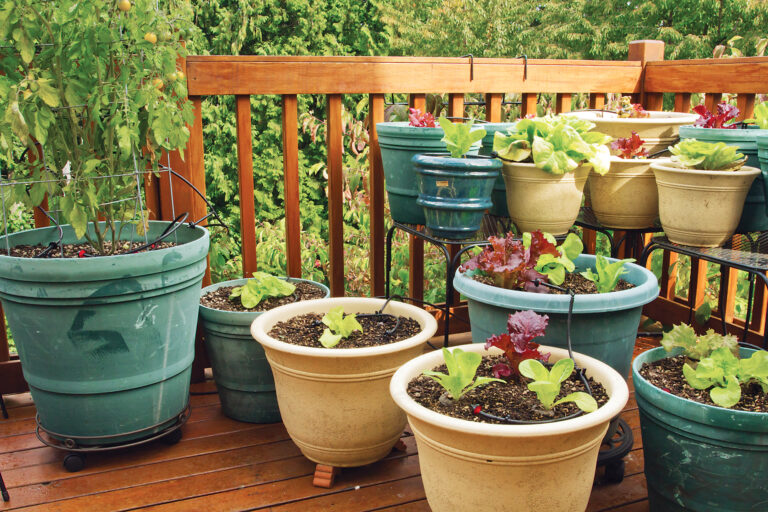
Get started growing food with small space gardening. You can even start with apartment vegetable gardening for a fun and productive hobby.
My first experiment in small-space gardening was in Brussels, Belgium, on a rooftop with no guardrails. While my official goal was container-grown tomatoes, my unofficial one was to avoid becoming human gazpacho on the pavement five floors below. Now, 15 years later, I’m still practicing my small-scale growing skills, this time in the safety of a 10-by-10-foot plot in the suburbs of Maine. I’ve learned that no space is too small for growing food. Whether your garden consists of a window box in the city or an acre in the country, you can still benefit from applying the techniques of small-space gardening.
Soil Is No Small Matter
All successful gardening endeavors, big or small, start with fertile soil. If you have a large plot, you can get away with having less-fertile soil by planting more and spacing out your crops. In a small space, however, that approach simply doesn’t work. When I was preparing my front yard garden back in 2008, I remember sifting my sandy soil through my fingers and realizing I had to improve it. I added lots of organic compost along with a little lime and bone meal, and I add more organic matter each year.

The ideal soil type for growing most crops is loam, the rich halfway point between clay and sandy soils. If you’re not sure which soil type you have, hold some in the palm of your hand, wet it and try to make a ball. If it forms a tight, hard wad, then you have lots of clay in your soil. If you can’t form a ball, you have sand. If the ball forms but pretty easily breaks apart, you probably have loam. No matter which type you have, you can improve both your soil’s structure and fertility by working compost into the top layer each year. Those with really limited space can take heart in knowing there are effective composting options suitable for even the smallest of spaces (see “Micro-Composting,” near the end of this article).
Get Intense
Fertile soil that retains nutrients and water is one of the keys to success with “intensive planting,” which is a fancy way of saying planting a lot in a little area. America’s intensive-growing tradition has two fathers: John Jeavons and Mel Bartholomew. In his classic 1974 book, How to Grow More Vegetables Than You Ever Thought Possible on Less Land Than You Can Imagine, Jeavons introduced Americans to French intensive-gardening techniques, notably deep soil preparation through double-dug beds and intensive crop-planting patterns. Seven years later, Bartholomew offered a new way to think about these patterns in a classic book of his own, Square Foot Gardening.

Instead of rows, Jeavons and Bartholomew suggest planting in tightly spaced geometric patterns that will allow the crops to create a “living mulch” of foliage as they mature. This living mulch performs two of the main tasks that regular old dead mulch does: keeping the soil moist and suppressing weeds.
In order to create this effect, however, you need to know how much space to give each plant. Mel Bartholomew’s brilliantly simple tactic is to set a 1-by-1-foot grid onto a garden space and plant crops into the grid. Large crops such as broccoli, peppers and cabbage require a whole square, whereas small ones such as carrots and radishes can be planted 16 to a square.
One critical lesson the square-foot gardening technique can teach newbie small-space gardeners is that they may have to put their dreams of squash, watermelons and potatoes on hold. For some, a garden without zucchini isn’t really a garden. However, if faced with the choice of having one bush summer squash plant or one tomato plant, one cabbage, one pepper, one large basil, one broccoli, four lettuces, four chards, 16 carrots and 16 onions (i.e., the number and types of crops you could get out of the same square footage required for one squash plant), you would really have to love zucchini bread to choose the former.
Books such as Jeavons’ and Bartholomew’s can be invaluable for making planting decisions like these. For those looking for a more modern tool for deciding what to plant where and in what quantity, there are some excellent online garden planners available that allow you to sketch out your garden on your computer screen and drag and drop crops onto your layout. I think the best one so far is MOTHER’s interactive, easy-to-use Vegetable Garden Planner.
One last thing to keep in mind about an intensively planted, geometric layout versus a row layout is that you won’t walk between your crops but rather will reach into them. So, unless you happen to have the arm span of an orangutan, your beds shouldn’t be wider than 3 or 4 feet. The length depends on the space you have and the amount of food you want to grow. Mel Bartholomew recommends building wooden boxes for your beds, but you can get the same benefits by forming and planting into boxless, level mounds.
Go Vertical, Baby
One cool technique for increasing your choices and your harvests in a small-space garden is vertical growing, which some people refer to as cubed-foot gardening. As you can guess, it’s about understanding and fully exploiting the vertical space plants can occupy.

I’ve seen this technique applied — or, more accurately, misapplied — in my own garden. My family and I rented our house and garden for a year to some lovely, well-meaning tenants who were eager to scratch at the dirt and decided to plant sunflowers in the southern part of our backyard garden. The plants thrived, reaching heights up to 9 feet, but the sun-starved squash planted behind them were not nearly as happy.
The first rule of vertical growing is knowing the heights of plants and situating the tallest ones in the northern part of your garden so as not to shade out the pipsqueaks. A more advanced lesson is learning the vertical space a crop is willing to occupy if coaxed and supported. While sunflowers shoot skyward without any cheerleading, crops such as tomatoes, cucumbers and even melons are willing to grow upward if trellised and shown the way. Understanding these three dimensions of gardening will allow you to harvest more from each precious square foot of soil. (Learn more about vertical gardening in Vertical Gardening Techniques for Maximum Returns.)
Don’t Settle for a Short Season
Another way to get more out of your small space is so cool that it’s ice-cold: season extension. Putting season extension to work will allow you to start gardening before your neighbors have even cracked their seed catalogs and finish long after they’ve stopped growing for the year. If Jeavons and Bartholomew are the patriarchs of America’s intensive-planting movement, Maine farmer and garden writer Eliot Coleman is the father of season extension.

Casual, small-space gardeners may not be interested in reading about Coleman’s experiments with portable and minimally heated greenhouses, yet they could learn a lot from his writings on cold frames, which are essentially miniature greenhouses. Unlike a typical raised-bed container garden with sides that are all the same height, the south-facing side of a cold frame is shorter so that it lets in more of the sun’s warming rays. The angle may not look like much, but as the sun starts to sink deeper in the autumn sky, those few extra degrees of slope translate into extra degrees of heat that can keep plants alive — and thriving!
If you’re just starting a small-space garden, work a season-extension option into your design. For example, rather than building a typical raised-bed box, you may be better off with a sloping cold frame design. Other season-extension options for small-space gardens include low tunnels and cloches. (See Eliot Coleman’s article, Use Low Tunnels to Grow Veggies in Winter: Quick Hoops, for great tips on using low tunnels, and read Garden Know-how: Extend Your Growing Season for even more season-extension advice.)
Success in Succession
After you have a season-extension plan in place, you’ll discover that your growing season has increased by several weeks, which is critical for implementing the small-space gardener’s most important technique of all: succession planting. Small-space gardening is not just a voyage in space, but also time. Just as you should avoid unproductive gaps in your planting layout, you should also avoid holes in your planting calendar. Succession planting is about turning unproductive spaces into productive ones by removing a crop that has stopped producing and replacing it with a new one.
Here the challenge isn’t simply understanding how tall or wide a crop grows, but how long it takes to mature. Succession planting requires that we toss the traditional notion of “getting your garden in Memorial Day weekend” onto the compost pile of outdated ideas and replace it with a new approach in which the garden is never really “in” but always in the process of being planted. When we do this, we transform gardening from an isolated activity that we try to fit into our busy lives into a holistic lifestyle that can bring health and happiness.
Choose Your Small-Space Adventure
Here are my top suggestions for creating a productive garden within the constraints of whatever space you have to work with:
No Space. If you have a large, south-facing window, you can grow herbs and salad greens in pots, containers or a window box. You may also succeed with container-grown crops such as tomatoes and peppers depending on the amount of sun you can provide them. The key to success is picking compact varieties suited to your taste and available space (see “Compact Varieties for Small-Space Growing” near the end of this article).
Small Balcony or Patio. In addition to the options above, a person in this category can grow crops that require more sun and vertical space. For example, try growing large pots of strawberries or trellising cucumbers. The most inspiring gardener I know from this category is Mark Ridsdill Smith, who grows more than $1,000 worth of food each year on his 9-by-6-foot balcony and five south-facing window boxes in London.

Small Yard. Perhaps choose plants that go well together. For example, you could plant a salad garden (i.e., different varieties of greens and lettuce), a soup garden (i.e., carrots, onions and celery) or a salsa garden (i.e., tomatoes, peppers and cilantro). For people just starting out and those growing in shady conditions, I think a small salad garden consisting of a few varieties of “cut and come again” lettuce varieties or mesclun mixes, one to two favorite herbs and a compact tomato plant or two is a great introduction to the pleasures of the kitchen garden. Leafy greens such as spinach and chard also do well in small, shady plots. (For more on successfully growing food in shady areas, read Best Vegetables to Grow in the Shade)
Micro-Composting
As the urban and suburban homesteading movement grows in strength and numbers, those looking to convert trash to treasure through composting have more options than ever. If you have a small yard or patio, you can look to the newest generation of compact compost tumblers that do everything the big boys do, but in less space and at a lower cost.
Apartment and condominium dwellers interested in converting kitchen scraps into compost for containers and window boxes should squirm their way to the closest worm composting bin. The latest models take a lot of the guesswork out of the process and eliminate any odor via their multitiered platforms that keep the worms and finished compost separate from one another. Worm composters are easy to maintain, and they create super-rich fertilizer. (Read more about worm composting in How to Make a Worm Bin.)
Compact Varieties for Small-Space Growing
Variety selection is more crucial to small-space gardening than you may think. The amount of space that a particular crop occupies can vary greatly from one variety to another. If you’re gardening in limited space, especially containers, you should be looking for vegetable varieties listed as “compact” or, in the case of fruit trees, “dwarf.”
- ‘Alibi’ Cucumber. You’ll need an alibi to tell your family after you’ve picked this short-vine variety clean and eaten all of the cukes yourself. Matures in 50 days.
- ‘Bush Delicata’ Squash. If you absolutely must plant squash in your tiny space, ‘Bush Delicata’ is a good choice. This open-pollinated heirloom variety only spreads about 4 to 6 feet, and you can save its seeds for the next year.
- ‘Compatto’ Dill. It may not grow any taller than 20 inches, but ‘Compatto’ will deliver the dill taste you need for salads and garnishes.
- ‘Green Tiger’ Zucchini. This stout, bushy variety produces brilliant, 6- to 8-inch fruits with glossy, dark green skin and pale stripes.
- ‘Mohawk’ Pepper. Picture 4- to 5-inch, brightly colored bell peppers spilling over your deck railing or window box, and you’re picturing ‘Mohawk.’
- ‘Ophelia’ Eggplant. This one is perfect for the patio. The eggplants are small — a little more than 2 ounces each — and grow in clusters like tomatoes do.
- ‘Temptation’ Strawberry. Compact, vigorous growth makes ‘Temptation’ well suited for hanging baskets, grow bags and short-season climates.
- ‘Totem’ Tomato. Growing no taller than 2 feet high and requiring no staking, ‘Totem’ offers big tomato taste in a small package.
- ‘Tumbling Tom’ Tomato. ‘Tumbling Tom’ is a heavy yielder of beautiful, bright red cherry tomatoes. Perfect for hanging baskets, as the tomatoes really do tumble over the edges.
Originally published as “Small-Space Gardening” in the February/March 2012 issue of MOTHER EARTH NEWS magazine and regularly vetted for accuracy.
Roger Doiron, founder of Seed Money, recently gave an inspirational speech about the powerful act of growing food (watch in The Power of Gardening: Start Your Subversive Plot Today).